How Slot Bonus Rounds Work: Simple Guide

 Explains what slot bonus rounds are, how they’re triggered, and the most common features: free spins, pick-and-win games, multipliers, and expanding wilds. Also breaks down how bonus rounds impact payouts and RTP, with an FAQ to wrap up.
Slot bonus rounds may look flashy, but they follow predictable rules that shape your real return. This guide explains what typically triggers bonus features, how free spins and pick games calculate payouts, and what terms like multipliers, retriggers, and win caps mean for your bankroll. Use these basics to compare games and judge value before you place a bet.
What slot bonus rounds are
In slot games, a bonus feature is an extra mode that runs alongside the base spins and adds a different way to win. Instead of relying only on standard payline or cluster hits, these rounds introduce special rules such as free spins, pick-and-click prizes, or expanding symbols. They are usually triggered by specific symbol patterns (often scatters) or by filling a meter over time.
The key idea is that the game temporarily changes its normal behavior. You might get spins that cost nothing, symbols that behave differently, or a separate screen where you choose items to reveal prizes. The result can be anything from small boosts to rare, high-value outcomes, depending on the game’s design and volatility.
How bonus features differ from regular spins
Base gameplay is predictable in structure: you spin, symbols land, and the paytable decides the payout. A bonus event adds a layer of rules that can’t happen (or don’t happen as often) in the main mode, like multipliers that grow, extra reels, or repeated re-spins. Think of it as a “special ruleset” that runs for a limited time, then returns you to normal play.
Many titles also use bonus mechanics to create momentum. For example, a feature might “lock in” winning symbols, carry multipliers forward, or give you extra chances after near-misses. These elements don’t guarantee a win, but they change the distribution of outcomes compared to standard spins.
Common types you’ll see
Bonus rounds come in several recognizable formats. The exact names vary by provider, but the underlying structures are similar across most modern slots.
- Free spins: A set number of spins where you don’t pay per spin, often with added multipliers or special symbols.
- Respins: One or more re-spins that keep certain reels or symbols locked while others spin again.
- Pick-and-reveal: You choose from hidden objects to uncover instant prizes, multipliers, or extra picks.
- Hold-and-win (collection features): You collect value symbols on a grid with a limited number of re-spins to fill spaces.
- Progressive or step-up features: You advance through levels or “stages,” with each step changing rewards or odds.
Triggers and entry conditions
Most games start a bonus when you land a required number of special symbols anywhere on the reels, such as three or more scatters. Others use a collection system: each spin can add to a counter, and when it reaches a threshold, the feature begins. Some slots offer multiple entry points, where different symbol combinations unlock different versions of the same feature (for example, one set of free spins with sticky wilds and another with expanding wilds).
It’s also common for a feature to include “re-triggers,” meaning you can earn additional spins or extra rounds while you’re already in the bonus mode. This extends playtime and can significantly affect the overall payout distribution.
Why they matter for payouts and volatility
Bonus rounds often carry a large share of a slot’s potential returns, especially in games labeled as medium-to-high volatility. That doesn’t mean they always pay more than base spins, but it does mean the biggest wins are frequently tied to feature mechanics like stacked multipliers, extra wilds, or repeated re-spins.
Because of that, two slots with the same RTP can feel very different: one may pay more steadily in the base game, while another saves much of its value for occasional feature hits. Understanding how a slot’s bonus events work helps you interpret what “swingy” gameplay might look like in practice.
How bonus rounds are triggered in slots
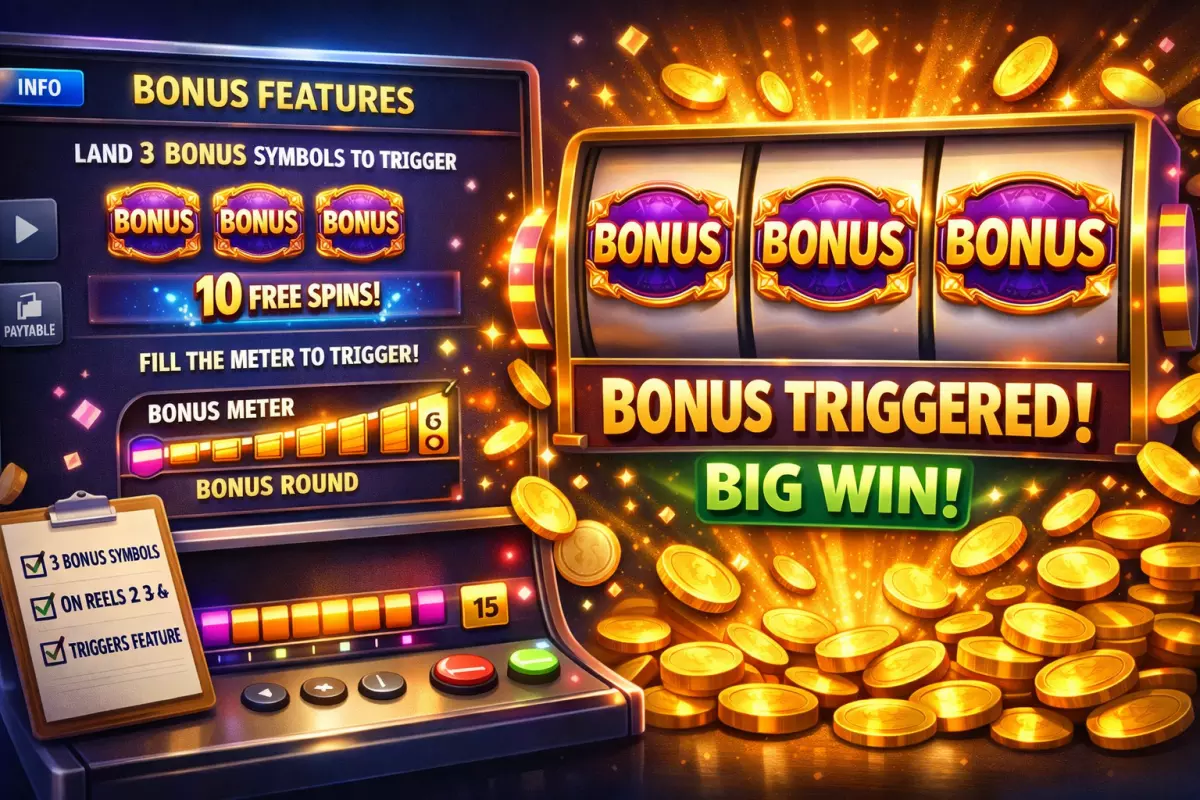
Slot games usually start their extra features when the game detects a specific symbol pattern or counter condition on a spin. The trigger is built into the rules: you either land the required symbols in the right way, or you progress a meter until it reaches a set point.
Most modern titles make the trigger conditions visible in the paytable or feature info screen. That’s where you’ll see how many symbols you need, whether they must land on certain reels, and what happens if the trigger lands during free spins or another feature.
Common trigger types you’ll see
Different games use different “keys” to unlock a bonus, but they tend to fall into a few familiar categories. Some are immediate (one spin can do it), while others are progress-based (you build toward it over time).
- Scatter symbol triggers: Land a set number of scatter symbols anywhere (often 3+). Scatter bonuses commonly start free spins or a pick-and-win round.
- Bonus symbol triggers: Special bonus icons must land, sometimes on specific reels (for example, reels 1, 3, and 5) to open a feature.
- Wild-based triggers: A certain number of wilds appear, or a wild lands in a particular position to activate a modifier (like expanding wilds or a multiplier mode).
- Meter/collection triggers: You collect items (coins, gems, letters) and fill a progress bar; when it’s full, a bonus round begins.
- Random (RNG) feature triggers: A “mystery” event can fire on any spin, sometimes after a qualifying condition (like a minimum bet or a base-game win).
- Buy feature triggers: Some games allow a direct purchase of the bonus; this bypasses the natural trigger but follows the same bonus rules once started.
What “must land on the reels” really means
When a game says symbols must land “on the reels,” it may still have strict placement rules. A common requirement is that the symbols appear on different reels (not stacked on one reel), or that they appear on a minimum number of reels even if multiple land in the same column.
It also matters whether the slot uses fixed paylines, ways-to-win, or clusters. In a cluster game, the feature might trigger from a certain number of matching symbols connected together rather than from a line-based pattern.
Triggers during free spins and other features
Bonus rounds can behave differently once you’re already inside a feature. Some games allow re-triggers (for example, landing more scatters adds extra free spins), while others block additional activations until the current mode ends.
Another common rule is “upgrades” mid-feature: collecting special symbols during free spins may increase multipliers, unlock extra reels, or switch you into a higher-paying version of the bonus. These aren’t new triggers in the base game, but they are still conditional events driven by symbol counts or meters.
Quick reference: triggers and what they usually start
| Trigger mechanism | Typical requirement | Most common bonus it starts |
|---|---|---|
| Scatters | 3+ scatters anywhere (sometimes on specific reels) | Free spins, bonus wheel, pick-and-win |
| Bonus symbols | 2–6 bonus icons, often on defined reels | Hold-and-spin, respin features, jackpots |
| Wild conditions | Wild lands in a target spot or a set count appears | Expanding wilds, multipliers, special reel modifiers |
| Collection/meter | Collect items until a bar fills or a level is reached | Enhanced free spins, feature upgrades, guaranteed bonus entry |
| Random event (RNG) | Can occur on any spin, sometimes after a qualifying outcome | Mystery free spins, instant prizes, random multipliers |
If you want to understand a specific slot quickly, focus on three details: the exact symbol count needed, whether placement matters (reels/positions), and whether the game allows re-triggers once a bonus is already running. Those rules explain most of the “why did it trigger?” moments players run into.
Common types of slot bonus features
Bonus rounds come in many shapes, but most are built from a few familiar mechanics. Once you know what each one does, it’s easier to understand why a feature feels “swingy,” why some payouts arrive in bursts, and why certain rounds can last longer than others.
Free spins (with variations)
Free spins are the most common bonus mode: you get a set number of spins without paying the base bet again. The twist is usually in the rules attached to them, such as higher multipliers, special symbols, or altered reels.
Typical free-spin modifiers include:
- Multipliers (fixed or increasing) that boost wins during the round.
- Expanding reels or extra rows that create more ways to win.
- Sticky wilds that stay in place for several spins.
- Retriggers that add more spins when certain symbols land.
Pick-and-click (selection) bonuses
These features pause the reels and ask you to choose items on screen (cards, chests, doors). Each pick reveals a prize such as credits, multipliers, extra picks, or a mini free-spins set. The main difference between games is whether the round ends after one reveal or continues until you hit a “stop” symbol.
Because outcomes are usually determined by the game’s RNG at the moment the bonus starts (not by your personal skill), the choice mainly affects presentation. Still, the structure matters: “collect until you bust” formats tend to produce more volatile results than single-reveal formats.
Hold-and-spin (respins) features
In a hold-and-spin bonus, you’re typically trying to fill a grid with special symbols while a respin counter ticks down. When a new special symbol lands, the counter resets, giving you more chances to complete the screen or reach higher prize tiers.
These rounds often pay through:
- Fixed-value symbols that add up across the grid.
- Jackpot labels (mini/minor/major/grand) awarded for certain patterns or full screens.
- Boost mechanics that increase symbol values after each reset or on specific reels.
Wild features (sticky, expanding, shifting)
Wild-focused bonuses change how wild symbols behave. Sticky wilds remain for multiple spins, expanding wilds cover entire reels or blocks, and shifting wilds move each spin to create repeated connections. The key idea is that wilds increase hit frequency and can turn near-misses into full combinations, especially in games with many paylines or “ways” systems.
Cascades, tumbling reels, and chain reactions
With cascades, winning symbols disappear and new ones fall into place, potentially creating another win in the same paid spin. During a bonus round, cascades are often paired with increasing multipliers or special symbols that appear more frequently, which is why payouts can ramp up quickly when a chain starts.
Multipliers and progress meters
Some bonus rounds revolve around building a multiplier or filling a meter. You might collect certain symbols to increase a win multiplier, unlock extra features, or trigger a “super” version of the round. These mechanics reward sustained sequences: a quiet start can still become strong if the meter fills late.
Bonus buy and feature entry options
Some slots let players pay an extra amount to enter a bonus directly (often called a bonus buy). Functionally, it skips the normal trigger requirement and starts a specific round immediately. The important detail is that the bonus still follows the same internal rules and volatility; you’re changing when you access it, not guaranteeing a particular outcome.
| Feature type | What usually happens | Common win driver | Typical volatility feel |
|---|---|---|---|
| Free spins | A set of spins with added rules (wilds, multipliers, retriggers) | Multipliers plus repeated connections over many spins | Medium to high (depends on modifiers and retriggers) |
| Pick-and-click | You reveal prizes from hidden items until the round ends | Prize tier distribution (small wins vs. rare big reveals) | Low to high (single reveal is steadier; “collect-until-stop” swings more) |
| Hold-and-spin respins | Special symbols lock in place while respins reset on new hits | Grid fill level and jackpot/boost symbols | Medium to very high (full-screen outcomes can be rare but large) |
| Cascades/tumbles | Wins remove symbols and can chain into more wins in one spin | Chain length and any rising multiplier | Medium (can spike when long chains happen) |
In practice, many modern slot bonus rounds combine two or more of these ideas, such as free spins with cascading reels and a rising multiplier, or a respin feature that also adds sticky wilds. When you see multiple mechanics stacked together, the round tends to feel more “all-or-nothing,” because the biggest payouts usually require several conditions to line up at once.
Free spins and how they work

Free spin rounds are a common bonus feature that gives you a set number of reel spins without deducting from your balance. They usually trigger after landing specific symbols (often scatters) or by entering a bonus screen from another event. The key detail is that the game is still using its normal random outcomes; you’re simply getting extra spins under special rules.
How the feature is triggered
Most slots start the round when you land a required number of scatter symbols anywhere on the reels. Some games use bonus symbols that must appear on certain reels, while others trigger via a “bonus buy” option (where available) or as a secondary reward inside another bonus.
- Scatter trigger: Typically 3+ scatters appear in any position and award a fixed number of spins.
- Bonus symbol trigger: Special icons land on specific reels or in a specific pattern.
- Feature chain: A pick-and-win or wheel bonus can award free rounds as one of the outcomes.
What changes during the free round
The main reason these rounds matter is that the game often adjusts mechanics while they run. Sometimes it’s a simple “X spins at your current bet,” but many titles add modifiers that can change the pace and size of wins. These changes can make results more volatile, meaning you may see longer dry spells and then a bigger hit, or the opposite, depending on the design.
Common rule changes include multipliers on wins, extra wilds, expanded reels, or a different paytable logic (for example, more ways to win). Importantly, the stake used is usually the bet size that triggered the feature, and you can’t change it mid-round.
Retriggers and “sticky” effects
Many slots allow retriggers, where landing additional scatters during the bonus adds more spins. This can extend the round significantly, but it’s never guaranteed. Another frequent twist is “sticky” wilds or symbols that stay in place for the duration of the feature, increasing the chance of building stronger lines or clusters over time.
Because retriggers and persistent symbols can compound, the round can feel like it “ramps up.” That’s a design choice: the game is rewarding repeated qualifying hits during the feature with more attempts and sometimes stronger board states.
Typical free spin variants (and what they mean)
Not all free spin bonuses behave the same way. The labels sound similar, but the math can be quite different depending on whether the game boosts win size, win frequency, or both.
| Variant | What changes | What it tends to affect |
|---|---|---|
| Plain free spins | A fixed number of spins at the triggering bet | More chances to hit, without extra modifiers |
| Multiplier spins | Wins are multiplied (fixed or rising multiplier) | Higher potential payouts; often higher volatility |
| Expanding/extra reels | More rows/reels or more ways during the feature | More hit opportunities; can increase win frequency |
| Sticky wilds/symbol collection | Wilds stick, or symbols collect to unlock boosts | Build-up mechanics that can improve later spins |
How wins are paid and what to watch for
Winnings from these rounds are usually added to your balance as they occur, and the total is shown on a bonus meter. In some games, the feature ends with a summary screen that tallies the combined payout. If the round includes multipliers, check whether they apply to every win, only to certain symbols, or only after a condition is met.
It also helps to note any caps or special rules. A few slots limit the maximum win per bonus, and others treat certain payouts differently (for example, counting only base wins before applying a final multiplier). Reading the in-game info panel is the most reliable way to understand what the feature is actually doing.
Pick-and-win and interactive bonus games
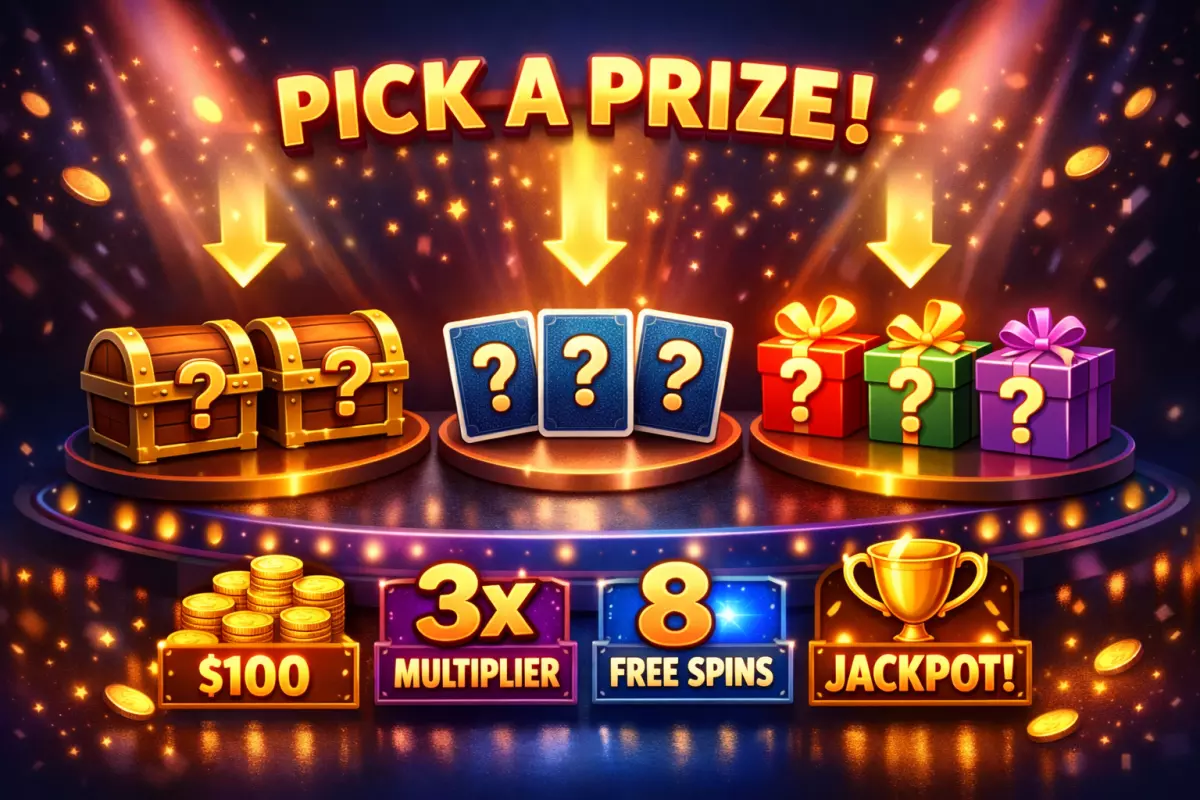
These bonus features pause the normal reel-spinning and give you a choice to make on screen. Instead of relying only on paylines, you select objects (like boxes, cards, or symbols) that reveal prizes such as cash values, multipliers, extra free spins, or progress toward a bigger award.
The key idea is simple: the game presents a set of hidden outcomes, and each pick uncovers one of them. In many slots, the results are determined by the random number generator (RNG) the moment the feature starts, so the “choice” changes the presentation more than the underlying math. Still, the format can make bonus rounds feel more engaging because you’re actively involved.
How the picking mechanic usually works
Most selection-style rounds follow a clear structure: you’re offered several items, you pick one or more, and the round ends when you hit a stop condition (like revealing three matching symbols, finding a “collect” item, or exhausting your allowed picks).
- Fixed number of picks: You get, for example, 3–10 selections, then the game totals the revealed prizes.
- Pick-until-stop: You keep choosing until you reveal a “game over” item (sometimes with consolation prizes along the way).
- Match-and-win: You pick until you match a set (such as three identical icons) to trigger a payout or a higher tier.
- Collect-and-build: Each pick adds to a meter; filling it can unlock multipliers, jackpots, or an extra stage.
Common prize types and what they mean
Selection rounds often mix different reward categories. Understanding what each one does helps you read the screen quickly and avoid confusion about how the final win is calculated.
| Reward type | What you actually receive | How it’s usually applied |
|---|---|---|
| Instant credit values | A fixed win amount (e.g., 10x, 50x) | Added directly to the bonus total |
| Multipliers | A multiplier (e.g., 2x, 5x) | Multiplies either the current collected total or a later stage win, depending on rules |
| Free spins / respins | Extra spins in a separate feature | Triggers an additional round; winnings from that round are added to the bonus payout |
| Progressive or fixed jackpots | A jackpot tier (mini/minor/major, etc.) | Awarded if revealed/collected under specific conditions (often matching or filling a meter) |
Do your choices affect the outcome?
In many modern slots, your selections don’t change the expected return because the RNG has already decided the sequence of reveals or the final result when the bonus begins. Your picks determine which item shows the next predetermined prize, not what prize exists in the pool.
Some games, especially older or simpler ones, may feel more “branching” (for example, choosing between paths with different risk levels). Even then, the slot’s overall payout model is designed so the feature fits the game’s intended volatility and return-to-player settings. If the rules mention different routes or tiers, treat it as a change in risk profile (swingier vs. steadier), not a guaranteed way to improve results.
Tips for reading the rules during an interactive bonus
Because these features can stack multiple mechanics, the paytable text matters. A quick check of the on-screen help can clarify whether you’re collecting values, building multipliers, or trying to avoid a “stop” symbol.
- Look for whether multipliers apply to the total collected or only to a specific win.
- Check the end condition (fixed picks, three strikes, matching requirement, etc.).
- Confirm whether jackpot symbols must be revealed or collected (some require multiple finds).
- Note if the bonus can upgrade into a second stage, since that changes how you should interpret early prizes.
Overall, these interactive rounds are designed to break up standard play with a more hands-on moment. The best way to approach them is to understand the stop rules and prize types, then treat your picks as part of the entertainment rather than a strategy puzzle you can “solve.”
Multipliers and expanding wilds in bonus rounds
Bonus features often raise the stakes by adding two mechanics that change how wins are calculated: win multipliers and wild symbols that grow to cover more positions. Both can make a single hit worth far more than it would be in the base game, but they do it in different ways and with different limitations.
How multipliers increase payouts
A multiplier is a number that scales a win after it’s formed. If you land a 10-credit win and the feature applies a 3x multiplier, the payout becomes 30 credits. The key detail is when the multiplier is applied: some games multiply each individual line/ways win, while others multiply the total win for the spin.
In bonus rounds, multipliers commonly appear as:
- Sticky multipliers that stay active for several free spins once triggered.
- Stacking multipliers that increase with each consecutive win, symbol collection, or retrigger.
- Random multipliers that land on reels or are assigned to specific wilds.
- Progressive feature multipliers that climb as you complete a meter or unlock extra modifiers.
Always check whether the multiplier affects only wins that include a wild, only wins on certain reels, or every win in the feature. Those small rules often matter more than the headline number.
What “expanding wilds” actually do
An expanding wild starts as a single wild symbol and then enlarges to cover a bigger area, typically a full reel, a full row, or a specific block of positions. By replacing multiple symbols at once, it increases the chance of completing paylines or “ways” combinations, especially in free spins where you get repeated attempts.
Common patterns include:
- Full-reel wilds that expand vertically and substitute across the entire reel.
- Row wilds that stretch horizontally across a row, useful in games with fixed paylines.
- Block expanding wilds (for example 2x2 or 3x3) that can connect clusters in grid or megaways-style layouts.
- Expanding sticky wilds that both grow and remain for the rest of the bonus, increasing potential over time.
Expansion doesn’t guarantee a win; it just increases coverage. If the surrounding symbols still don’t line up with the game’s pay rules, the wild’s extra area may not convert into a payout.
When multipliers and expanding wilds combine
The most dramatic swings happen when a growing wild also carries a multiplier, or when the game applies a global multiplier on top of wins created by expanded wild coverage. In those setups, one spin can create multiple winning lines/ways, and then each win is scaled up.
To understand the real impact, look for these interaction rules:
- Per-win vs. per-spin multiplication: per-win multipliers usually benefit most when expanding wilds create many separate wins.
- Multiplier attachment: some games multiply only the lines that include the wild; others multiply everything once a special symbol lands.
- Cap or ceiling: bonuses sometimes limit the maximum multiplier or the maximum win, which changes how “explosive” the combo can be.
- Order of operations: games may add wins together first and then multiply, or multiply each win and then sum them.
Quick comparison: what each mechanic is best at
| Mechanic | Main effect | Typical trigger in a bonus | Best suited for |
|---|---|---|---|
| Win multiplier | Scales payouts after wins are formed | Feature meter, random modifier, special symbol, win streak | Boosting already-strong hits, increasing value of frequent small wins |
| Expanding wild | Increases substitution coverage to help create wins | Wild lands on a reel/position and expands by rule | Improving hit rate and connecting more paylines/ways |
| Sticky expanding wild | Builds board advantage across multiple spins | Wild expands and remains for remaining free spins | Momentum-style bonuses where potential grows over time |
| Multiplier wild (often with expansion) | Creates wins and increases their value at the same time | Wild lands with an assigned multiplier value | High-variance features where one spin can dominate the total payout |
If you want a practical takeaway, treat expanding wilds as the mechanic that helps you make wins, and multipliers as the mechanic that helps you magnify them. In many bonus rounds, the best results come from a mix: enough wild coverage to connect combinations, plus a multiplier rule that meaningfully scales what you hit.
How bonus rounds affect payouts and RTP
Bonus features change the way a slot pays by shifting a portion of the game’s expected returns into special events like free spins, pick-and-win rounds, or multipliers. That means two games with the same base game feel can still produce very different results depending on how often their features trigger and how much those features tend to award.
In most modern slots, the base game is designed to pay less on average than the headline RTP suggests, because some of the long-term value is “reserved” for feature payouts. The more a slot relies on features, the more you may notice quieter base spins punctuated by occasional larger hits when a bonus round lands.
RTP: where the bonus value “lives”
RTP (return to player) is a long-run average across an enormous number of spins. It usually includes everything the game can pay: base wins, scatter pays, and all bonus rounds. So if a slot advertises 96% RTP, that figure typically assumes the bonus features trigger at their designed frequency and pay out at their designed averages.
Because RTP is an average, it does not tell you how quickly results will approach that number. A feature-heavy game can take longer to “show” its RTP in real play, since a meaningful portion of returns may come from rarer, higher-impact bonuses.
Hit frequency and volatility: why payouts can feel swingy
Bonus mechanics strongly influence volatility (how much results swing) and hit frequency (how often you get any win). Frequent, low-paying features can make a game feel steadier, while rare, high-paying bonuses can create long dry spells followed by big spikes.
- Frequent bonuses often mean smaller average feature wins and a smoother ride, but fewer headline-sized payouts.
- Rare bonuses can concentrate value into occasional events, increasing the chance of long losing stretches.
- Multipliers and “win up to” caps can increase top-end potential without changing how often the feature triggers, which typically raises volatility.
How different bonus types shift the payout profile
Not all features affect returns in the same way. Free spins often add value through extra chances to hit paylines, sometimes with enhanced rules (sticky wilds, expanding symbols, or retriggers). Pick bonuses tend to deliver a more controlled range of outcomes, while “hold-and-spin” or respin features often concentrate wins into a few high-value symbol collections.
Design choices inside the bonus matter as much as the trigger itself. A free spins round with retriggers can dramatically increase the upper range of outcomes, while a fixed-length bonus with no upgrades may keep results more predictable even if it triggers at a similar rate.
Why the base game can feel “tight” in feature-led slots
When a large share of expected value is allocated to bonuses, the base game may intentionally pay less often or with smaller average wins. This is not automatically “worse”; it is a trade-off. You’re effectively accepting lower day-to-day payouts in exchange for a chance at bigger feature outcomes that help the game reach its overall RTP in the long run.
Some slots also use near-miss style designs (for example, two bonus symbols landing often) to create anticipation without changing the underlying odds. This affects perception, not the math, but it can make the wait for a bonus round feel longer or more intense.
RTP variants and feature contribution
Some games ship with multiple RTP settings (for example, different versions used by different casinos). When that happens, the change may be implemented by adjusting the base game paytable, the bonus payout distribution, the feature trigger rate, or a mix of these. Two versions can look identical while paying differently over time.
If a slot offers an optional “buy bonus” feature, it does not guarantee better returns. The cost is usually priced so the expected value is close to (or sometimes slightly below) the standard play RTP, with higher short-term variance because you are forcing entry into a high-impact part of the game.
| Bonus design element | Typical effect on payouts and RTP experience | What players often notice |
|---|---|---|
| High feature contribution (large share of RTP in bonuses) | Base game pays less on average; returns are concentrated in bonus events | Longer stretches of small or no wins, then occasional bigger bonus hits |
| Frequent, low-value bonuses | Smoother distribution; RTP is reached through many modest feature payouts | More regular “something happens” moments, fewer huge swings |
| Rare, high-value bonuses | More volatile distribution; RTP depends heavily on infrequent big outcomes | Dry spells can be common; a single bonus can change a session |
| Bonus upgrades (retriggers, escalating multipliers, expanding reels) | Raises upper payout potential; often increases variance even if RTP stays similar | Most bonuses are average, but a “runaway” bonus is possible |
| RTP variants across operators | Same-looking game can have different long-run return depending on configuration | Results feel subtly different over time, especially in feature value |
The practical takeaway is that bonus rounds don’t just add excitement; they reshape where and how the game pays. To understand what a slot’s RTP will feel like in real play, consider how much value is tied to features, how often they trigger, and whether the bonus rules allow outcomes to scale dramatically through multipliers or retriggers.
FAQ about slot bonus rounds
Bonus features can feel confusing because each game handles triggers, prizes, and rules a little differently. These common questions explain what usually happens behind the scenes and what you can check before you spin.
1. What is a bonus round in a slot?
A bonus round is a special feature that activates separately from the base game and can award extra prizes. It might be free spins, a pick-and-win screen, a wheel spin, a hold-and-respin feature, or a short mini-game. The key idea is that the game switches into a different mode with its own rules for a limited time.
2. How do bonus rounds get triggered?
Most are triggered by landing specific symbols or symbol combinations, such as scatters, bonus icons, or a certain number of special tokens. Some games also use “meter” mechanics (collect items over multiple spins) or random triggers, where the feature can start without a visible pattern. The exact trigger conditions are set in the game’s paytable or info menu.
3. Are bonus rounds random or skill-based?
In regulated online slots, outcomes are determined by a random number generator (RNG). Even when you make choices in a bonus game (for example, picking chests), those picks typically reveal pre-determined RNG results rather than changing your long-term odds. Some titles may present “illusion of choice” decisions that change the presentation, volatility, or distribution of prizes, but the overall return is still governed by the game’s math model.
4. Do bonus rounds change the RTP?
They can affect how the total RTP is delivered, but not usually the stated overall RTP for the game. Many slots allocate a large portion of expected return to features like free spins and other bonuses, meaning the base game may feel “tighter” while the bigger swings happen during features. If a game offers multiple RTP settings, the chosen setting applies to the whole game, including its bonus features.
5. Can I increase my chances of getting a bonus round?
You generally can’t influence the trigger rate through timing, bet patterns, or stopping the reels. Each spin is independent. The only practical levers are choosing a different game with a higher feature frequency, or using a built-in option like a “buy feature” (if available) that trades a higher cost for immediate access to the bonus round.
6. What is a “feature buy,” and is it worth it?
A feature buy (also called bonus buy) lets you pay a set multiple of your bet to enter a bonus round immediately. Whether it’s “worth it” depends on your goal and risk tolerance: it usually increases volatility and can produce large swings quickly. It does not guarantee profit, and the long-run expectation still follows the game’s RTP. If you use it, treat it as a higher-variance way to experience the feature, not as a shortcut to winning.
7. What’s the difference between free spins and other bonus games?
Free spins are a bonus mode where you spin without paying for each spin, often with extras like multipliers, expanding wilds, or sticky symbols. Other bonus games may use picks, wheels, or respins with different win conditions. Free spins tend to preserve the “slot feel” while adding modifiers; pick-and-win or wheel features often compress the action into fewer decisions with a broader prize range.
8. Do multipliers and wilds work differently during bonus rounds?
Often, yes. Many games add temporary rules such as higher multipliers, extra wild reels, or symbol upgrades during the feature. Some mechanics only exist in the bonus mode (for example, a persistent multiplier that grows each win). Always check the feature rules, because a multiplier might apply only to line wins, only to wins including certain symbols, or only at the end of the round.
9. Can a bonus round retrigger?
Many slots allow retriggers, meaning you can win additional free spins or extend the feature by landing the right symbols during the bonus. Some games cap retriggers or change the conditions after the first activation. If retriggers are possible, the paytable usually states what triggers them and how many extra spins or respins you can earn.
10. Are bonus rounds the same on mobile and desktop?
In most modern online slots, the math and rules are identical across devices; only the layout changes to fit the screen. If you notice differences, it’s more likely a UI issue (missed info panel, hidden rules tab) than a different bonus model. When in doubt, open the game’s information screen and compare the feature descriptions.
11. What should I check in the paytable before chasing a bonus feature?
Look for the trigger requirement, whether the feature can retrigger, and any special rules that affect payouts (like multipliers, symbol transformations, or win caps). It also helps to note the game’s volatility and maximum win, because those two details hint at how much of the payout potential is concentrated in the bonus mode versus the base game.
12. Why do some bonus rounds feel “cold” or “hot”?
Variance can create clusters of triggers or long dry spells, even when the underlying odds are stable. Human pattern-seeking makes streaks feel meaningful, but RNG-driven spins don’t “remember” what happened earlier. If a feature feels inconsistent, that’s usually normal volatility rather than a change in the game’s behavior.