What Is RTP in Casino Games? Simple Player Guide

 This article explains what RTP means in casino games, how it’s calculated and tested, and how it differs from house edge. It covers typical RTP ranges by game, why volatility makes results vary, how online slot RTP works, how players use RTP to pick games, and common RTP myths.
A casino game’s return-to-player percentage (RTP) shows the share of wagers it is designed to pay back over the long run. It does not predict what will happen in a short session, where luck and volatility can dominate. Use RTP as a comparison tool across slots and table games, along with rules and betting limits, to make more realistic choices.
What RTP means in casino games

RTP stands for Return to Player. It’s a percentage that describes how much of the money wagered on a game is expected to be paid back to players over the long run. If a slot lists 96% RTP, the model behind the game suggests that, across a very large number of spins, about $96 is returned for every $100 wagered in total (with the remaining amount representing the casino’s theoretical edge).
The key idea is the timeframe: RTP is a long-run statistical expectation, not a promise about what will happen in your next session. In the short term, results can swing widely, and you can win big or lose quickly regardless of the posted percentage.
RTP as an average, not a guarantee
Think of the percentage as a property of the game’s math, similar to how a coin has a 50/50 expectation even though you can get several heads in a row. A casino game’s return rate is calculated across huge samples of play, often millions of rounds. Your personal outcome depends on variance, bet size, and how long you play.
Because it’s an average, two players can experience the same game very differently. One might hit a large payout early and walk away ahead; another might play the same number of rounds and lose. Both outcomes can still be consistent with the same theoretical return.
How RTP relates to the house edge
RTP and house edge are two sides of the same coin. If a game has 97% RTP, its theoretical house edge is about 3%. This doesn’t mean the casino “takes” 3% of each bet in a direct, immediate way; it means that over enough play, the game is designed to keep roughly that share of total wagers on average.
- Higher RTP generally means a smaller built-in advantage for the casino.
- Lower RTP generally means a larger built-in advantage for the casino.
- Even with a high return, short-term results can still be volatile depending on the game.
What RTP does (and doesn’t) tell you
RTP is useful for comparing games, but it’s only one part of the picture. It helps you understand the game’s expected cost over time, yet it doesn’t describe how “swingy” the game feels or how often it pays.
For example, two slots can share the same theoretical return while playing very differently: one might pay small wins frequently, while another might pay rarely but with occasional large hits. That difference is usually explained by volatility/variance and the game’s payout distribution, not by the return percentage alone.
Why RTP can differ between games (and sometimes within the same game)
Different titles are built with different mathematical models, so their expected return rates vary. In some cases, the same slot can be offered in multiple RTP versions (for example, one variant set lower than another). Casinos may choose which version to run, so it’s worth checking the game info panel or paytable details when available.
Also note that player decisions can matter in certain games. In pure chance games like many slots, the number is fixed by design. In decision-based games, the effective return can depend on how you play, meaning the published figure may assume optimal strategy rather than casual choices.
How RTP is calculated and tested
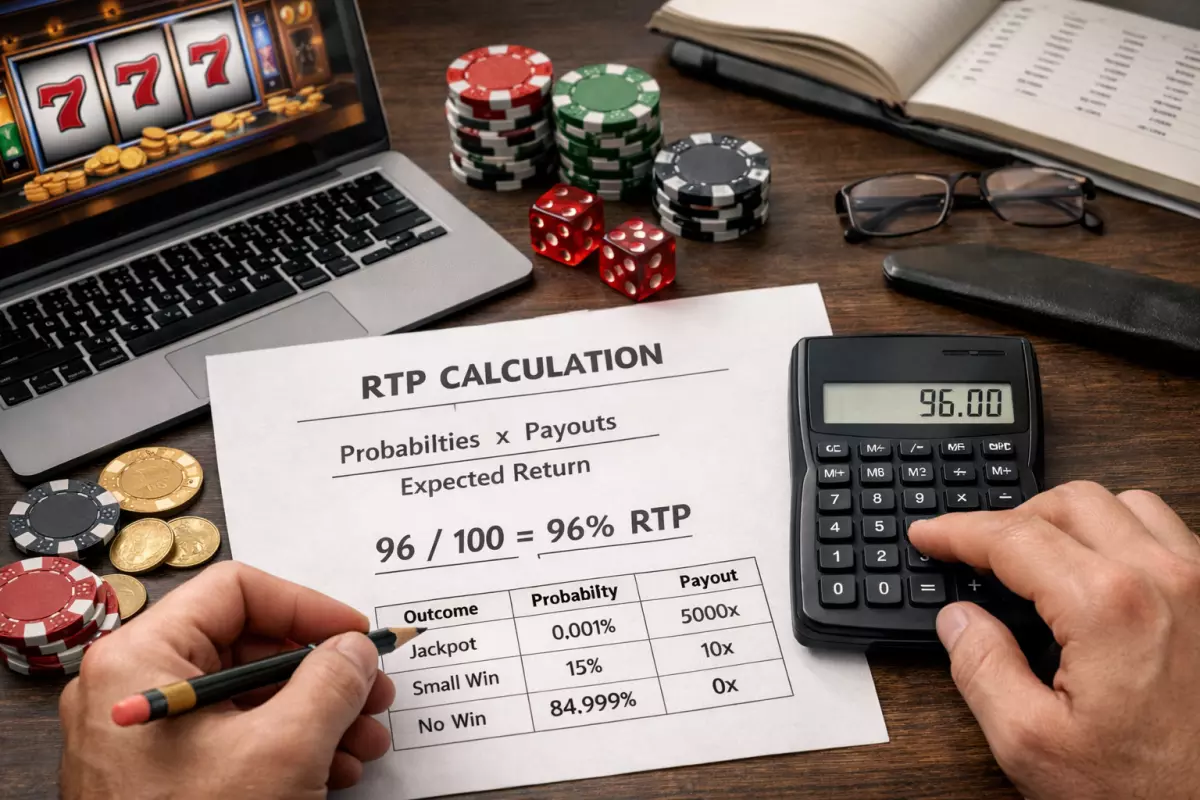
Return to Player is not a promise about what you will get back in a single session. It’s a long-run statistical average based on how a game is designed to pay out over a very large number of bets.
How the percentage is calculated
At its core, the figure comes from expected value: the game’s possible outcomes are weighted by their probabilities, then converted into an average return per unit wagered. If a slot is designed so that, over time, it returns 96 units for every 100 units bet, its RTP is 96%.
For slots and many digital games, the math is built from the paytable, symbol frequencies, reel mapping (or equivalent RNG mapping), and bonus feature rules. For table games, the return is derived from the rules and payout odds (for example, blackjack rules like dealer stands on soft 17, number of decks, and whether doubling is allowed).
What “the long run” really means
The published percentage assumes an enormous sample size. In real play, results can swing above or below the average for long stretches, especially in high-volatility games. That’s why two players can have completely different short-term experiences on the same title even though the underlying return is fixed by design.
How RNG-based games are tested
For games that use a Random Number Generator, testing focuses on two things: whether the RNG produces unbiased, unpredictable results, and whether the game logic correctly converts those results into outcomes and payouts according to the rules.
- RNG verification: checks that the number generation behaves as expected (no detectable patterns, proper distribution).
- Game logic validation: confirms paylines, bonus triggers, multipliers, and feature interactions pay exactly as specified.
- Statistical simulation: runs very large batches of spins/rounds to see whether the observed return converges toward the theoretical value within acceptable tolerance.
- Configuration review: verifies the correct RTP version is enabled if the game supports multiple return settings.
Theoretical RTP vs. observed RTP in testing
Labs typically start with the theoretical calculation from the game’s math model, then compare it to results from extensive simulations. The simulated (observed) return won’t match the target perfectly in smaller samples, so testers look for convergence and for results that fall within a defined statistical range.
It’s also common to test edge cases: maximum win paths, rare bonus chains, and rule conflicts that could cause incorrect payouts. These checks are less about the average return and more about making sure the game always pays correctly when specific conditions occur.
Why RTP can differ between casinos or regions
Some slots are released with multiple RTP configurations (for example, a “high” and “low” setting). The gameplay looks identical, but the long-term return changes because the underlying probabilities or feature frequencies are tuned differently. Which version you get depends on the operator’s chosen configuration and what local rules allow.
Even when the percentage is the same, your personal results can still vary widely due to variance. RTP describes the destination over time, not the path your bankroll takes to get there.
RTP vs house edge explained
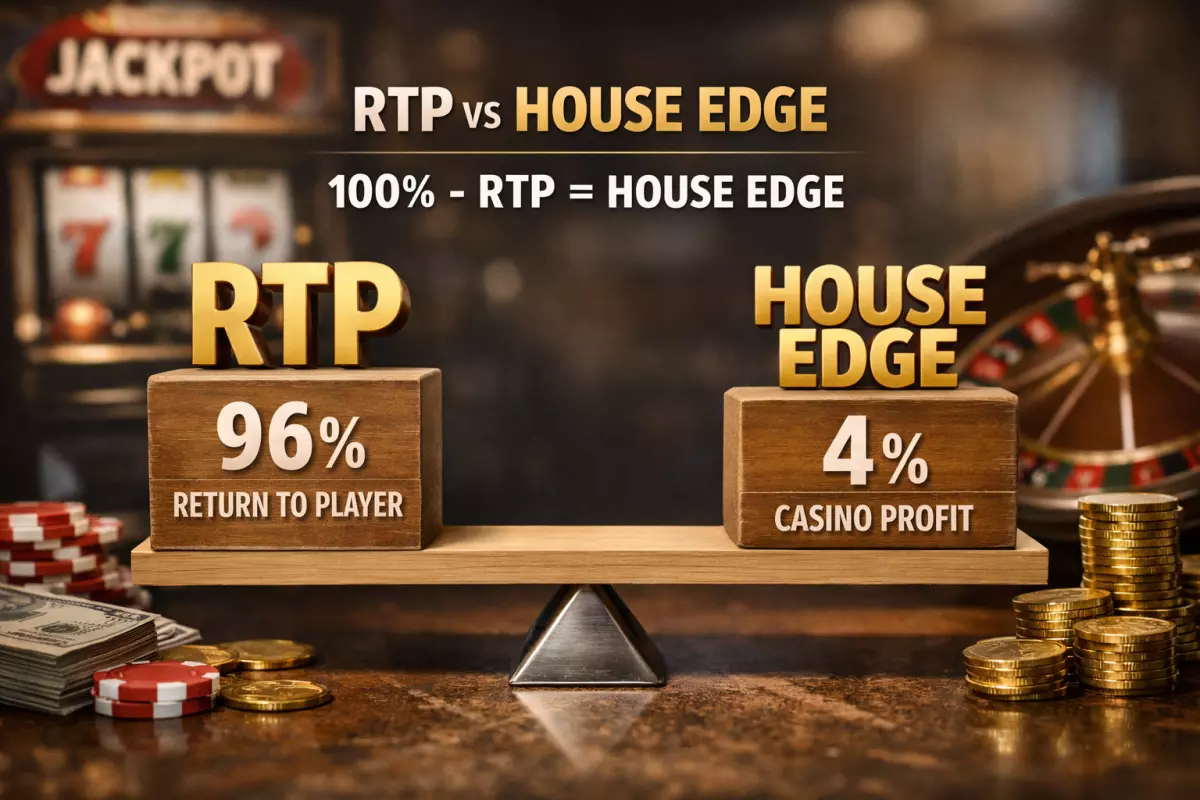
These two numbers describe the same relationship between player payouts and casino advantage, just from opposite angles. One tells you the long-term share of stakes that a game is expected to return to players; the other tells you the long-term share the operator keeps as profit margin (before costs).
In most standard casino games, the connection is straightforward: house edge = 100% − RTP. So if a slot shows 96% RTP, the implied house edge is 4%.
What each metric is actually saying
RTP (Return to Player) is a theoretical average over a very large number of bets. It does not promise what you will get back in a short session; it’s a statistical expectation built into the game’s math model.
House edge expresses the same expectation as the casino’s advantage per unit wagered. It’s often easier to compare across games because it directly states the expected loss rate (again, over the long run).
Quick conversions and examples
| Game metric shown | Example value | Converted value | What it means over time (per $100 wagered) |
|---|---|---|---|
| RTP | 97% | House edge 3% | Expected loss about $3 on average |
| RTP | 94.5% | House edge 5.5% | Expected loss about $5.50 on average |
| House edge | 1.5% | RTP 98.5% | Expected loss about $1.50 on average |
| House edge | 8% | RTP 92% | Expected loss about $8 on average |
Why the same RTP can still “feel” different
Two games can share an identical theoretical return yet play very differently because of variance (also called volatility). A high-variance slot may pay less often but in bigger bursts, while a low-variance game may produce smaller, more frequent wins. Both can still average out to the same long-run return.
That’s why RTP and casino advantage are best used for comparing the underlying math, while variance helps you understand the ride: how swingy your balance might be before the long-term average has any chance to show up.
Important caveats: when the simple formula isn’t the whole story
The “100% minus RTP” shortcut assumes you’re looking at a fixed ruleset and a fixed strategy. In some table games, the displayed return depends on how you play. For example, blackjack has a much lower house advantage with basic strategy than with random decisions.
Also, some games have multiple configurations (different paytables, side bets, or optional features) that change the expected return. In those cases, the meaningful comparison is the RTP/edge for the exact version you’re playing, not the headline number you saw elsewhere.
How to use these numbers as a player
- Use RTP or house edge to compare games on expected cost per bet, not to predict short-term outcomes.
- When choosing between similar games, a higher return (or lower edge) is generally better, all else equal.
- Check whether skill/strategy affects the expected return (common in blackjack and some video poker variants).
- Consider variance alongside the theoretical return so the risk level matches your bankroll and session goals.
Typical RTP ranges for different casino games

RTP varies a lot by game type and, in some cases, by the exact rules or version you’re playing. The ranges below are typical for reputable online casinos, but individual titles can sit outside them—especially slots, which may have multiple “return” settings.
Use these figures as a quick benchmark: a higher return-to-player percentage generally means the game gives back more of the total stakes over the long run, while a lower one means the house keeps more on average.
| Game type | Typical RTP range | What makes it move within the range |
|---|---|---|
| Slots (video slots) | 90%–97% (some lower, some higher) | Provider settings, jackpot contributions, bonus features, and volatility design. |
| Classic table games (Blackjack) | ~98%–99.5% (with correct basic strategy) | Rule set (dealer hits/stands on soft 17, number of decks, surrender, blackjack payout) and player decisions. |
| Roulette | European: ~97.3% American: ~94.7% |
Number of zeroes (one vs two). Bet type changes variance, not the built-in edge for standard bets. |
| Baccarat | Banker: ~98.9% Player: ~98.8% Tie: often much lower |
Commission rules and side bets; the Tie and many side bets usually reduce expected return. |
| Video poker | ~95%–99%+ (depends heavily on paytable) | Paytable quality and optimal play; small paytable changes can shift RTP noticeably. |
| Live dealer games | Similar to the same table games online | Same math as the underlying rules, but side bets and optional features can lower the effective return. |
| Casino game shows / “money wheel” games | Often ~90%–97% (varies widely) | Bonus rounds, multipliers, and special bets; headline features can come with a lower long-run return. |
Why slots have the widest spread
Slot RTP is set by the game’s math model, and many titles are released with more than one RTP configuration. That’s why two casinos can offer the same slot name but show different return figures in the info panel. Also, progressive jackpots often divert a slice of bets into the prize pool, which can reduce the base return compared with a non-jackpot version.
Table games: rules and decisions matter
For games like blackjack and video poker, the published RTP assumes near-optimal play. If you deviate—taking insurance in blackjack, holding the wrong cards in video poker, or chasing long-shot side bets—the effective return you experience tends to drop. With roulette, the main driver is simply whether the wheel has one zero or two.
A quick way to use these ranges when choosing a game
If your goal is to maximize long-run expected return, compare the displayed RTP (or the known house edge) and then check what could quietly lower it: side bets, unfavorable rule variants, or a weaker paytable. If your goal is entertainment and bigger swings, volatility and bet sizing will matter more than a small RTP difference.
RTP and volatility – why results vary
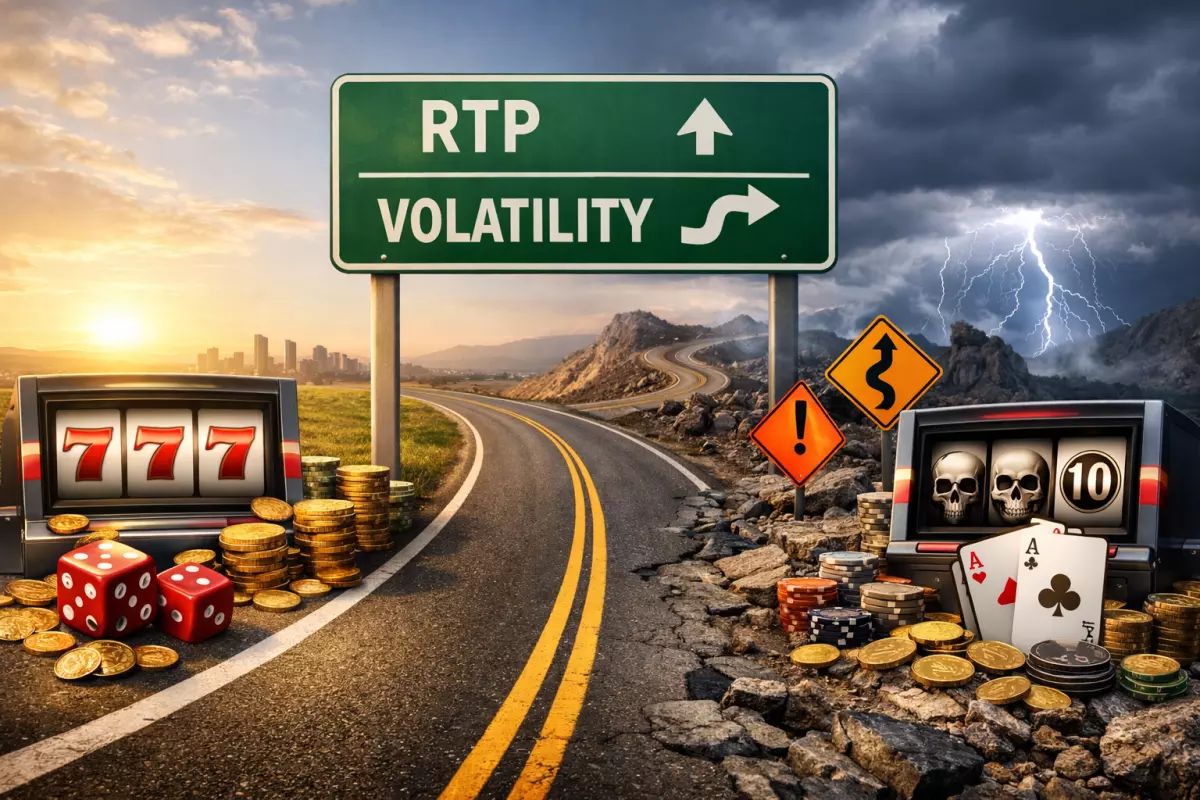
Two games can show the same RTP and still feel completely different in your session. That’s because RTP is a long-run average, while short-term outcomes are shaped by volatility (sometimes called variance) and plain randomness. In other words, RTP tells you the expected return over a huge number of bets, not what will happen in the next 50 spins or hands.
Think of RTP as the destination and volatility as the road conditions. With the same expected return, one game may deliver lots of small hits, while another stays quiet for long stretches and then pays out in bursts. Both can be “on track” mathematically even if your results look wildly different.
RTP is a long-run average, not a session promise
RTP is calculated across an enormous sample size, often millions of rounds. Your personal play is usually a tiny slice of that, so it’s normal to land above or below the stated percentage. A 96% RTP does not mean you “get back” 96% of your money in a night; it means that, over very long play across many bets, the game is designed to return about 96 units for every 100 wagered, on average.
This is why short sessions can be misleading. You can have a great run on a lower-RTP game or a rough run on a higher-RTP one, simply because variance dominates in the short term.
What volatility changes in practice
Volatility describes how spread out the results are around the average. Higher volatility usually means fewer wins, but when wins arrive they tend to be larger. Lower volatility typically means more frequent payouts, but they’re smaller and often just keep you afloat rather than creating big spikes.
- Low volatility: steadier bankroll swings, more frequent small wins, fewer dramatic peaks.
- Medium volatility: a mix of dry spells and meaningful hits; many mainstream slots sit here.
- High volatility: longer losing streaks are common, with occasional large payouts that can change the session.
Same RTP, different “feel”: a quick comparison
Below is a simple way to compare how two games with identical RTP can still play very differently depending on volatility.
| Volatility level | Typical win frequency | Typical payout size | What a session often feels like |
|---|---|---|---|
| Low | Higher | Smaller | More “busy” with regular hits; bankroll tends to move in smaller steps. |
| Medium | Moderate | Mixed | Alternates between calm periods and noticeable wins; swings are present but not extreme. |
| High | Lower | Larger | Longer quiet stretches; results can hinge on a few big moments. |
| Very high | Lowest | Largest (occasionally) | Pronounced streakiness; bigger risk of quick drawdowns, with rare but dramatic spikes. |
Why you can lose on a “high RTP” game
A higher RTP improves your expected return, but it doesn’t remove the house edge or guarantee short-term profit. If the game is high variance, you may hit a long downswing before the math has any chance to “average out.” Even with lower variance, you can still run below expectation for a while because each round is independent.
It also matters how payouts are distributed. Some games return value through many small wins; others concentrate a lot of the expected return into rare bonus rounds or top prizes. If you don’t trigger those features in your session, your results can lag behind the theoretical average.
How to use RTP and volatility together
RTP is best for comparing the built-in edge between similar games, while volatility helps you choose a style that fits your bankroll and patience. If you prefer longer play with fewer sharp swings, lower variance games tend to align better. If you’re comfortable with bigger fluctuations and are chasing occasional large payouts, higher variance may suit you more, even when the RTP is the same.
As a practical rule, match volatility to your budget: the higher the variance, the more important it is to keep stakes conservative so you can survive the dry spells that often come with that payout structure.
How RTP works in online slots
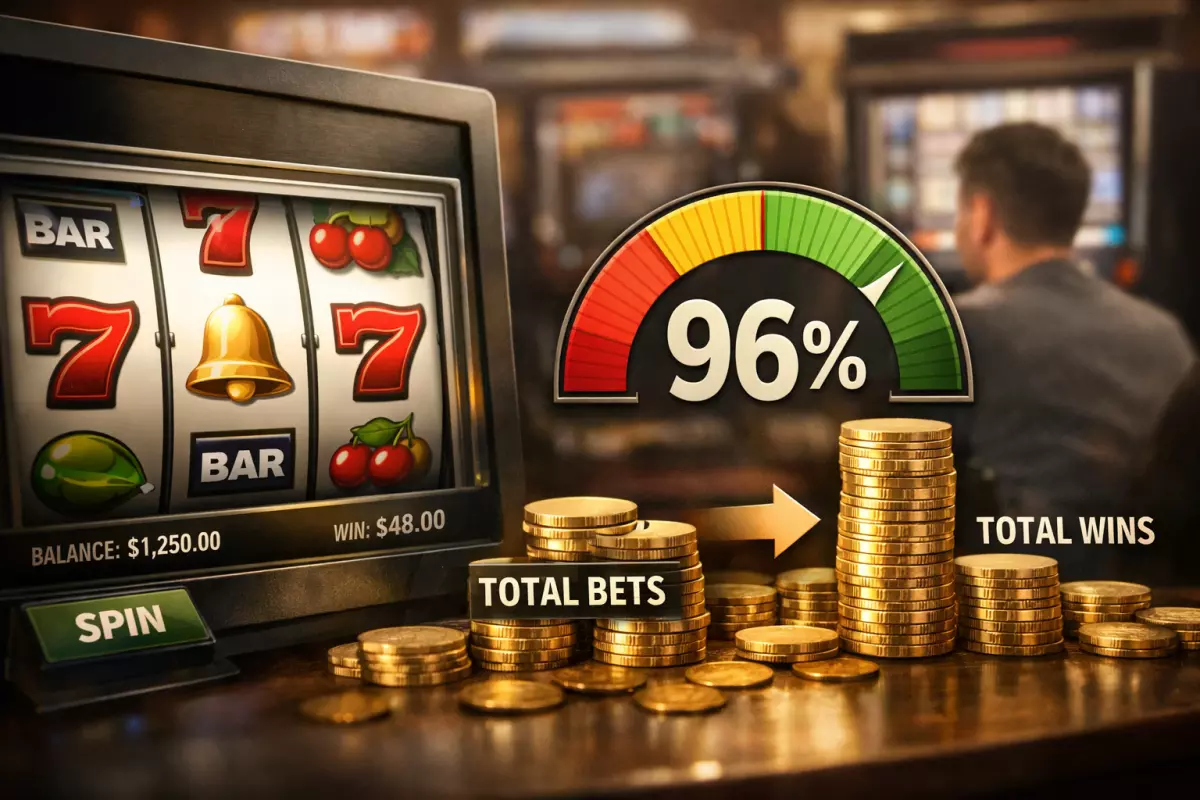
In slot games, RTP (return to player) is a long-run average that describes how much of all money wagered is paid back to players over time. If a slot is listed at 96% RTP, it doesn’t mean you’ll get 96% back in a single session—it means that across a very large number of spins from many players, the game is designed to return about 96% of total stakes as winnings.
The key idea is scale: slot results are highly variable in the short term, but they tend to drift toward the published percentage as the number of spins grows. Your personal outcome can be far above or far below the stated return, especially over a few hundred spins.
What actually determines the RTP
Online slots use a random number generator (RNG) to create outcomes. Each spin is independent, and the RNG selects a result that maps to the game’s reel symbols and paytable. The RTP comes from the math behind those mappings: how often each outcome can occur and how much it pays when it does.
In practical terms, the game designer tunes the expected return by adjusting factors like symbol frequencies, hit rates, and payout sizes. The RNG provides unpredictability; the paytable and probabilities determine the long-term average.
Why your results can differ from the listed percentage
RTP is an average across an enormous sample size, not a promise for any one player. Variance (often discussed as volatility) is what makes the experience feel “swingy” or “steady.” Two slots can have the same RTP but behave very differently: one might pay small wins often, while another pays rarely but can hit bigger prizes.
- Short sessions are noisy: a handful of bonus rounds (or none) can dominate your results.
- Big features are lumpy: free spins, multipliers, and jackpots can skew outcomes for long stretches.
- Independence of spins: a losing streak doesn’t make a win “due,” and a hot streak doesn’t increase future odds.
RTP, bonus features, and where the “return” comes from
Many modern slots distribute a large portion of their expected payouts through bonus mechanics—free spins, expanding wilds, hold-and-win rounds, or progressive-style features. That means two players can experience the same game very differently depending on whether they trigger those features.
Some titles also offer optional buy-bonus or enhanced bet modes. These can change the underlying payout distribution and sometimes the displayed RTP version. If a slot shows multiple RTP settings (for example, different percentages depending on configuration), the casino chooses which version is active, and that’s the one that matters for your play.
How to use RTP information as a player
Think of the RTP figure as a tool for comparing games, not as a way to predict your next session. All else equal, a higher return percentage is mathematically more favorable over time, but it won’t remove short-term risk. Pair the RTP with volatility info (when available) and your budget: high-volatility slots can require a larger bankroll to withstand dry spells, even if the RTP is similar to a lower-volatility game.
If you’re checking a slot’s details page, look for the published RTP value, whether there are multiple RTP versions, and whether special modes (like bonus buys) alter the expected return. That small bit of homework helps you understand what the game is designed to do over the long run—even though any single session can still swing either way.
How players use RTP to choose games
RTP (return to player) is one of the quickest ways to estimate how “costly” a casino game is over the long run. It doesn’t predict what will happen in your next 20 spins or hands, but it does help you compare options on a like-for-like basis and set realistic expectations for your bankroll.
A simple way to think about it: a higher percentage generally means a smaller built-in house edge. That can translate to slower bankroll drain during long sessions, even though short-term swings can still be large.
Use RTP as a comparison tool, not a promise
Two games can feel very different in practice even if their RTP numbers are close. RTP is a long-run average calculated over a huge number of bets, so it’s best used to compare similar games (slot vs slot, roulette variant vs roulette variant) rather than to forecast outcomes.
If you’re choosing between two slots you like equally, picking the one with the higher return percentage is a rational tie-breaker. If one game is 96% and another is 92%, that gap is meaningful over time, even if you won’t “see” it in a short session.
Factor in volatility and your session goals
RTP tells you the average return; volatility (sometimes called variance) hints at how bumpy the ride can be. A high-volatility slot may have a solid RTP but still produce long losing stretches, while a lower-volatility game may pay smaller wins more often.
Match the game profile to what you want from the session: if you prefer longer playtime on a fixed budget, you’ll often lean toward higher RTP and lower volatility. If you’re comfortable with bigger swings for a chance at larger payouts, volatility may matter more than a small RTP difference.
Check what the published RTP actually applies to
Some games have multiple RTP settings (common with slots) or rules that change the effective return (common with table games). Before you rely on a number, make sure it matches the version you’re playing and the way you’re betting.
- Slots: the same title may be offered at different RTP configurations depending on the casino or jurisdiction.
- Blackjack: rule sets (like dealer hitting/standing on soft 17) and your strategy can move the real-world return noticeably.
- Roulette: the wheel type matters; European roulette typically has a better theoretical return than American due to fewer zero pockets.
- Side bets and bonus features: these often have a lower expected return than the main game and can drag down your overall results.
Use RTP to plan bankroll and bet size
Once you know a game’s return percentage, you can make more grounded choices about how much to stake and how long you want to play. Higher RTP games usually give you better odds of stretching a bankroll, but they don’t remove variance, so conservative bet sizing still matters.
A practical approach is to decide your session budget first, then pick a game with a return rate you’re comfortable with, and finally choose a bet size that can absorb normal downswings. If you notice a game’s payouts feel unusually harsh, it may be higher volatility than you expected, or you may be on a colder streak—either way, adjusting stakes is often smarter than chasing losses.
| Player goal | What to prioritize | How RTP helps | Common pitfall |
|---|---|---|---|
| Maximize long-run value | Higher RTP, fair rules, low-cost variants | Helps identify lower house edge options | Ignoring game rules that change the effective return |
| Longer playtime on a budget | Higher RTP, lower volatility, smaller bets | Improves expected “time on bankroll” | Choosing high volatility and mistaking swings for “bad RTP” |
| Chasing big wins | Volatility and payout potential (within budget) | Ensures you’re not sacrificing too much expected return | Overvaluing jackpots while underestimating long losing runs |
| Comparing similar games quickly | RTP plus any key rule differences | Acts as a clean baseline for comparison | Assuming a published RTP is identical across all casinos/settings |
Used this way, RTP becomes a practical filter: it won’t tell you what you’ll win today, but it can help you avoid the worst-value options, choose games that fit your risk tolerance, and make your entertainment budget last longer.
Common myths about RTP in casinos
RTP (Return to Player) is one of the most misunderstood numbers in gambling. It’s useful, but it’s often treated like a promise, a timer, or a “hack” for beating the house. Clearing up a few common misconceptions helps you use this metric the way it was intended: as a long-run average, not a guarantee for your next session.
Myth 1: “A 96% RTP game will pay back 96% to me tonight”
RTP is calculated over a very large number of bets, often millions or more. In a single evening, your results can be far above or far below the stated percentage because short-term outcomes are driven by variance (volatility) and randomness. A high RTP usually means better long-run value, but it does not protect you from losing streaks in the short run.
Myth 2: “If a slot hasn’t paid in a while, it’s due”
This is the classic “due” or “hot/cold machine” belief. Modern casino games that use RNGs (random number generators) don’t track what they “owe” you. Each spin is independent, so a long dry spell doesn’t increase the chance of a win on the next spin. RTP describes the average return across huge samples, not a balancing mechanism that forces payouts after losses.
Myth 3: “RTP means I can predict how often I’ll win”
RTP tells you the average amount returned, not the frequency of wins. Two games can share the same return rate but feel completely different: one might pay small amounts often, while another pays rarely but with bigger hits. To understand how a game “behaves,” you also need volatility information and the paytable structure, not just the percentage.
Myth 4: “Higher RTP always means lower risk”
A higher return rate can improve expected value, but it doesn’t automatically reduce swings. Risk is more directly tied to volatility and bet sizing. A 97% RTP slot can still be high volatility and produce long losing runs, while a 95% RTP game could feel steadier if it pays small wins more frequently.
Myth 5: “Casinos can change RTP whenever they want during play”
In regulated markets, game parameters are tested and certified, and operators generally can’t just tweak the return on the fly for a specific player or session. That said, some games can exist in different RTP configurations (for example, multiple versions of the same slot). The key point: if there are variants, the RTP is set at the game configuration level, not dynamically adjusted spin-by-spin to target you.
Myth 6: “Bet size changes the RTP”
For most slots and many RNG table-style games, the return percentage is designed to be consistent regardless of stake, meaning a $1 spin and a $5 spin have the same long-run return rate. What changes with a bigger bet is the money you can win or lose per outcome, so the session can feel more intense even though the underlying math is similar.
Myth 7: “Bonuses and features ‘add extra RTP’ on top of the base game”
In most cases, the published RTP already includes the contribution of bonus rounds, free spins, and other features. That’s why a slot can have long stretches of small returns and then a feature that swings the results: the bonus is part of the same overall expected return. If a game shows separate “base” and “feature” returns, treat that as a breakdown of where the value comes from, not a stackable extra.
Myth 8: “RTP guarantees profit if I play long enough”
An RTP below 100% implies a house edge in the long run. Playing longer tends to make your results drift closer to the expected average, which typically means the casino advantage shows up more reliably over time. Higher RTP can reduce the expected loss rate, but it doesn’t flip the math into guaranteed winnings.
If you use RTP as a comparison tool rather than a prediction tool, it becomes genuinely helpful: it can guide game selection, set realistic expectations, and remind you that short sessions are dominated by variance while long sessions are dominated by the house edge.