How Online Casino Payouts Work

 Understand online casino payouts step by step: cashable balances, verification, processing times, payment methods, bonus rules, fees, delays, and dispute options.
- Online casino payout overview
- Payouts, winnings, and RTP are different
- How the payout process works step by step
- Cash, bonus, and pending balances
- KYC, AML, and source-of-funds checks
- Online casino payout methods compared
- How long online casino payouts take
- Fees, limits, and currency conversion
- Bonus winnings and wagering requirements
- Jackpots and large withdrawals
- Taxes and reporting
- Why payouts are delayed or rejected
- How to assess payout reliability
- Tips for smoother withdrawals
- What to do if a casino does not pay
- Payouts and safer gambling
- Author verdict
- FAQ
An online casino payout is not one single event. First, a game result is settled and any winnings are credited to the correct casino balance. Then, if the player requests a withdrawal, the operator reviews the transaction and sends the money through a bank, card network, e-wallet, cryptocurrency network, or another supported payment route.
This guide explains both sides of the process: how casino games produce and credit winnings, and how withdrawable funds move from the casino account to the player. It also covers identity checks, anti-money-laundering reviews, bonus restrictions, payout times, fees, limits, jackpots, taxes, and disputes. Exact rules depend on the player’s country, the casino’s licence, and the selected payment method.
Author methodology: A useful payout review should verify the casino licence, separate cash from bonus funds, compare internal processing with transfer time, inspect fees and limits, and confirm that a formal complaint procedure exists. Marketing phrases such as “instant payout” are not enough on their own.
Online casino payout overview
The word payout is used in several ways. It may describe a win credited after a spin or hand, the theoretical return of a game, the amount available to withdraw, or the final transfer to a bank account. These meanings are connected, but they are not interchangeable.
| Term | What it means |
|---|---|
| Game win | The prize calculated when a slot spin, table-game round, live-dealer hand, or another wager is settled. |
| Cash balance | Real-money funds that are normally eligible for withdrawal, subject to verification and transaction checks. |
| Bonus balance | Promotional funds that may be locked behind wagering, game contribution, maximum-bet, expiry, or cashout rules. |
| Pending withdrawal | A withdrawal request recorded by the casino but not yet fully approved, released, or settled. |
| Casino processing time | The period used by the operator to review and approve the request. |
| Transfer time | The period after approval while the bank, card network, wallet, or blockchain delivers the funds. |
| RTP | Return to player: a long-run percentage based on total prizes compared with total stakes. |
| House edge | The mathematical advantage built into a casino game. |
| Maximum win | The largest prize allowed by a game’s rules, often expressed as a multiplier of the stake. |
| Withdrawal limit | A transaction, daily, weekly, or monthly payout limit stated by the casino or payment provider. |
A legitimate withdrawal can still take time because several independent systems are involved. The casino controls account review and release. The payment provider controls routing and settlement. The receiving bank or wallet controls when the money becomes visible and usable.
Payouts, winnings, and RTP are different

The concept of casino RTP does not tell a player how much a specific deposit will return, how often a game will win, or how fast a withdrawal will arrive. It is a mathematical percentage calculated across a very large amount of play. A theoretical RTP is designed into the game, while actual RTP is calculated from real turnover and prizes over a measured period.
For example, a slot with 96% theoretical RTP does not promise that a player who stakes $100 will finish with $96. In a simplified mathematical model, the remaining 4% represents the casino’s house edge. One short session can still end far above or below the theoretical return. Volatility also matters: a high-volatility game may award larger but less frequent prizes, while a low-volatility game usually produces smaller, more frequent results.
| Metric | What it answers | What it does not answer |
|---|---|---|
| RTP | What percentage of total stakes a game is designed or measured to return over extensive play. | What one player will receive from one session. |
| Hit frequency | How often any winning result may occur. | Whether those wins will be large enough to create a profit. |
| Volatility | How unevenly prizes tend to be distributed. | The exact result of the next spin or hand. |
| Maximum win | The game’s top possible prize under its rules. | The probability of reaching that prize unless the game publishes it. |
| Withdrawal speed | How quickly approved cash reaches the player. | Whether the game itself has favourable mathematics. |
In regulated markets, virtual casino results are normally generated by a random number generator, while live games are settled from physical cards, wheels, dice, or other equipment. The result is passed to the game server, the prize is calculated under the paytable or table rules, and the casino wallet is updated.
Game software and random number generators may be tested by independent laboratories before release. This testing examines whether the software follows its published mathematical model, but it does not determine how quickly the casino processes customer withdrawals.
Author note: Never use a high RTP figure as proof that a casino pays withdrawals reliably. Game mathematics and cashier performance are separate checks. A strong review verifies both.
How the payout process works step by step
- The game or wager settles. The platform receives the result and calculates the prize according to the published rules.
- The correct balance is updated. A cash-funded win normally enters the cash balance. A bonus-funded win may enter a restricted or bonus-linked balance.
- The player requests a withdrawal. The cashier shows eligible methods, minimum and maximum amounts, possible fees, and any verification requirement.
- The platform runs automated checks. These may include available balance, payment ownership, account status, duplicate-account signals, location, bonus compliance, fraud indicators, and transaction risk.
- A manual review may follow. Staff may verify identity documents, source of funds, unusual activity, a large win, a changed payment method, or a technical game record.
- The casino approves and releases the payment. At this stage, the money leaves the internal pending queue and is sent to the payment processor.
- The payment route settles the transfer. The card network, bank, e-wallet, or blockchain processes the transaction.
- The receiving institution posts the funds. The player sees the money once the bank or wallet completes its own checks and account posting.
| Stage | Main party in control | Typical cause of delay |
|---|---|---|
| Game settlement | Game provider and casino platform | Interrupted round, provider outage, or a result requiring reconciliation |
| Balance classification | Casino wallet and bonus system | Unfinished wagering or an incorrectly applied promotion |
| Withdrawal review | Casino payments, risk, and compliance teams | KYC, AML, fraud, payment ownership, or bonus checks |
| Payment release | Casino and payment processor | Batch schedules, processor maintenance, or an unsupported route |
| Final settlement | Bank, card issuer, wallet, or blockchain | Weekends, holidays, intermediary banks, confirmations, or account review |
Author note: When support says a payout is “processed,” ask what that status means. It may mean approved internally, sent to the processor, accepted by the payment network, or fully settled. Request the transaction reference when one is available.
Cash, bonus, and pending balances
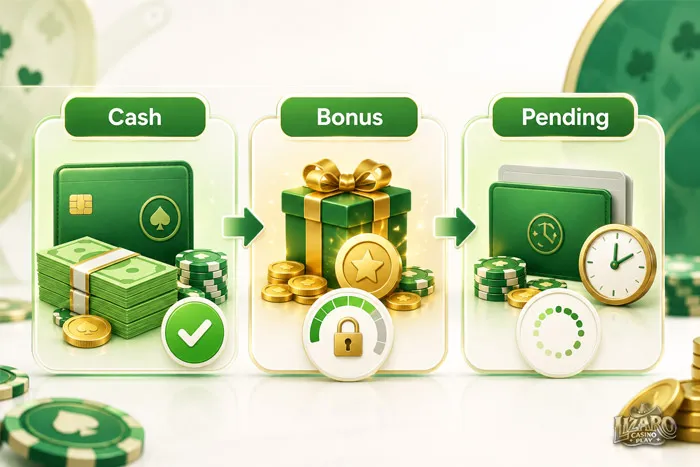
Most payout disputes become easier to understand once the account balances are separated. A casino wallet may display several categories of money, and only some may be immediately withdrawable.
Cash balance
This normally includes deposits made with the player’s own funds and winnings generated from cash play. It may still be temporarily unavailable if a deposit has not cleared, a withdrawal is under a lawful review, or the payment is connected to suspected fraud or a chargeback.
Bonus balance
This includes promotional credit and, depending on the bonus model, winnings linked to that credit. With a non-sticky bonus, deposited cash and promotional funds are often tracked separately, allowing the player to use the cash balance without immediately combining it with the bonus. The casino may still require wagering before the promotional portion becomes cashable. Terms may also specify eligible games, contribution percentages, maximum stakes, expiry dates, and maximum cashout amounts.
Locked or restricted winnings
Some systems show bonus-related winnings separately until all conditions are met. Others convert the whole bonus wallet to cash after completion. The balance label matters less than the written rule explaining when the money becomes withdrawable.
Pending withdrawal
Once a request is submitted, the amount may be deducted from the playable balance and marked as pending. In some jurisdictions, casinos are not allowed to offer a reverse-withdrawal option that lets players cancel the request and gamble the money again. Where reversal is available, leaving the withdrawal untouched reduces the risk of losing it back.
Balance note: Withdrawing cash may cancel an active bonus and remove remaining promotional funds. The cashier should show this consequence before the player confirms the request.
KYC, AML, and source-of-funds checks
KYC means “know your customer.” It is used to confirm that the account belongs to a real, eligible person and that the information attached to the account is accurate. AML means anti-money laundering. AML controls are designed to identify suspicious movement of funds, fraud, criminal proceeds, sanctions risk, and attempts to use a gambling account as a payment-transfer service.
A casino may request one or more of the following:
- A passport, national identity card, driving licence, or another accepted photo ID.
- Proof of address, such as a recent utility bill, bank statement, or official letter.
- Proof that the player owns the card, bank account, wallet, or other payment method.
- A selfie, liveness check, or video verification where identity theft or account control is a concern.
- Source-of-funds evidence, such as salary records, bank statements, sale documents, or another record explaining where deposited money came from.
- Source-of-wealth information for unusually high or sustained gambling activity.
Routine identity verification and enhanced financial checks are not the same. A player can pass basic KYC and later be asked for more information if activity changes materially, a large withdrawal is requested, a new payment method appears, or the operator identifies a legal risk it could not reasonably have resolved earlier.
| Check | Main purpose | Common issue |
|---|---|---|
| Identity | Confirm name, age, date of birth, and account holder | Expired ID, blurred image, or details that do not match the account |
| Address | Confirm residence and jurisdiction | Old document, missing page, or unsupported document type |
| Payment ownership | Prevent third-party deposits, fraud, and account misuse | Card or bank account belongs to a partner, relative, or company |
| Source of funds | Explain the origin of money used for gambling | Statements do not cover the relevant deposits or period |
| Enhanced due diligence | Review higher-risk or unusual activity | Incomplete explanation, inconsistent records, or delayed replies |
Use only the casino’s secure document portal or another verified official channel. Do not alter documents, hide requested information without permission, or send sensitive files to an address that cannot be confirmed through the casino account.
A genuine compliance request should identify what is needed and how to submit it safely. The casino may be unable to disclose every part of a fraud or money-laundering investigation, but it should still communicate which documents are outstanding whenever the law permits.
Author note: Complete available verification before making a large deposit. Use a payment method in the same legal name as the casino account and keep the profile address current. These steps do not guarantee instant approval, but they remove several avoidable causes of delay.
Online casino payout methods compared
The fastest method on the deposit page is not always the fastest withdrawal method. Some tools can fund a casino account but cannot receive money back. Casinos also commonly prefer a closed-loop route, meaning funds are returned to the original source where that is technically and legally possible.
| Withdrawal method | Illustrative time after approval | Main advantages | Main limitations |
|---|---|---|---|
| E-wallet | Often minutes to 24 hours | Fast posting, clear transaction record, and separation from the main bank account | Wallet verification, country restrictions, account fees, or currency conversion may apply |
| Instant bank payout | Often minutes to 1 business day where supported | Direct delivery to a bank with fewer manual details | Availability depends on the country, casino, bank, and payment partner |
| Standard bank transfer | Commonly 1 to 5 business days | Suitable for larger sums and widely understood | Intermediary banks, weekends, holidays, and incorrect details can add time or fees |
| Payment card | Commonly 1 to 5 business days | Convenient when the casino can return funds to the original card | Some cards or issuers cannot receive payouts; expired or replaced cards may require another route |
| Cryptocurrency | Network delivery may take minutes to hours after approval | Transparent network record and no traditional banking hours | Price volatility, network fees, address errors, confirmation requirements, and legal restrictions |
| Prepaid voucher | Often not available for withdrawals | Useful for controlled deposits | The casino may require a verified bank account or wallet for the payout |
| Cheque or manual payment | Several business days or longer | May serve markets with limited digital options | Slow delivery, banking delay, replacement risk, and possible fees |
These ranges begin after casino approval and are estimates, not guarantees. A first withdrawal, a large amount, a new destination, or an enhanced compliance review can take longer. Crypto also has two separate time variables: the operator’s review and the number of blockchain confirmations required by the receiving wallet.
Payment warning: A cryptocurrency payout is not proof that the casino is licensed, solvent, or fair. Verify the operator independently, check the exact network, and copy the destination address carefully. A transfer sent to the wrong address or incompatible network may be irreversible.
How long online casino payouts take
Total payout time can be expressed as a simple chain:
Total payout time = casino review + payment release + payment-network settlement + receiving-account posting.
A claim such as “payouts in 15 minutes” may refer only to selected verified accounts and selected payment methods. It may exclude first withdrawals, weekends, large wins, bonus reviews, or enhanced due diligence. The cashier terms should say when the clock starts and whether the quoted period uses calendar hours or business days.
| Situation | What may happen | Useful action |
|---|---|---|
| Verified account, familiar method, ordinary amount | Automated or short manual review | Check the cashier status and wait for the published processing window |
| First withdrawal | Identity and payment ownership may be reviewed | Upload complete, readable documents through the official portal |
| Request submitted late Friday | Casino or bank business-day processing may not begin until the next working period | Read whether the operator processes payments on weekends |
| Large or unusual withdrawal | Enhanced risk, source-of-funds, or game verification may be triggered | Ask for a complete document list and keep all replies in writing |
| Casino says “paid,” but funds are absent | The transfer may still be with the processor or receiving bank | Request the transfer reference, date, amount, currency, and destination details |
| Published maximum time has passed | The request may be stalled, rejected, or awaiting undisclosed information | Open a formal complaint rather than repeatedly starting new chat sessions |
A normal payout can arrive within hours or a few business days, but the first withdrawal often takes longer because the account and payment method may need to be checked. Bank holidays, weekends, payment outages, and receiving-bank reviews can extend the total period even after the casino approves the request.
Author note: Compare payout speed using the slowest realistic scenario, not the fastest advertised one. The better question is: “How long does a first verified withdrawal take by my chosen method, including weekends?”
Fees, limits, and currency conversion
The amount received can be lower than the amount requested even when the casino approves the full withdrawal. Before depositing, check every layer that can reduce or split a payout.
- Casino fee: A fixed or percentage charge stated in the withdrawal policy.
- Payment-provider fee: A wallet, processor, or card-service charge.
- Bank fee: A receiving or intermediary bank may deduct a transfer charge.
- Currency conversion: The casino, processor, wallet, or bank may apply its own exchange rate and spread.
- Blockchain network fee: Crypto withdrawals may include a fixed or variable network charge.
- Minimum withdrawal: Requests below a threshold may be unavailable or subject to a processing fee.
- Maximum per transaction: A large balance may need several transfers even if the player is entitled to the full amount.
- Daily, weekly, or monthly schedule: Some casinos divide large withdrawals according to stated payment limits.
| Before depositing, find | Why it matters |
|---|---|
| Cashier fee table | Shows whether the casino deducts a charge from each payout |
| Minimum and maximum by method | Prevents a large balance from being trapped behind an unsuitable route |
| Account and payout currencies | Reveals where exchange conversion may happen |
| Weekend and holiday policy | Clarifies whether quoted hours are calendar or business hours |
| Large-win policy | Explains manual review, instalments, jackpot verification, and documents |
| Bonus maximum cashout | Shows whether promotional winnings can be capped |
Withdrawal-limit rules vary by jurisdiction. Some regulated markets restrict how casinos can apply maximum withdrawal limits to cash balances, while other licences allow daily, weekly, or monthly schedules. The casino should publish these limits before the player deposits.
Author note: A “no withdrawal fee” label does not mean the transfer is free. Currency conversion and receiving-bank deductions can cost more than the casino’s own fee.
Bonus winnings and wagering requirements
Bonus money is not automatically withdrawable cash. The wagering requirements determine how much must be wagered, which games contribute, how much can be staked per round, and whether converted winnings are capped.
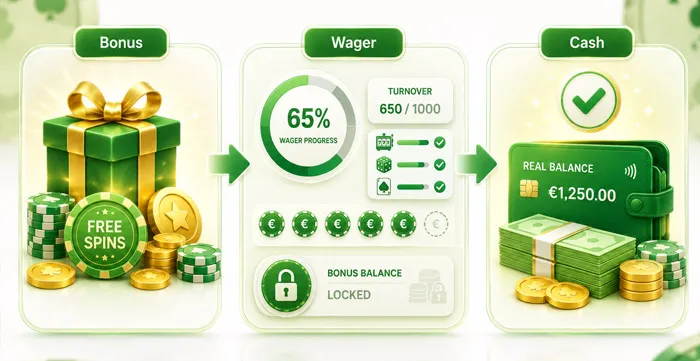
Consider a simple example:
- Deposit: $100
- Bonus: $100
- Wagering requirement: 30x bonus
- Required turnover: $100 × 30 = $3,000
If the rule instead says 30x deposit plus bonus, the calculation becomes ($100 + $100) × 30 = $6,000. Those two phrases create very different payout conditions.
| Bonus rule | Payout effect |
|---|---|
| Wagering requirement | Bonus-linked funds remain restricted until the required turnover is completed |
| Game contribution | A $10 wager may count as $10, a smaller amount, or nothing toward wagering |
| Maximum bonus bet | Exceeding the permitted stake may invalidate promotional winnings under the stated rules |
| Excluded games | Play on listed games may not count or may breach the promotion |
| Expiry | Unfinished bonus funds may be removed after the stated deadline |
| Maximum cashout | The amount converted from a no-deposit bonus or free-spin offer may be limited |
| Withdrawal during bonus play | The bonus and bonus-linked winnings may be forfeited when the player cashes out the real-money balance |
Read the version of the terms that applied when the bonus was accepted. Save the promotion page, wagering progress, and relevant support messages. A casino should not invent a new condition after a win, but a player is still responsible for clear rules that were available when the promotion was accepted.
Author note: The headline bonus percentage is less important than the wagering base, game contribution, maximum bet, expiry, and cashout cap. Those five terms determine whether a promotional balance can realistically become withdrawable.
Jackpots and large withdrawals
Large wins usually pass through the same basic withdrawal chain, but additional parties and checks may be involved. Progressive jackpots can be funded across several casinos and controlled by the game provider rather than the individual operator. The provider may verify the game round, jackpot state, stake, timestamp, and technical logs before confirming the prize.
A large withdrawal may also trigger enhanced due diligence. The casino can ask how the account was funded, whether the payment method belongs to the player, and whether the activity matches previous behaviour. That review should be specific and proportionate rather than an endless sequence of unrelated requests.
Before playing a jackpot game, check:
- Whether the displayed jackpot is paid as a lump sum or an annuity.
- Whether the advertised amount is in the game currency or converted at payout.
- Whether the prize is paid by the casino, the game provider, or a network administrator.
- Whether the game has a maximum-win cap separate from the jackpot.
- Whether local tax withholding applies.
- Whether payment-method transaction limits require several transfers.
Large-win note: Take screenshots of the result, balance, game name, round identifier, date, and cashier request. Screenshots do not replace server records, but they help preserve a clear timeline if the transaction is reviewed.
Taxes and reporting
Tax treatment depends on the player’s residence, the casino’s location, the type of gambling, the size and frequency of winnings, and whether the player is considered recreational or professional. Some countries generally do not tax ordinary player winnings, while others require reporting, withholding, or tax on certain prizes.
A casino’s decision not to withhold tax does not automatically mean the winnings are tax-free. Keep deposit records, bet history, win statements, withdrawal confirmations, fees, exchange rates, and any tax forms. For a significant payout, use guidance from the relevant tax authority or a qualified local adviser.
Tax note: This article explains payout mechanics and is not personal tax advice. Do not rely on a casino support agent for a final interpretation of tax law.
Why payouts are delayed or rejected
A delay means the request remains open while information or settlement is pending. A rejection means the request has been cancelled or refused, usually with the money returned to the casino balance, held for investigation, or adjusted under a stated rule. The operator should explain the status and identify the relevant term or legal reason whenever it is permitted to do so.
| Reason | What it may mean | What the player should do |
|---|---|---|
| Incomplete KYC | The operator cannot confirm identity, age, address, or document validity | Submit clear, current documents and ask which item failed |
| Name mismatch | The casino account and payment method do not belong to the same person | Explain any legal name change and provide supporting documents |
| Expired or closed card | The original payout route can no longer receive funds | Ask for the approved alternative and prove ownership of the old and new account if requested |
| Incorrect bank details | The transfer failed or was returned | Confirm account number, routing details, IBAN, SWIFT code, name, and currency |
| Unfinished wagering | The requested amount includes restricted bonus funds | Review the bonus ledger and decide whether to complete or cancel the promotion |
| Bonus-term review | The system detected a maximum-bet, excluded-game, expiry, or another possible breach | Request the exact term, bet records, and calculation used |
| Duplicate or linked accounts | The operator suspects multiple accounts, shared payment methods, or coordinated bonus use | Do not create another account; provide a factual explanation and ownership evidence |
| Location or VPN issue | Play may have occurred from a restricted jurisdiction or masked location | Provide travel or residence evidence and review the location terms |
| Unusual transaction pattern | Rapid deposits and withdrawals, sudden stake changes, or other activity triggered risk controls | Answer the compliance questions and document the source and purpose of funds |
| Failed deposit or chargeback | The original funding transaction was reversed, disputed, or never settled | Obtain the bank record and resolve the failed transaction |
| Game or provider review | An interrupted round, jackpot, or technical anomaly is being reconciled | Request the round ID, provider status, and expected review period |
| Payment outage | The casino approved the request, but the selected route is unavailable | Ask whether the transfer can be rerouted without restarting all checks |
Scam warning: Do not send an extra deposit, cryptocurrency payment, “release tax,” or insurance fee to an individual in order to unlock winnings. Legitimate fees should be disclosed in the casino terms and processed through its verified cashier, not through a private wallet or messaging account.
Never submit edited documents, invent a source-of-funds explanation, or create a second account to bypass a review. Those actions can create a genuine fraud concern and weaken an otherwise valid complaint.
How to assess payout reliability
Payout reliability should be checked before the first deposit, not after a large win. Start by confirming the casino’s licensing information and checking whether the company name and website domain match the licence details. A copied licence logo or number is not sufficient on its own.
| Check | Positive sign | Red flag |
|---|---|---|
| Licence and domain | The exact domain and operating company match the published licence details | The licence belongs to another company or the website gives incomplete information |
| Withdrawal policy | Processing times, methods, fees, limits, and KYC are stated clearly | Only vague promises such as “fast payments” are provided |
| Cash and bonus balances | Balances and wagering progress are displayed separately | The player cannot tell which money is withdrawable |
| Payment ownership | Terms explain same-name and original-source requirements | Third-party deposits are accepted without warning and questioned only after a win |
| Large-win terms | Jackpot verification and any payout schedule are disclosed | The operator claims broad discretion to delay or confiscate without clear criteria |
| Complaint route | A formal complaints procedure and response period are published | Only live chat is available or support refuses to issue a case number |
| Security | Secure login, two-factor authentication, protected payment pages, and a document portal | Documents or payments are requested through personal email or messaging apps |
Author note: A small test withdrawal can reveal the real verification flow, cashier usability, support quality, and payment compatibility before a larger balance is involved. It is not proof that every future withdrawal will be identical, but it provides more evidence than an advertising badge.
Tips for smoother withdrawals
- Verify the account early. Complete every available identity step before placing significant funds at risk.
- Use your own payment method. The legal name should match the casino account.
- Choose a method that supports withdrawals. A deposit-only voucher may force the casino to verify a new payout route later.
- Keep profile details current. Update address, phone number, expired ID, and payment changes through the official account process.
- Read bonus rules before opting in. Record wagering progress, maximum bet, eligible games, expiry, and maximum cashout.
- Request one accurate withdrawal. Repeated cancellation and resubmission can restart queues or risk checks.
- Submit complete documents together. Make sure all corners, names, dates, and required pages are visible.
- Protect the account. Use a unique password and two-factor authentication to reduce the risk of a payout being redirected.
- Keep written records. Save request numbers, dates, status messages, terms, and transaction references.
- Do not gamble a pending withdrawal. Where reversal is available, leave the request in place rather than returning the funds to play.
What to do if a casino does not pay

Use a documented escalation path. Repeated live-chat conversations without a formal complaint number can create noise without moving the case forward.
- Check the stated status and deadline. Confirm whether the request is pending, approved, sent, failed, returned, rejected, or cancelled.
- Collect evidence. Save the account statement, withdrawal request, game or round ID, relevant terms, verification uploads, emails, and chat transcripts.
- Ask a precise question. Request the exact missing document, disputed term, transaction reference, or reason for the hold.
- Open a formal complaint. Use the operator’s published procedure and include dates, amounts, currency, method, and the resolution requested.
- Wait for the formal response period. The period depends on the casino’s licence and complaints policy.
- Escalate the dispute. If the casino does not resolve the complaint, use the dispute-resolution provider or regulator stated in the casino terms.
- Consider professional advice. Legal assistance may be appropriate when the amount is substantial or the dispute involves complex jurisdictional issues.
| Evidence | Why it helps |
|---|---|
| Withdrawal confirmation | Establishes amount, date, currency, method, and request number |
| Terms in force at the time | Shows the agreed processing, bonus, and payout conditions |
| Account and game history | Supports the origin and calculation of the balance |
| KYC submission receipts | Shows what was supplied and when |
| Support and complaint replies | Creates a timeline and records the operator’s stated reason |
| Bank or wallet statement | Confirms whether a transfer arrived, failed, or was returned |
The complaint should remain factual. State what happened, when it happened, what documents were supplied, what the casino said, and what resolution is expected. Avoid threats, duplicate complaints, or edited evidence, as these can make the case harder to review.
Chargeback warning: Contact a bank promptly for an unauthorised or fraudulent payment. Do not use a chargeback simply to recover legitimate gambling losses or bypass an active dispute, because false claims can lead to account closure, debt recovery, or fraud concerns.
Payouts and safer gambling
A withdrawal is a useful stopping point. Once money has been moved out of the casino balance, it is less immediately available for another wager. Deposit limits, loss limits, time limits, reality checks, cooling-off periods, and self-exclusion can add further friction.
Do not treat casino payouts as wages, savings, or a predictable income stream. RTP and probability ensure that gambling outcomes remain uncertain, and the house edge means repeated play is expected to favour the operator over time. Never chase a delayed payout by depositing more or gambling the remaining balance.
Author verdict
Online casino payouts work through a chain of game settlement, balance classification, account review, casino approval, payment processing, and final posting. The quickest-looking cashier is not necessarily the most reliable. Transparency is more important: the operator should identify which funds are cashable, what checks may apply, how long internal approval normally takes, what the payment method adds, and where a complaint can be escalated.
The strongest payout checklist is simple: verify the casino and its licence, use a same-name payment method, complete KYC early, understand bonus restrictions, compare both payout clocks, save the transaction record, and never send extra money to “unlock” winnings. A licensed casino may conduct legitimate checks, but it should not use vague or repetitive demands to create unnecessary withdrawal friction.
FAQ
How do online casino payouts work?
A game first settles the wager and credits any prize to a cash or bonus-related balance. When the player withdraws, the casino checks the balance, account, payment method, bonus status, and compliance risk. After approval, the payment provider and receiving bank or wallet complete the transfer.
How long does an online casino payout take?
It depends on two periods: casino approval and payment settlement. E-wallet and instant-bank routes may arrive quickly after approval, while standard bank and card payments often take additional business days. First withdrawals, large amounts, weekends, and enhanced checks can take longer.
What is the fastest casino payout method?
E-wallets and supported instant-bank payouts are often among the fastest after approval. The best option still depends on the player’s country, the casino’s processor, verification status, currency, and receiving institution.
Why does a casino ask for ID before paying?
Identity checks help confirm age, account ownership, payment ownership, location, and fraud risk. Additional AML or source-of-funds checks may be required when activity is unusual or legally higher risk. Documents should be submitted through a secure official channel.
Can a casino ask for documents after I request a withdrawal?
Yes. A casino may request documents when account information is incomplete, a payment method has changed, activity is unusual, or an additional legal check becomes necessary. The request should be relevant to the account or transaction.
Can I withdraw my deposit without wagering it?
It depends on the casino licence, local rules, and transaction circumstances. A casino may check the payment for fraud or money-laundering risk before returning unused funds. Withdrawing may also cancel an active bonus.
What does pending withdrawal mean?
It means the request has been recorded but has not completed every stage. It may be waiting for casino review, document approval, payment release, processor acceptance, or final settlement.
Is casino RTP the same as payout speed?
No. RTP describes long-run game mathematics. Payout speed describes how quickly withdrawable funds move through the casino and payment system. A high-RTP game can be offered by a slow-paying operator, and a fast cashier does not improve a game’s RTP.
Can a casino refuse to pay winnings?
A casino may reject or hold a payout for a valid reason such as fraud, an unsettled deposit, identity failure, prohibited location, a bonus-term breach, or another compliance obligation. It should identify the status and relevant basis whenever it is permitted to do so.
What happens if the deposit card has expired?
Contact the casino before submitting repeated requests. The operator may be able to return funds through the card network, ask for proof of the replacement card, or approve a verified bank or wallet alternative. Do not use a third party’s account.
Are jackpot wins paid immediately?
Not always. A progressive jackpot may require verification by the game provider or jackpot network. Large transaction limits, enhanced due diligence, currency conversion, and tax rules can also affect timing and delivery.
Are online casino winnings taxable?
Tax treatment varies by country and player circumstances. The absence of casino withholding does not prove that no tax is due. Keep complete records and check the current rules that apply in your country.
What should I do if a casino does not pay?
Save all evidence, ask for the exact status and missing information, open a formal complaint, and follow the operator’s published response period. If the matter remains unresolved, escalate it through the dispute-resolution or regulatory route named in the casino terms.