House Edge in Casino Games Explained

 Explains what house edge means, how it’s calculated, and how it differs from RTP. Covers typical edges across casino games, which games have the lowest edge, how the edge shapes long-term results, why casinos keep an advantage, and common myths.
Understanding the built-in casino advantage in each game helps you see what your bankroll is really paying for before you bet. It is the small mathematical edge that, over time, turns long sessions into steady profit for the house, even if you win in the short run. Learn how it is calculated, how to compare games, and how it should guide your choice of stakes.
What house edge means in casino games
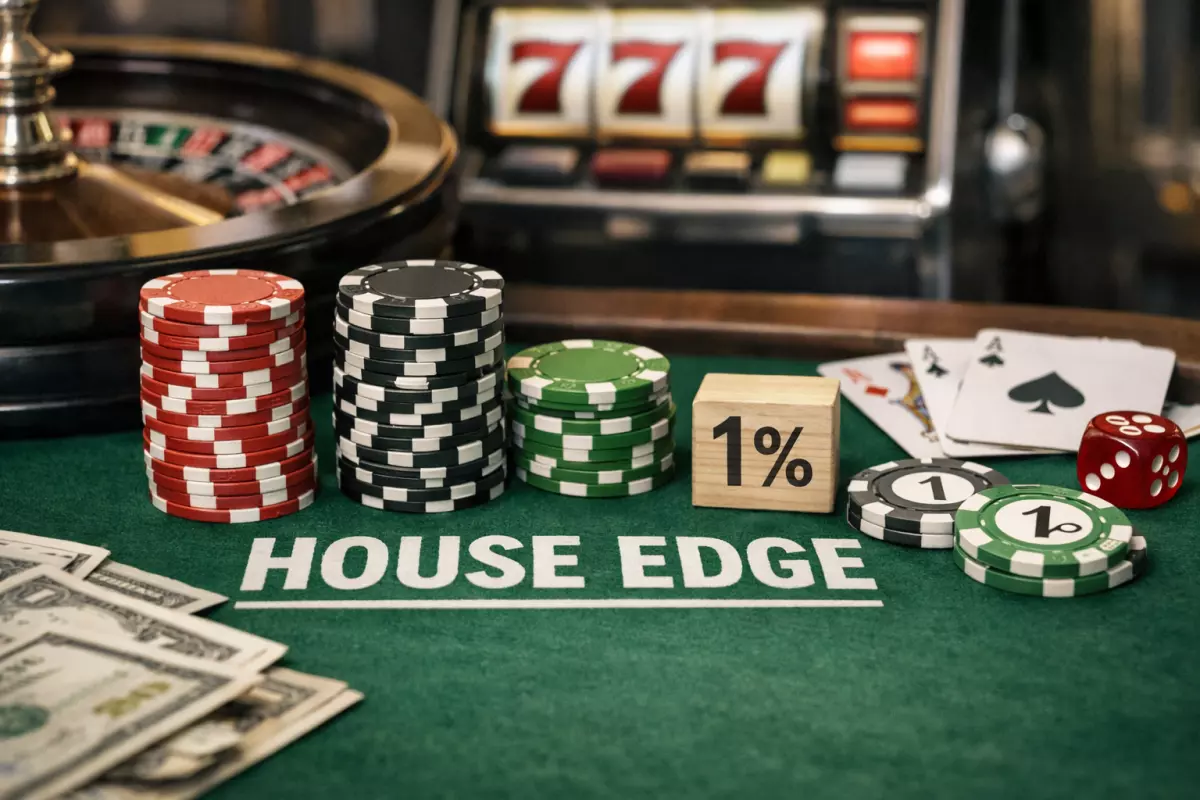
The house edge is the built-in statistical advantage a casino has over players. It describes how much of each wager the game is expected to keep over the long run, assuming the rules are followed and the game is played repeatedly. This is not a guarantee about any single hand or spin; it’s a way to express the game’s average cost to the player over time.
Think of it as the “price” of playing for entertainment. A game with a 1% edge means that, on average, the casino retains about 1 unit for every 100 units wagered across many bets. You can still win in the short term, but the math is tilted slightly toward the house.
House edge vs. your actual results
In the short run, outcomes swing around due to variance. You might hit a big win early or lose several bets in a row, even in a low-edge game. Over a large number of wagers, results tend to drift toward the expected value implied by the edge, which is why casinos can offer games that occasionally pay out large wins and still remain profitable overall.
This is also why two players can have very different sessions on the same game: the house advantage is a long-term average, while a single session is a small sample with lots of randomness.
How the edge is calculated (and what it includes)
The advantage comes from the rules and payout structure. If payouts were perfectly “fair” relative to the true odds, the edge would be 0%. Casinos create a margin by paying slightly less than the true probability would justify, or by using rules that subtly improve the dealer’s position.
In most games, the edge already accounts for all standard outcomes, including pushes, ties, and bonus payouts where applicable. What it usually does not include are optional side bets, progressive jackpots, or player decisions that deviate from optimal strategy, which can change your effective cost per bet.
House edge vs. RTP (return to player)
You’ll often see RTP listed, especially for slots and some digital games. RTP is the expected percentage returned to players over time, while the house edge is the complement.
- House edge = 100% − RTP
- Example: an RTP of 96% corresponds to a 4% casino advantage
Both describe the same idea from different perspectives: one focuses on what the casino keeps, the other on what players get back on average.
Why it matters when choosing games
The edge helps you compare games on a common scale. A lower percentage generally means your bankroll tends to last longer for the same betting pattern, because the expected loss per unit wagered is smaller. A higher percentage means the game is more expensive to play in the long run, even if it can still produce big wins in the short run.
It’s also useful to separate two factors that get mixed together: expected cost (house edge) and volatility (how swingy results are). Two games can have similar expected loss but feel completely different because one pays frequent small wins while the other pays rare large ones.
How house edge is calculated
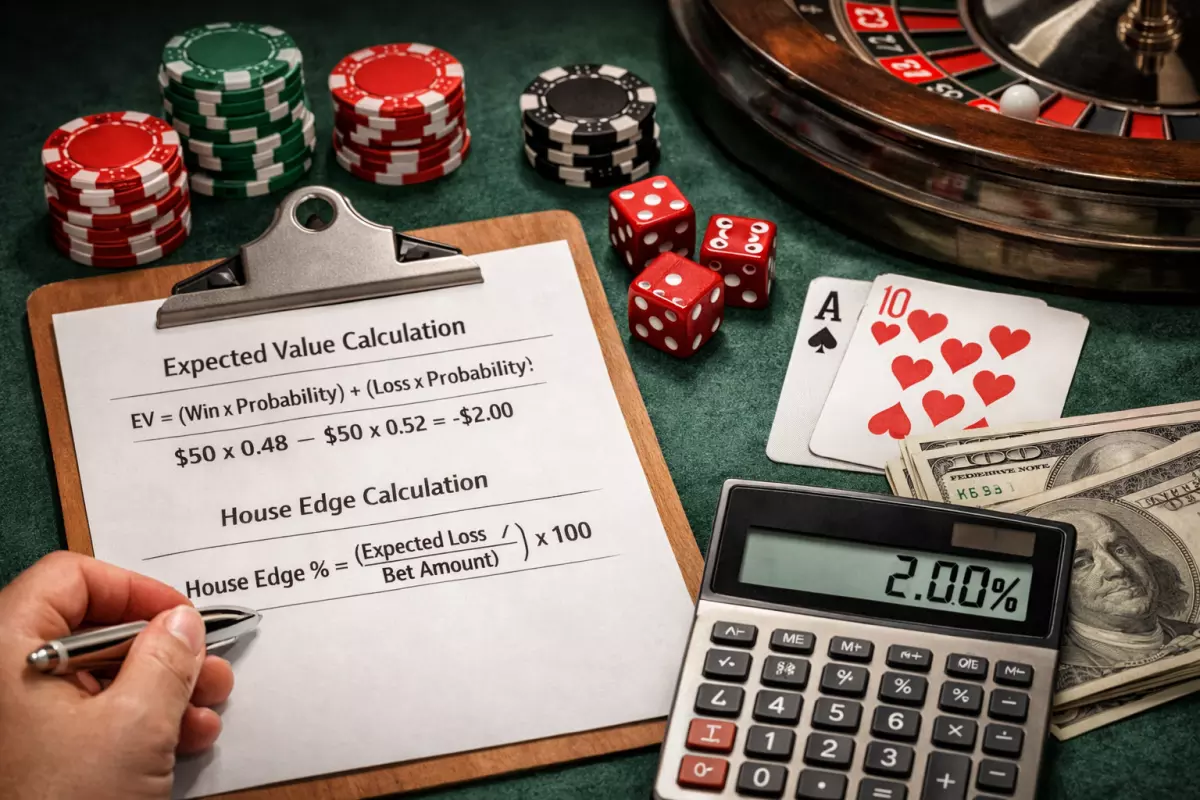
The casino’s advantage is derived from the gap between what a bet pays and what probability says it should pay. In other words, you compare the expected value of a wager to the amount staked, and the shortfall (on average) is the operator’s long-run edge.
Expected value: the core idea
Every bet has a set of possible outcomes, each with a probability and a payout. The expected value (EV) is the probability-weighted average result. A convenient way to express the house advantage is:
House edge (%) = (Player loss per bet / Bet size) × 100
Where “player loss per bet” is the negative of EV measured in money. If a $1 wager has an EV of -$0.05 for the player, the house edge is 5%.
Step-by-step calculation on a simple bet
For a single, fixed wager, the process is straightforward:
List all possible outcomes of the bet.
Assign each outcome its probability (based on the game’s rules and any known information).
Convert payouts into net results (profit/loss relative to the stake).
Multiply each net result by its probability and add them up to get EV.
Turn EV into a percentage of the stake to express the edge.
Example: a coin-flip bet that pays even money (win +$1, lose -$1) would have EV = 0.5×(+1) + 0.5×(-1) = 0, so the house edge is 0%. If the same fair coin paid +$0.95 on a win and -$1 on a loss, EV = 0.5×0.95 + 0.5×(-1) = -0.025, meaning a 2.5% advantage to the house.
Why “true odds” matter
A useful shortcut is to compare the game’s offered payout to the “fair” payout implied by probability. If an event happens with probability p, the fair net profit on a $1 stake (ignoring pushes) would be roughly (1/p) - 1. When the casino pays less than that, the difference shows up as a negative expectation for the player.
Handling pushes, multiple payouts, and complex rules
Many casino bets include outcomes that return the stake (pushes), partial losses, or tiered payouts. The method doesn’t change: you still compute EV using all outcomes, but you must include those “neutral” or partial results correctly.
Push/return of stake: net result is $0 for that outcome, not a win.
Blackjack-style 3:2 payouts: a win might be +$1, while a natural might be +$1.5; each gets its own probability term.
Rule variations: small changes (like whether you can re-roll, draw, double, or surrender) alter probabilities and therefore the expectation.
House edge vs. RTP: two sides of the same number
Casinos often describe the same concept as return to player (RTP). If a bet has an RTP of 96%, the corresponding house edge is 4%. Both are long-run averages, not a prediction of what happens in a short session.
What the percentage does (and doesn’t) tell you
The edge is a measure of average cost per unit wagered, not how “swingy” a game feels. Two games can share the same house advantage while having very different volatility, because variance depends on payout distribution and bet structure. That’s why a low edge doesn’t guarantee small short-term losses, and a higher edge doesn’t prevent short-term wins.
House edge vs RTP explained
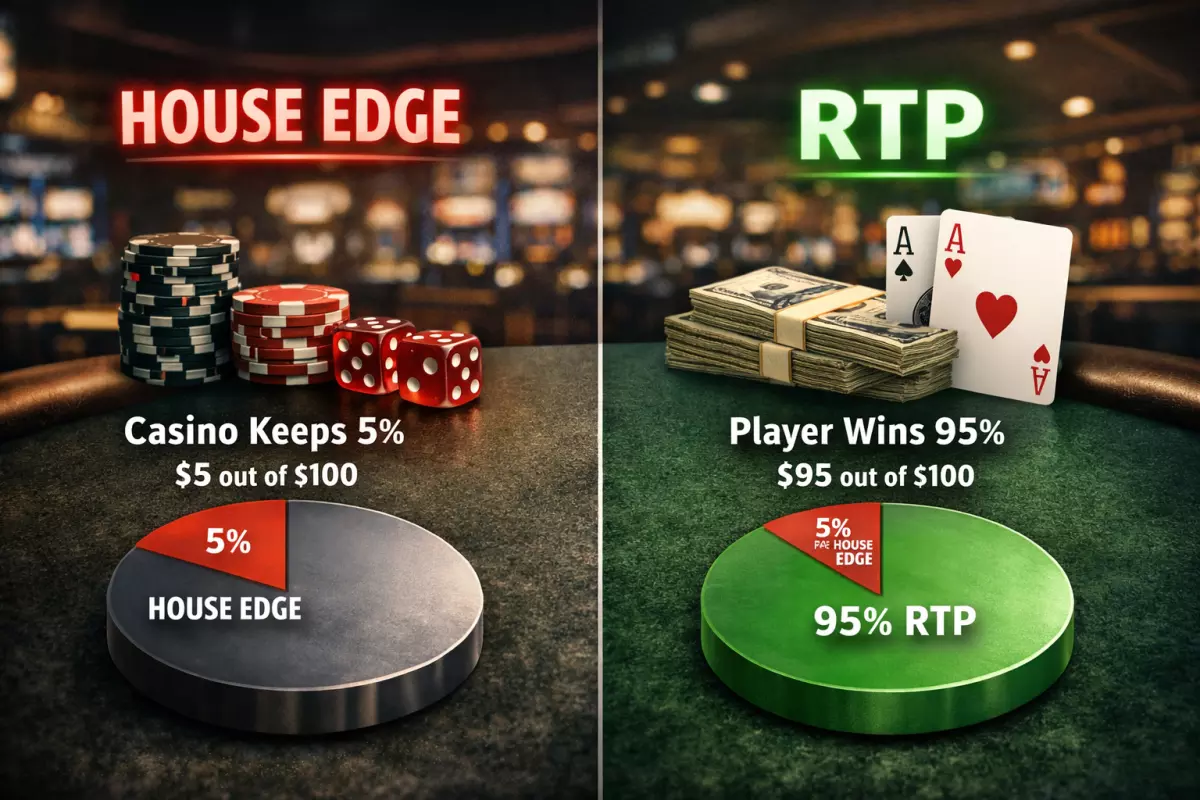
These two terms describe the same math from opposite angles: one is the casino’s long-run advantage, and the other is the player’s long-run payback. Understanding how they connect helps you compare games without getting lost in jargon.
What house edge means
House edge is the average percentage of each bet the casino expects to keep over a very large number of wagers. If a game has a 2% house advantage, the model says the casino retains about $2 for every $100 staked in the long run. It does not mean you lose 2% every session; short-term results can swing widely.
What RTP means
RTP (Return to Player) is the flip side: the average percentage of stakes the game is designed to pay back over time. An RTP of 98% implies that, across many bets, about $98 is returned to players for every $100 wagered, with the remaining $2 representing the operator’s expected margin.
The simple conversion (and when it’s not so simple)
In many casino games, the relationship is straightforward:
RTP (%) = 100% − House edge (%)
This works cleanly when the “return” is calculated on the same basis as the “edge” (typically per unit wagered). Where people get confused is when games have extra features that change what “return” includes, such as side bets, optional bonuses, or different rule sets. In those cases, the base game can have one expected return while the add-ons have another, and your overall result depends on what you actually bet on.
Why both numbers can be true but still feel different
Even with a clearly stated RTP, your experience depends on variance. A high-RTP game can still produce long losing stretches, and a lower-RTP game can still deliver a big win in a short session. The edge and return describe expected value, not a guarantee of what happens today.
- Time horizon matters: the more bets you place, the more results tend to drift toward the expected percentage.
- Bet size matters: doubling your stake roughly doubles the expected cost of the edge per bet.
- Game choices matter: side bets and “bonus” options often carry a larger built-in advantage than the main wager.
Quick examples you can calculate in your head
If a table game lists a 1.5% house edge, the implied RTP is 98.5%. If a slot advertises 96% RTP, the implied house advantage is 4%. These conversions are useful for comparing games, but remember that different casinos (and even different versions of the same title) can offer different settings, so the number you see is tied to that specific ruleset or configuration.
| Concept | What it tells you | How it’s usually presented | Common misunderstanding |
|---|---|---|---|
| House edge | Casino’s expected share of total stakes over the long run | As a percentage (e.g., 0.5%, 2%, 5%) | Assuming you “must” lose that exact amount in a single session |
| RTP | Expected portion of stakes returned to players over time | As a percentage (e.g., 96%, 98.5%) | Assuming RTP is a promise of short-term outcomes |
| Variance (volatility) | How swingy results are around the expected return | Often labeled low/medium/high (especially on slots) | Confusing “high variance” with “better” or “worse” value |
| Rules/side bets | How options change the overall expected value of what you wager | Separate edges/returns for main bet vs extras | Comparing a base-game RTP to a strategy that heavily uses add-ons |
When you’re comparing casino games, treat RTP as the player-facing way to express expected return and house edge as the operator-facing way to express expected profit. Convert between them when they’re measured on the same basis, and always account for the specific rules and bets you plan to use.
Typical house edge in casino games

House advantage varies a lot by game type, the exact rules in use, and how you play. Some options have a built-in edge that stays fairly stable (like many slot machines), while others swing dramatically depending on decisions (like blackjack or video poker). Treat the numbers below as realistic ranges, not guarantees for every table or machine.
Two casinos can offer the “same” game with meaningfully different expected loss because of rule tweaks: extra zeroes on roulette wheels, different blackjack payout rules, or a higher commission on baccarat. Even small changes can shift the expected value over thousands of bets.
Common ranges by game (rules and strategy matter)
| Game | Typical house edge (approx.) | What most affects it |
|---|---|---|
| Blackjack | About 0.5% to 2%+ | Basic strategy use, payout (3:2 vs 6:5), dealer stands/hits on soft 17, number of decks |
| Roulette | European: ~2.7%; American: ~5.26% | Single vs double zero wheel; special rules like “la partage” can lower some bets |
| Baccarat (banker/player) | Banker: ~1.06%; Player: ~1.24% | Commission rate on banker wins; avoid high-edge side bets |
| Craps | Best bets ~1.4%; many bets 5% to 15%+ | Bet selection (pass/come with odds vs proposition bets); odds bets reduce overall edge on the combined wager |
| Video poker | Roughly 0.5% to 5%+ (some paytables can be lower) | Paytable quality and correct hold/discard decisions |
| Slots | Often ~4% to 12% (can be outside this range) | Machine return setting (RTP), volatility, and bonus feature design |
| Sports betting (typical pricing) | Often ~4% to 10%+ | Bookmaker margin (vig), line shopping, and market type |
Why “typical” can still be misleading
Published or commonly quoted edges assume a specific ruleset and, for skill-based games, a specific level of play. For example, blackjack with 3:2 payouts and solid basic strategy can be near the low end of the range, while 6:5 tables and frequent mistakes push the casino advantage much higher.
In games with many bet types, the spread is the real story. Craps is the classic case: the same table can offer bets near 1% and others well into double digits. The casino’s overall take depends on what players choose, not just what game they’re standing at.
Quick ways to estimate your expected cost
A simple rule of thumb is: expected loss per hour ≈ average bet × bets per hour × house edge. It won’t predict short-term results, but it’s useful for budgeting and comparing options. If you bet $10 per hand, play 60 hands per hour, and the edge is 1%, the long-run expected loss is about $6 per hour.
If you want the lowest expected loss, focus on (1) games where correct decisions matter and you’re willing to learn them, and (2) tables with player-friendly rules. If you prefer games with no decisions, compare return-to-player information where available and remember that higher volatility changes the ride, not the underlying math.
Games with the lowest house edge
The smallest casino advantage usually shows up in games where your decisions (or strict rules) limit the casino’s long-term profit. In practice, the “best” options are the ones with stable rules, transparent payouts, and fewer side bets that quietly raise the expected loss.
It’s also worth separating theoretical numbers from what you’ll actually face. Published figures assume correct play, standard rules, and no unusual pay tables. Change the rules even slightly and the edge can move a lot.
Quick comparison of low-edge options
| Game / bet type | Typical house edge (approx.) | What keeps it low | Common ways it gets worse |
|---|---|---|---|
| Blackjack (basic strategy, favorable rules) | ~0.3%–0.8% | Player choices can reduce mistakes; strong rules (e.g., dealer stands on soft 17, good doubling options) | 6:5 blackjack payouts, restricted doubling/splitting, dealer hits soft 17, poor strategy |
| Baccarat (Banker bet) | ~1.0%–1.1% | Fixed drawing rules; commission balances the Banker advantage | Avoiding commission variants with worse pay, switching to Tie bets |
| Craps (Pass Line with odds) | Pass Line ~1.4% (odds bet: 0%) | Adding odds doesn’t increase the casino advantage; it dilutes it | High-edge proposition bets (hardways, any 7, etc.) |
| Roulette (European single-zero) | ~2.7% | Single zero reduces the built-in advantage versus double-zero | Playing American double-zero (~5.26%) or adding side bets |
| Video poker (full-pay variants with correct play) | Often ~0.5%–2% (varies widely) | Pay table + optimal decisions can keep expected loss low | Short-pay machines, suboptimal holds/discards |
Blackjack: low edge only if you play it “by the book”
Blackjack can be one of the best games on the floor, but only when you use basic strategy and the table rules aren’t quietly stacked against you. The house advantage comes mainly from player errors and rule tweaks, so small differences (like payout for a natural blackjack) matter a lot.
To keep the expected loss down, prioritize tables that pay 3:2 on blackjack and allow flexible doubling and splitting. If you’re guessing decisions, the casino edge can jump from under 1% to several percent surprisingly fast.
Baccarat: the Banker bet is the workhorse
Baccarat is low-variance in terms of decision-making because there aren’t many choices to make. The key is bet selection: the Banker wager typically carries the smallest house edge, while Player is slightly worse and Tie is usually much worse.
If you see no-commission variants, read the payout rules carefully. Many of them “make up” the missing commission by reducing payouts in specific situations, which can raise the casino advantage.
Craps: combine a solid base bet with odds
Craps looks complicated, but the low-edge approach is simple: stick to Pass Line (or Don’t Pass) and add odds behind it. The odds portion pays at true odds, meaning it has 0% house edge; it doesn’t give the casino extra profit, it just increases variance.
What usually inflates the casino advantage in craps is drifting into proposition bets. They can be fun, but many carry a much higher built-in edge than the main line bets.
Roulette: single-zero is the meaningful difference
Roulette’s house edge is fixed by the wheel layout, so strategy systems don’t change the math. If you want a lower casino advantage, the practical move is choosing European (single-zero) over American (double-zero).
Even-money bets and straight-up numbers share the same underlying edge on a given wheel; they just change volatility. The only reliable way to reduce the built-in disadvantage is selecting the better wheel and avoiding extra side wagers.
Video poker: pay tables decide everything
Video poker is one of the few casino games where the pay table can dramatically change the expected return. Two machines that look similar can have very different house edges depending on how they pay for hands like full houses and flushes.
Correct play matters too: the “right” hold is often not intuitive. If you’re not following optimal decisions for that specific variant, the casino advantage rises quickly even on a decent pay schedule.
Bottom line: the lowest house edge usually comes from either (1) games where correct decisions reduce the casino advantage (blackjack, video poker) or (2) bets with fixed rules and historically small margins (Banker in baccarat, line bets with odds in craps). The moment you add side bets, ignore pay tables, or play without a plan, the edge tends to climb.
How house edge affects long term results
The casino advantage shows up most clearly over many bets. In the short run, luck can dominate and you can see big swings either way. Over time, though, the math behind the game pulls results toward the expected value, meaning the average outcome trends negative for the player.
Think of house edge as the expected cost per unit wagered. If a game has a 2% edge and you stake $10 per round, the long-run expectation is to give up about $0.20 per round on average. That does not mean you lose $0.20 every round; it means that across a large number of rounds, your average result tends to settle near that figure.
Expected value: what the percentage really means
House edge is typically quoted as a percentage of the initial bet. A 1% edge means that for every $100 wagered (in total action), the expected loss is $1. The key detail is “total action”: if you make 200 bets of $5, you have wagered $1,000 in total, even if you never had $1,000 in your account at once.
A simple way to estimate long-run cost is:
Expected loss = (house edge) × (average bet) × (number of bets)
Volume matters: more bets usually means more predictable outcomes
The more rounds you play, the more your results tend to resemble the game’s underlying expectation. This is why fast games (many decisions per hour) can feel “expensive” even with a modest edge: you are putting more money into action in the same amount of time.
- Bet size increases the expected loss linearly: doubling the stake doubles the long-run cost.
- Speed of play increases the number of trials: more rounds per hour generally increases the expected loss per hour.
- Time spent compounds both effects: longer sessions usually mean more total wagering.
Variance: why you can win (or lose) despite the edge
Short-term outcomes are driven by variance: the natural randomness in results. High-variance games can produce long winning streaks or sharp downturns, even when the casino advantage is constant. That’s why two players can have completely different experiences over a single night while facing the same odds.
Over longer play, variance still exists, but its influence shrinks relative to the growing number of bets. Practically, this means big deviations from expectation become less common as the sample size grows, even though they never become impossible.
Comparing long-run cost across different edges
The table below shows how the expected loss changes with different house edges when the total amount wagered is the same. It highlights a useful takeaway: the edge percentage matters most when your total wagering is large.
| Total amount wagered | House edge | Expected loss (long run) |
|---|---|---|
| $1,000 | 0.5% | $5 |
| $1,000 | 2% | $20 |
| $1,000 | 5% | $50 |
| $1,000 | 10% | $100 |
This doesn’t predict what will happen in a single session; it describes the average destination if you repeat the same wagering pattern many times. If you want to reduce the long-term drain, the most direct levers are choosing lower-edge games, limiting total action (fewer rounds or smaller bets), and avoiding side bets or rule variations that increase the built-in advantage.
Why casinos always have an advantage
Casinos don’t rely on luck to stay profitable; they rely on math. Every game is built so that, over many bets, the expected results tilt slightly toward the house. Individual players can win in the short run, but the underlying probabilities make consistent long-term profit unlikely without some outside edge.
This built-in tilt is the house edge: the average percentage of each wager the casino expects to keep over time. It isn’t a guarantee that you lose on every bet; it’s a statement about what happens after thousands of outcomes, when randomness smooths out and the game’s design shows through.
Expected value: the engine behind casino profit
The core idea is expected value (EV). If a $1 bet has an EV of -$0.05 for the player, that means the player is expected to lose 5 cents per bet on average in the long run. Multiply that by huge volumes of play across many customers, and a small disadvantage becomes steady revenue.
Variance can be dramatic—especially in high-volatility games—so a player might walk away ahead today. But the casino can endure swings because it has two advantages: massive sample size (lots of bets) and time (the game keeps running).
Payouts are set just below “fair” odds
Many games look like they offer even chances, but the payouts are slightly reduced compared to what would be fair if the game were perfectly balanced. That gap between fair payout and actual payout is where the house edge lives.
A simple example is a coin-flip-style wager. If it were truly fair, a 50/50 bet would pay 1:1 with no extra cost. In casino games, even when the win probability is close to 50%, the payoff is often shaved or a rule is added so the casino keeps a small statistical advantage.
Rules and constraints quietly shift the odds
Casinos don’t need to “cheat” to win; they use rules that subtly favor the house. In blackjack, for instance, the dealer acts last and may win ties under certain conditions depending on the variant. In roulette, the presence of green zero pockets breaks what otherwise looks like an even split between red and black.
Games also limit player control. Even in skill-influenced games, there are boundaries—fixed pay tables, mandatory rules, and capped decision points—that prevent optimal play from turning into a player advantage in normal conditions.
Why the edge matters more as you play longer
The longer you play, the more your results tend to drift toward the expected outcome. This is why “playing through” a losing streak is risky: more bets usually mean more exposure to the built-in disadvantage, not a higher chance of “getting even.”
Bet sizing affects how wild the ride feels, not the direction of the math. Larger bets can produce bigger short-term wins or losses, but the expected loss rate (as a percentage) remains tied to the game’s structure and your decisions.
Common design features that create a house advantage
- Non-fair payouts: wins pay slightly less than true odds would suggest.
- Extra losing outcomes: added results like zeros in roulette that don’t benefit the player’s “even money” bets.
- Forced rules: dealer/player action constraints that systematically favor the house.
- Commission or fees: a small cut taken from winnings or certain bet types.
- Complexity and mistakes: games where suboptimal decisions are common effectively increase the casino’s advantage.
Put together, these elements ensure that while wins are real and sometimes substantial, the casino’s advantage is structural. The house edge is simply the price of playing a game designed to be entertaining first and profitable for the operator over the long haul.
Common myths about house edge
Players often misunderstand what the casino’s built-in advantage really means in practice. The result is a set of persistent myths that can distort expectations about risk, bankroll swings, and what “good” or “bad” luck looks like over time.
Myth 1: A lower percentage means you can’t lose
A smaller house advantage only means the game takes less on average per unit wagered, not that losses are unlikely in a single session. Even with a favorable-looking edge, short-term results can be brutal because variance (how swingy outcomes are) can dominate what you experience in the moment.
Two games can have similar expected loss rates but feel totally different: one may produce frequent small wins and rare big drops, while another may be quiet for long stretches and then pay in bursts. The edge doesn’t describe that “feel”; it describes the long-run average cost.
Myth 2: The edge guarantees what you’ll lose tonight
It’s tempting to treat the percentage like a receipt: “I bet $1,000, so I’ll lose $50.” That’s not how expectation works. The average loss is a long-run statistic across many bets; any single session can finish far above or below that number.
A clearer way to think about it is: if you repeated the same betting situation a huge number of times, your average result would drift toward that expected loss. Your actual result in one run is a sample, and samples bounce around.
Myth 3: If you’re due, the edge gets weaker
Being “due” is a classic gambler’s fallacy. In most casino games, each round is independent, so previous outcomes don’t make a win more likely on the next spin, hand, or roll. The casino advantage doesn’t “reset” or “run out” because it isn’t a meter; it’s embedded in the payoff rules.
What can change is your perception: after a streak of losses, a normal win can feel overdue, even though the probability was the same all along.
Myth 4: Betting systems can overcome the math
Progressions like Martingale, Fibonacci, or “press on wins” can change the pattern of wins and losses, but they don’t change the underlying expectation when the rules stay the same. If the payouts are slightly unfavorable, scaling your bets up and down doesn’t turn a negative expected value into a positive one.
In real play, betting systems often add practical problems: table limits can stop a progression, and bankroll constraints can force you to quit at the worst time. In other words, the strategy can increase the chance of a dramatic loss even if it produces many small wins along the way.
Myth 5: A “hot” machine or dealer means the edge is gone
Streaks happen naturally in random sequences. A slot paying several bonuses in a short window doesn’t imply it will keep paying, and a “cold” run doesn’t imply a payout is imminent. The built-in advantage remains because the game’s return structure hasn’t changed.
Some games do have conditions that affect outcomes (for example, certain rule variations in table games), but that’s about rules and information, not vibes. If nothing about the rules or your decision quality changed, the expected value didn’t either.
Myth 6: The edge is the same as volatility
House edge measures average cost; volatility measures how bumpy the ride is. A game can have a relatively modest casino advantage but still produce long losing stretches, and another can have a higher advantage but smoother short-term results.
- Edge: how much the game tends to keep over the long run.
- Variance/volatility: how widely results can swing around that average.
- Session risk: how likely you are to hit a big drawdown before you stop.
Myth 7: The casino advantage is fixed no matter how you play
In some games, your decisions can meaningfully change the expected loss. For example, in blackjack, playing basic strategy reduces the casino’s advantage compared to common mistakes like standing too often or taking insurance in poor spots. In other games—like many slot machines—your choices don’t affect the math much beyond selecting a different game or denomination.
The key distinction is whether the game includes player decisions that alter probabilities and payouts. If it does, skillful play can reduce the average cost (though it typically doesn’t flip it positive under normal casino conditions).
Myth 8: Promotions always beat the edge
Bonuses, comps, and cashback can reduce your effective cost, but they don’t automatically create a positive expectation. The details matter: wagering requirements, excluded games, maximum bet rules, and the time it takes to clear an offer can all change the real value.
A practical way to stay grounded is to separate the game’s built-in advantage from the promotion’s value, then consider them together. Sometimes the offer meaningfully offsets expected losses; other times it mostly changes how long you can play before the math catches up.