Three Card Poker: Rules and How to Play

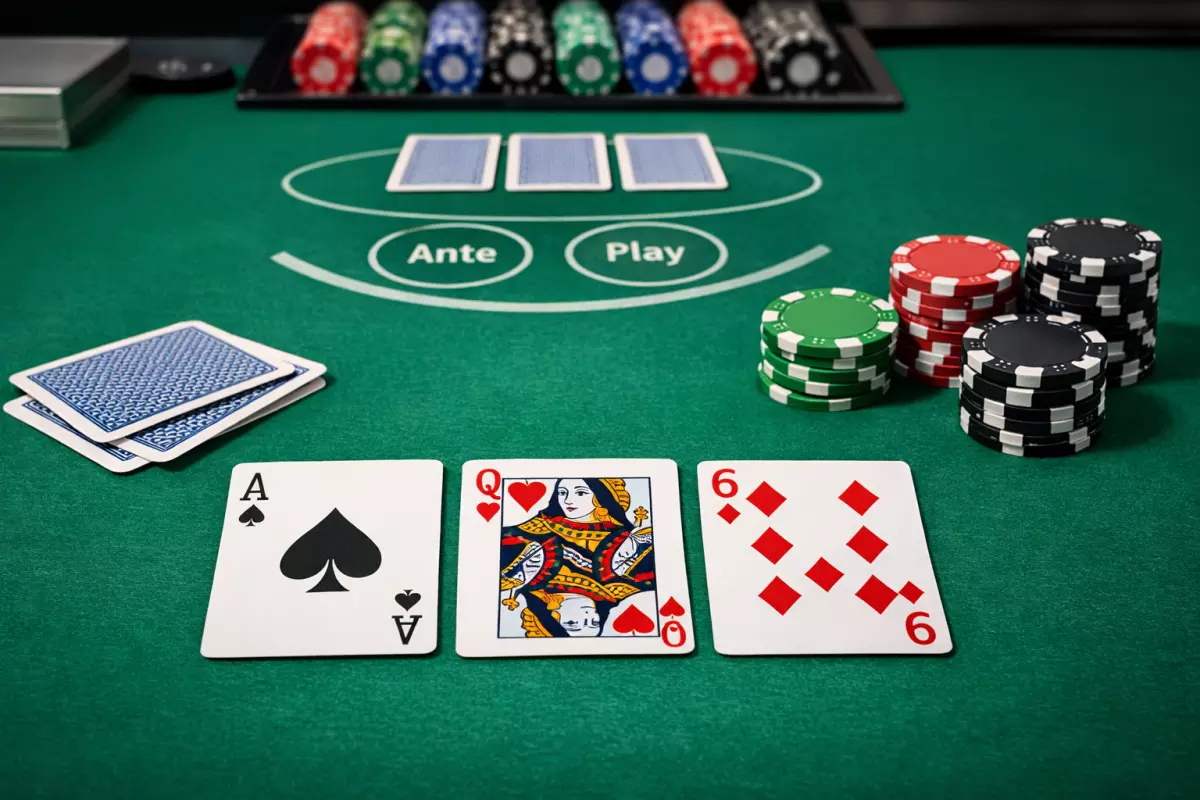 This article explains what Three Card Poker is, the basic rules, and how to play step by step from ante to showdown. It breaks down betting options including Pair Plus, covers payouts and odds, shares strategy tips, and flags common beginner mistakes.
Three-card poker is a quick table game with easy choices, making it one of the simplest casino games to learn. This guide explains the basic rules, how the ante and play bets work, and when to fold or raise based on your hand. It also covers how the dealer qualifies, how payouts are determined, and how optional side bets can increase both risk and potential rewards.
What is Three Card Poker
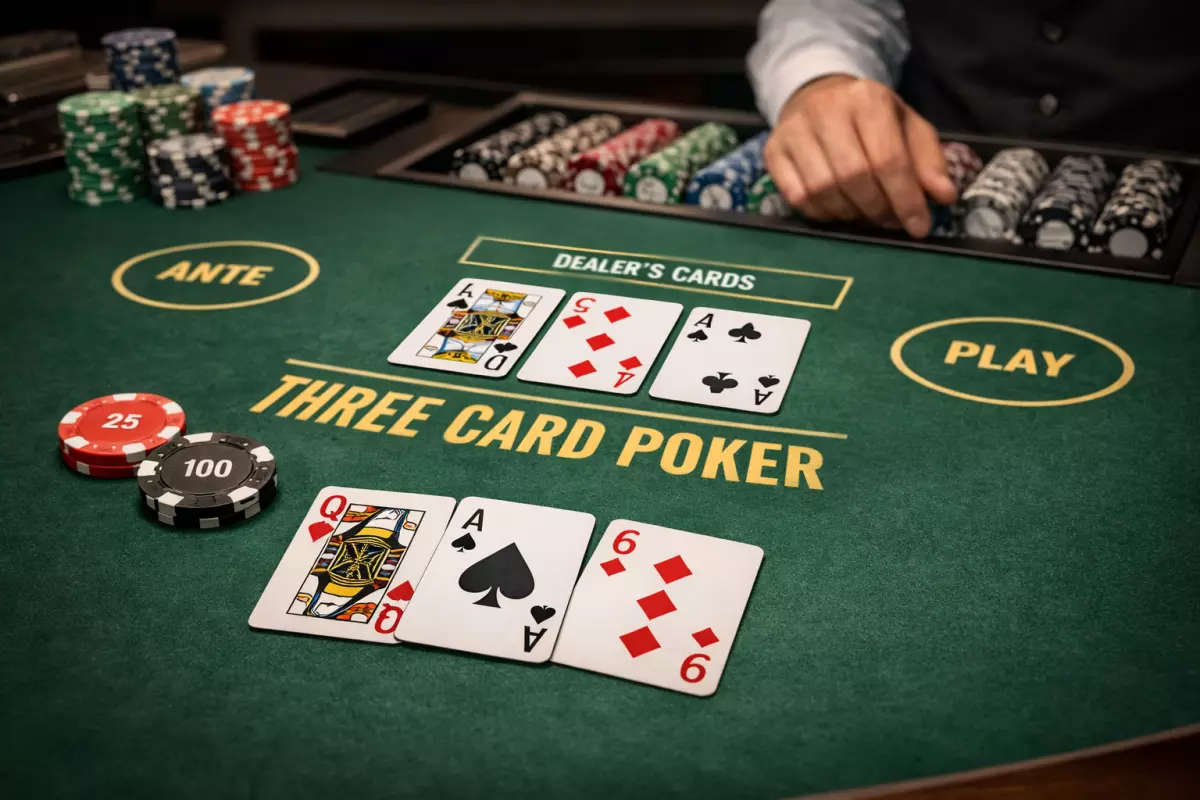
This casino table game is a fast, simplified poker variant where you build a three-card hand and decide whether to continue against the dealer. It mixes familiar poker hand rankings with a straightforward decision: play or fold. Because each hand uses only three cards, rounds move quickly and the strategy is easier to learn than many five-card poker formats.
Unlike player-versus-player poker, you are not competing against other people at the table. Your main goal is to make a hand strong enough to beat the dealer’s hand, with a separate rule that the dealer must “qualify” (meet a minimum hand strength) for some parts of the bet to be settled.
How the game works at a glance
Each round starts with you placing an initial wager, receiving three cards, and then choosing whether to continue. If you continue, you place an additional bet and compare hands with the dealer after the dealer’s cards are revealed. The dealer’s hand must typically be at least queen-high to qualify; if it doesn’t, the outcome is handled differently depending on the wager.
- You receive three cards and make a single decision based on their strength.
- The dealer also receives three cards; hands are compared using three-card rankings.
- Some bets depend on whether the dealer qualifies, which changes how payouts are applied.
How it differs from standard poker
The biggest difference is the hand size. With only three cards, probabilities shift: pairs and high-card hands show up often, and there’s no need to think about long betting rounds or reading opponents. You’re essentially playing a fixed-structure comparison game with one key choice point.
Another twist is that many tables offer optional side bets that pay based on the strength of your three-card hand, regardless of what the dealer holds. These extras can add variety, but they also change the risk profile because they’re separate from the main dealer-comparison wager.
Basic objective and outcomes
Your core objective is simple: either fold and lose the initial bet, or play and try to beat the dealer’s hand. If you play and your hand is higher, you win; if it’s lower, you lose; and if it ties, it’s typically a push. When the dealer doesn’t qualify, the “play” portion is usually returned while the initial wager may still be paid according to the table rules.
Overall, Three Card Poker is popular because it feels like poker but behaves more like a quick table game: minimal decisions, clear comparisons, and consistent pacing from hand to hand.
Basic rules of Three Card Poker
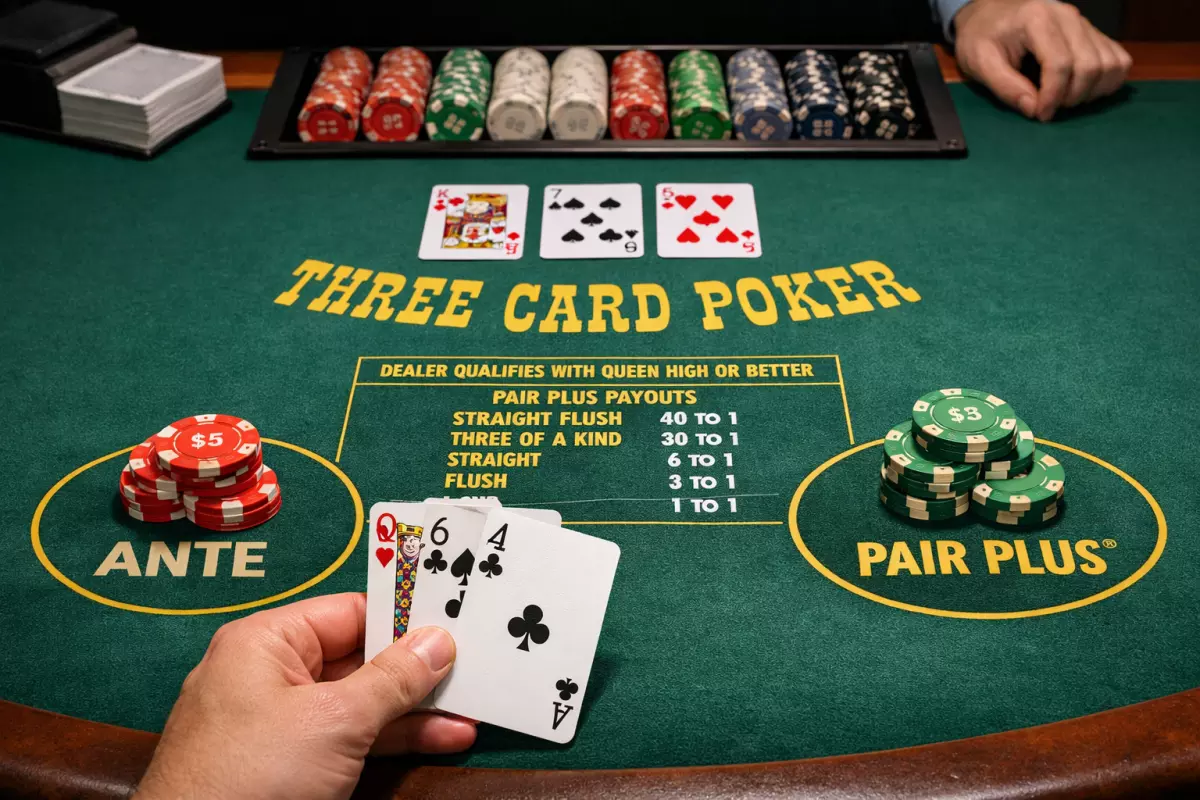
Three Card Poker is a casino table game where you play your own three-card hand against the dealer’s three-card hand. Each round moves quickly: you place a bet, receive three cards, decide whether to continue, and then compare hands if the dealer qualifies.
Table setup and the two main bets
Most tables offer two different wagers with different goals. The Ante/Play bet is the main “against the dealer” game, while Pair Plus (if offered) pays based only on your hand strength and does not depend on the dealer’s cards.
- Ante: required to start the hand in the main game.
- Play: placed only if you choose to continue after seeing your cards; it is typically equal to your Ante.
- Pair Plus: optional side bet that wins or loses based on whether your three cards make at least a pair (payouts vary by casino).
How a round works
Gameplay follows a fixed sequence, with only one real decision: fold or play. You always see your cards before deciding.
- Place bets: Put out an Ante (and optionally Pair Plus).
- Receive cards: You and the dealer each get three cards; your hand is face up to you, the dealer’s stays face down.
- Decide: Either Fold (give up the Ante) or place a Play bet (usually matching the Ante).
- Dealer reveals: If you played, the dealer turns over their hand to determine qualification and the winner.
- Settle bets: Payouts are made based on dealer qualification and hand comparison; Pair Plus (if placed) is settled independently.
Dealer qualification (the key rule many players miss)
In the main Ante/Play game, the dealer must “qualify” with at least Queen-high (or better) for the Ante bet to be fully in action. If the dealer does not qualify, the usual outcome is:
- Your Ante is paid at even money (1:1).
- Your Play bet is returned as a push (no win, no loss).
If the dealer qualifies, both hands are compared and the Ante and Play bets are settled based on who has the higher-ranked three-card poker hand.
Hand rankings (three-card order)
Three-card hand rankings are similar to five-card poker, but with fewer categories. From highest to lowest, the standard order is:
- Straight flush (three consecutive cards of the same suit)
- Three of a kind
- Straight (three consecutive cards, mixed suits allowed)
- Flush (three cards of the same suit, not consecutive)
- Pair
- High card
When two hands share the same category, the higher cards decide the winner (for example, higher pair wins; for high card, compare highest card, then next, then next). Casinos typically treat Ace as high in most comparisons, and it can also be used as low in A-2-3 straights.
What happens on ties
If your hand and the dealer’s hand are exactly equal in rank and card values, it is a tie. In that case, the standard rule is that both the Ante and Play bets push (you get your money back). Pair Plus, if you made it, is still resolved only by your hand.
Common extra payouts you may see
Some tables add an Ante Bonus that pays when your hand is strong enough (often straight or better), regardless of whether you beat the dealer. The exact pay table and qualifying hand can differ, so it’s worth checking the layout before you sit down.
How to play Three Card Poker step by step
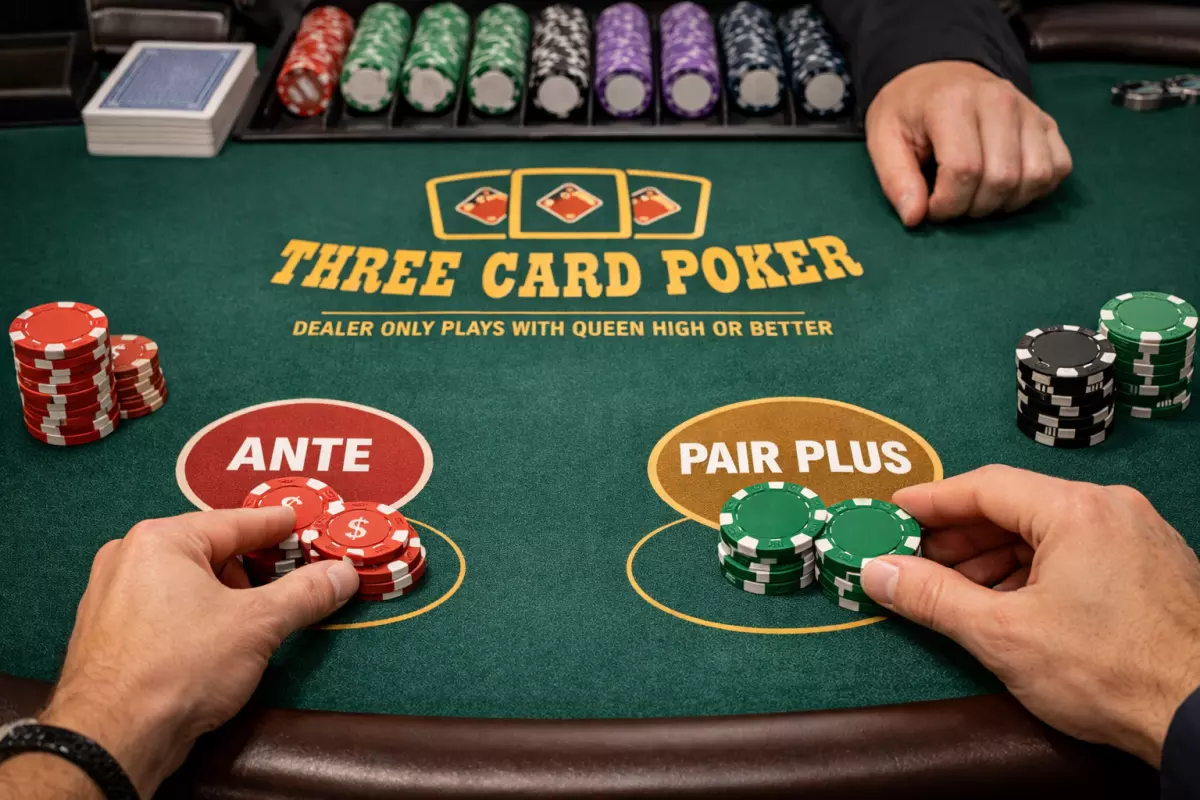
Three Card Poker is played against the dealer, not other players. Each round moves quickly: you place your bets, receive three cards, decide whether to continue, and then compare hands if you stay in.
1) Place your bets before any cards are dealt
Start by choosing your base wager. Most tables offer two main betting areas: Ante (the standard bet that lets you play your hand against the dealer) and Pair Plus (an optional side bet that pays based only on your three-card hand, regardless of the dealer’s cards).
If you want to play the dealer comparison, you must place an Ante. Pair Plus can be placed with or without an Ante, depending on house rules, but it is typically offered as an independent bet.
2) Receive three cards (dealer also gets three)
After betting closes, you receive three cards. The dealer also receives three cards, usually face down. At this point, you evaluate your hand strength using Three Card Poker rankings (which differ from five-card poker in a few key ways).
3) Decide: Fold or Play
Look at your three cards and choose one of two actions:
- Fold: You end the hand and forfeit your Ante (and any optional side bets already placed are resolved separately under their own rules).
- Play: You place an additional bet called the Play wager, which is typically equal to your Ante, to continue to the showdown.
A common beginner guideline is to continue with hands around Queen-high or better, but the exact “best” decision depends on the paytable and house rules. If you’re unsure, ask the dealer what the table’s usual strategy threshold is; they often can clarify general guidance (without advising you on a specific hand).
4) Dealer reveals cards and checks if they “qualify”
Once all players have acted, the dealer turns over their hand. In most versions, the dealer must qualify with at least Queen-high (or better) to fully compete against your hand.
If the dealer does not qualify, the outcome is usually:
- Your Ante is paid (often at 1:1).
- Your Play bet is returned as a push (no win/no loss).
5) Compare hands if the dealer qualifies
If the dealer qualifies, your hand is compared to the dealer’s hand using Three Card Poker hand rankings. If your hand is higher, you typically win both the Ante and Play wagers at even money. If the dealer’s hand is higher, you lose both bets. If the hands tie exactly, the Ante and Play usually push.
6) Resolve any bonus payouts (if offered)
Many tables include an Ante Bonus (or similar) that pays extra when your hand is strong enough, such as a straight or better. This bonus is based on your cards and is often paid whether or not the dealer qualifies, but the exact trigger and payout schedule depend on the table’s rules.
Pair Plus, if you placed it, is settled separately based only on your three-card hand (for example, pair, flush, straight, three of a kind). You can win the side bet even if you fold the Ante/Play portion, because it is not a head-to-head comparison.
Quick round recap
In one cycle: place Ante (optional Pair Plus), receive three cards, choose Fold or add the Play bet, dealer reveals and qualifies (or not), then hands are compared and any bonuses are paid according to the posted paytable.
Three Card Poker betting options explained
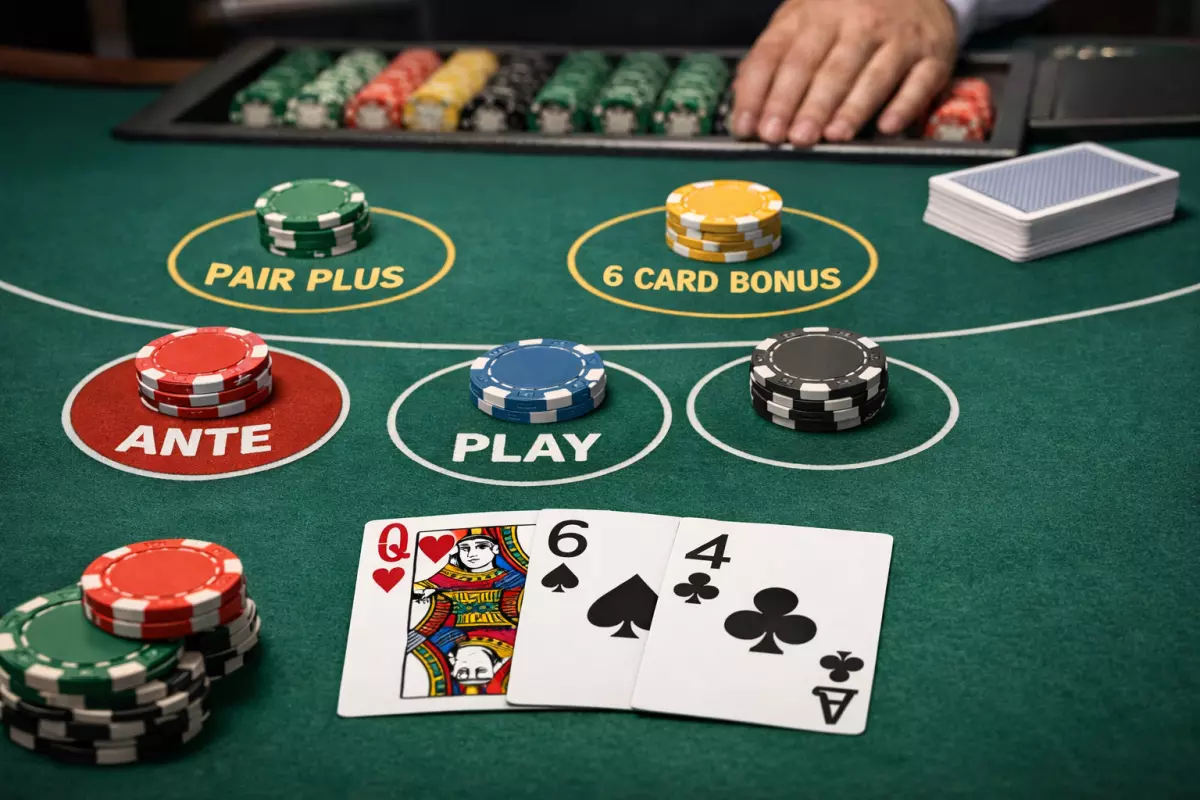
In this game you’re not just choosing cards to root for—you’re choosing which wagers to place and when to commit more money to the hand. The core decision is whether to continue after seeing your three cards, but the table layout can include a few optional bets that work very differently.
Ante and Play (the main hand)
The standard way to play is to post an Ante before any cards are dealt. After you look at your three-card hand, you decide to either Play (also called “Raise”) or Fold.
If you choose to Play, you place a Play bet that is typically equal to your Ante. Folding ends the hand for you and you lose the Ante (and any optional wagers you made, unless the rules say otherwise).
When you stay in, the dealer reveals their three cards and the main wager is settled under the table’s qualification rule, which is usually based on at least Queen-high.
What happens if the dealer does not qualify
If the dealer does not qualify, the standard non-qualifying outcome applies. At most tables, your Ante is paid at even money and your Play bet is returned as a push, but the exact rule should always be checked on the layout or paytable.
This matters because the extra Play wager is only worthwhile when your hand is strong enough to justify continuing under the table’s qualification and comparison rules.
Pair Plus (optional side bet)
Pair Plus is a separate wager based only on your three-card hand. It ignores the dealer’s cards and whether the dealer qualifies. You win if your hand is at least a pair, and the payout increases for stronger hands such as a flush, straight, three of a kind, and straight flush.
Because it’s independent, Pair Plus can win while your main Ante/Play loses (and vice versa). It’s best thought of as a bonus-style bet with higher variance: you’ll lose it often, but occasional hits can pay more than even money depending on the paytable.
Ante Bonus (automatic or optional, depending on the table)
Many tables offer an Ante Bonus that pays based on your hand strength (typically straight or better). On some layouts it’s built into the Ante rules; on others it may be presented as a separate feature. Importantly, this bonus usually pays even if you lose the main hand to the dealer, as long as your cards meet the bonus threshold.
Always check the posted paytable: what qualifies for a bonus and how much it pays can vary, and it changes how “swingy” the game feels.
6 Card Bonus and other add-on bets
Some casinos add a 6 Card Bonus (name varies) that combines your three cards with the dealer’s three cards to form the best five-card poker hand. This wager is resolved independently of the Ante/Play result and is purely paytable-driven.
Other proprietary side bets exist, but they share a common trait: they don’t affect whether you should Play or Fold on the main hand, because they settle on their own rules and payouts.
Quick comparison of common wagers
| Bet type | When you place it | What it depends on | Typical result style |
|---|---|---|---|
| Ante | Before the deal | Compared vs. dealer (with qualification rule) | Usually even-money win/lose; may receive Ante Bonus for strong hands |
| Play (Raise) | After seeing your cards | Compared vs. dealer (only if you don’t fold) | Usually even-money win/lose; may push if dealer doesn’t qualify |
| Pair Plus | Before the deal | Your 3-card hand only | Paytable payouts for pair or better; otherwise loses |
| 6 Card Bonus (or similar) | Before the deal | Best 5-card hand from both player + dealer cards | Paytable payouts for made hands; otherwise loses |
How these choices fit together at the table
A typical round looks like this: you place the Ante (and any side bets), receive three cards, then decide whether to add the Play bet or fold. Side bets resolve based on their own criteria, while the Ante/Play outcome is determined by dealer qualification and the head-to-head comparison.
If you’re learning, it helps to treat the main hand and each optional wager as separate decisions. The main hand is about whether your three cards are strong enough to justify putting out the additional Play bet; side bets are about whether you want extra volatility for a chance at paytable payouts.
Three Card Poker payouts and odds
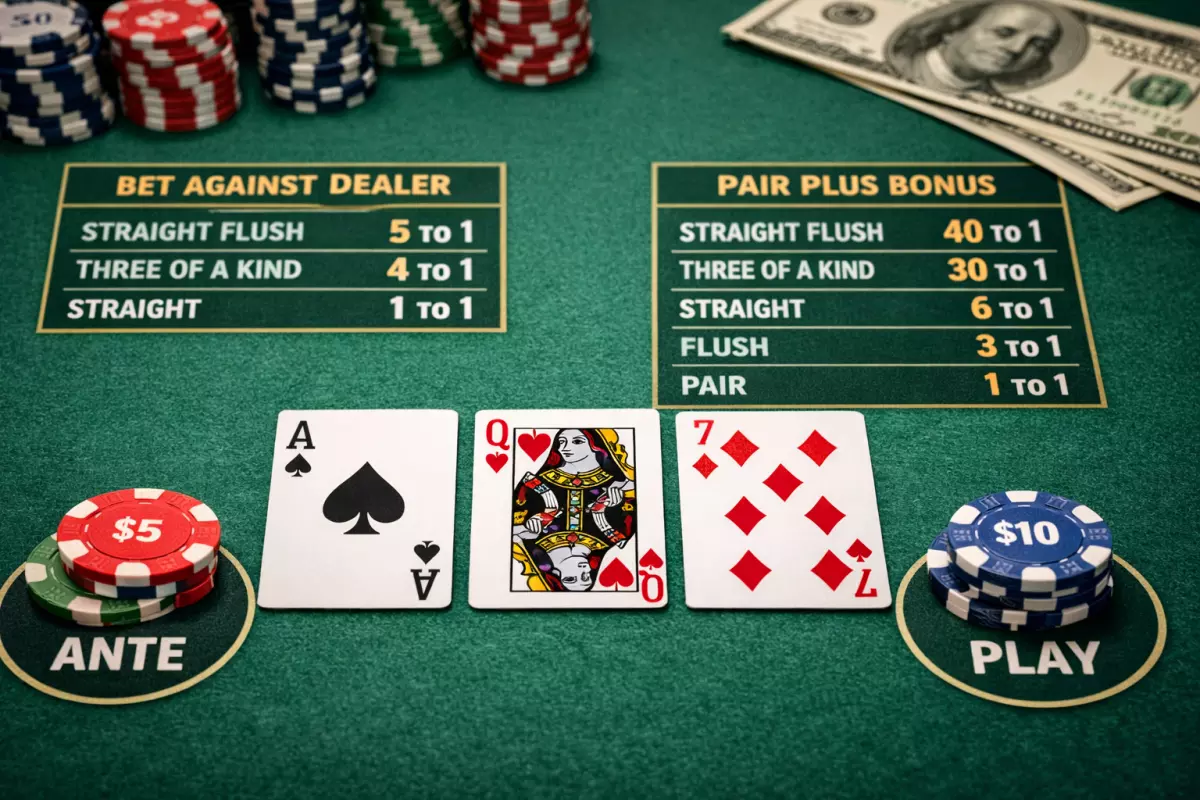
The money side of this game is split into two tracks: what you win (or lose) against the dealer on the Play bet, and what you can win from optional bonuses that pay based only on your hand. Because you see your three cards before deciding, your best long-term results come from understanding which bets have the lowest house edge and when folding is correct.
How the main bets pay
The core wager is the Ante. If you continue after seeing your cards, you also place a Play bet (usually equal to the Ante). The dealer must “qualify” with queen-high or better in most versions; if the dealer does not qualify, you typically win the Ante and the Play bet pushes.
When the dealer qualifies, your hand is compared to the dealer’s hand using standard three-card hand rankings. If you win, both Ante and Play are usually paid at 1:1 (even money). If you lose, you lose both bets. If you tie, both bets push.
Ante Bonus (common paytable)
Many tables add an Ante Bonus that pays when your hand is strong enough, regardless of whether the dealer qualifies. The exact schedule varies by casino, but a very common version looks like this:
| Hand (player) | Typical Ante Bonus payout |
|---|---|
| Straight | 1 to 1 |
| Three of a kind | 4 to 1 |
| Straight flush | 5 to 1 |
| Mini-royal (A-K-Q suited, if offered) | Typically higher; varies by house rules |
Some casinos start the bonus at three of a kind (skipping straights), while others add extra top-end awards. Always check the felt or placard because small changes here can noticeably affect the value of the Ante portion.
Pair Plus (optional side bet) payouts
Pair Plus is a separate bet that pays purely on your three-card hand and ignores the dealer entirely. It is simple to resolve, but it usually carries a higher house edge than the Ante/Play portion. A widely used paytable is:
- Pair: 1 to 1
- Flush: 3 to 1
- Straight: 6 to 1
- Three of a kind: 30 to 1
- Straight flush: 40 to 1
Other schedules exist (for example, slightly lower payouts on flush/straight or different top awards). The more the casino trims the mid-tier hands, the tougher it is for this wager to break even.
House edge and what it means in practice
With correct decisions, the main game (Ante + Play) is typically one of the better-value options on the table because you can fold weak hands and avoid putting in the Play bet. The optional bonuses are convenient for adding volatility, but they usually cost more per dollar wagered over time.
As a rule of thumb: if you want the best odds, focus your bankroll on the Ante/Play portion and treat Pair Plus and similar side bets as entertainment rather than a “must.” The exact house edge depends on the paytables in use and the dealer-qualification rule.
Quick odds guidance: when to Play vs. Fold
The standard strategy used for most casino rules is straightforward: Play with Q-6-4 or better (where the cards are evaluated as a high-card hand), and fold anything worse. This threshold is designed to maximize expected value by balancing the cost of placing the Play bet against the chance your hand beats a qualifying dealer.
If your hand contains a pair or better, you generally continue. The borderline decisions happen with high-card hands, and that Q-6-4 guideline is the common benchmark used to keep the game close to its best mathematical return.
Pair Plus bet explained
This optional wager is a side bet you can place in Three Card Poker that pays based only on the strength of your three-card hand. It doesn’t matter what the dealer has, and it doesn’t depend on whether you play or fold the main hand. You either make a qualifying hand and get paid according to the paytable, or you don’t and the bet loses.
Because it’s independent of the dealer, this bet feels closer to a short “hand lottery” than a head-to-head contest. You’re essentially betting that your three cards will contain at least a pair or better.
How it works at the table
You place the side wager in the Pair Plus circle before any cards are dealt (along with, or instead of, the Ante). After you receive your three cards, the casino evaluates only your hand for this bet. If your hand meets the minimum payout category (typically pair or higher), you’re paid according to the posted schedule; otherwise, the stake is collected.
- Dealer’s hand is irrelevant for this wager.
- Your decision to play/fold the Ante/Play hand does not change the Pair Plus result.
- Payouts are fixed by the table’s posted paytable, not by odds you negotiate.
Typical payouts (paytable examples)
Casinos can set different payout schedules, and the house edge can change a lot depending on which one is used. The table below shows common examples you may see on the felt.
| Hand (your 3 cards) | Example paytable A | Example paytable B |
|---|---|---|
| Pair | 1 to 1 | 1 to 1 |
| Flush | 4 to 1 | 3 to 1 |
| Straight | 6 to 1 | 6 to 1 |
| Three of a kind | 30 to 1 | 30 to 1 |
| Straight flush | 40 to 1 | 40 to 1 |
Even when the top prizes match, small differences in the mid-tier payouts (especially flush and straight) can noticeably affect the long-run cost of making this side wager.
What counts as a winning hand
In Three Card Poker rankings, the relevant paying hands for this bet are usually:
Pair (two cards of the same rank), flush (three cards same suit), straight (three consecutive ranks), three of a kind, and straight flush. High card hands do not receive a payout on this wager.
How it differs from the main Ante/Play game
The main game is a comparison between your hand and the dealer’s, and the dealer must typically “qualify” (often with queen-high or better) for the Ante to be paid normally. This side wager ignores all of that: there is no dealer qualification step, and you’re not trying to beat anyone—only to hit a paying combination.
That separation is why you can win the side bet while losing the main hand, or lose the side bet while still beating the dealer with something like ace-high.
Practical tips before you place it
Check the posted paytable and treat this wager as higher-variance than the base game. It can produce frequent small losses with occasional larger hits, so it’s best played with a stake you’re comfortable seeing swing up and down.
Strategy tips for Three Card Poker
Play decisions in Three Card Poker are mostly about one question: whether your hand is strong enough to beat the dealer’s likely range. Because you only see three cards, the math is simpler than in many poker variants, and a consistent approach can reduce costly “guess” plays.
Use a simple, reliable Play/Fold rule
For the Ante/Play part of the game, a widely used baseline is: Play with Q-6-4 or better (where “better” means a higher hand by rank, then by kickers). If your hand is lower than Q-6-4, folding is usually the lower-risk choice over the long run.
This guideline works because it balances two realities: the dealer must qualify (typically with Queen-high or better), and weak three-card holdings lose often enough that paying the extra Play bet tends to be negative value.
How to interpret “Q-6-4 or better” in practice
Think of the threshold as a quick way to compare high-card hands without overthinking. If you have a Queen-high hand, compare your second card to 6 and your third card to 4. Any improvement at the top end (for example, Q-7-2 or Q-6-5) generally pushes you into “Play” territory, while hands like Q-5-4 or J-9-8 are usually folds.
- Always Play: any pair, any straight, any flush, any three of a kind.
- Usually Play: Q-high hands that are at least Q-6-4 by kicker comparison.
- Usually Fold: J-high or lower high-card hands, and Q-high hands below the kicker cutoff.
Ante/Play and Pair Plus: treat them as separate games
The Ante/Play wager is about beating the dealer (and the dealer qualifying), while Pair Plus is purely about whether your three cards form a paying poker hand. A common mistake is letting a good Pair Plus hand influence the Ante/Play decision, or chasing Pair Plus payouts with weak holdings.
If you choose to bet Pair Plus, decide on it before seeing cards and keep your Play/Fold choice based on the Ante hand strength rule. This prevents “double-dipping” logic that feels intuitive but tends to leak money.
Be cautious with the optional 6 Card Bonus
The 6 Card Bonus (or similar side bet) evaluates the best five-card hand made from your three cards plus the dealer’s three cards. It can be fun, but it often comes with a higher house edge than the main game. If you’re focused on tighter strategy, consider limiting side bets or keeping them small and consistent rather than increasing them after near-misses.
Mind the payout tables and house rules
Small rule differences can change the value of certain bets. Before you sit down, check the posted payouts for Pair Plus and any bonus wagers, and confirm the dealer qualification rule (commonly Queen-high). Better payout schedules generally mean better odds for the player, while reduced payouts quietly increase the house edge.
Bankroll and pace tips that actually help
Because Three Card Poker resolves quickly, swings can feel sharp even with solid decisions. A few practical habits can keep variance from turning into poor choices.
- Set a session budget and a stop point (win or lose) before you start.
- Keep bet sizing steady; avoid “recovering” losses by jumping stakes.
- Don’t let a streak change your Play/Fold rule; the cards don’t remember prior hands.
If you want one takeaway to play more consistently: follow the Q-6-4 cutoff for the Ante/Play decision, and view side bets as optional entertainment rather than a core plan.
Common mistakes beginners make in Three Card Poker
Most new players lose money in Three Card Poker for predictable reasons: they misunderstand what the dealer needs to qualify, they play weak hands too often, or they treat side bets like “bonus rounds” instead of separate wagers with their own odds. Cleaning up a few habits usually makes the game feel simpler and more controlled.
1) Playing too many hands (not folding often enough)
The biggest leak is staying in with hands that don’t have enough strength to justify the Play bet. A common beginner mindset is “I already paid the Ante, so I might as well see it through,” but the Play bet is where most of the risk comes from.
A practical rule that many players use is: continue with Q-6-4 or better (high card), and fold weaker high-card hands. Anything with a pair or better is typically a clear continue. This isn’t about being timid; it’s about avoiding paying the extra bet when your hand is usually behind.
2) Misunderstanding dealer qualification
In the standard rules, the dealer usually qualifies with Queen-high or better. Beginners often assume the dealer always “plays,” or they expect the dealer to need a pair. Both mistakes lead to confusion about payouts and can cause bad decisions at the table.
Remember: if the dealer doesn’t qualify, the usual result is that your Ante is paid and your Play bet pushes, but optional wagers follow their own rules. Pair Plus is resolved independently of the dealer’s hand, so it is judged only by the strength of your three-card hand. Always check the posted table rules because small variations exist.
3) Treating Pair Plus like it’s “free value”
Pair Plus (and similar side bets) is resolved based only on your three-card hand, not against the dealer. New players often add it automatically every hand, thinking it’s a harmless add-on. In reality, it’s a separate wager with a higher house edge than the main Ante/Play decision in many casinos.
If you enjoy the volatility, set a budget for it and keep it consistent. If your goal is steadier play, consider skipping side bets or using them sparingly rather than reflexively.
4) Confusing hand rankings (especially straights vs. flushes)
Three Card Poker uses a ranking order that surprises many first-timers: a straight beats a flush. Players coming from five-card poker often assume the opposite and misread their own strength, which can affect whether they should place the Play bet and how they react to outcomes.
Also, because there are only three cards, hands like straights and flushes show up more often than you might expect. That doesn’t mean they’re “due,” just that the distribution is different from five-card games.
5) Ignoring that the Play bet is not a “raise for information”
In this game, you don’t gain new information by making the Play bet; you already see all three of your cards before deciding. Beginners sometimes treat it like a poker raise meant to pressure the dealer. The decision is simply whether your hand is strong enough to justify matching the fixed Play amount (typically equal to the Ante).
6) Chasing losses with bigger Antes or extra side bets
Because rounds are fast, it’s easy to slip into “one big hand to get even.” That usually increases variance without improving your long-run results. If you feel tilted, the most effective adjustment is boring but real: reduce bet size, drop side bets, or take a short break.
7) Overvaluing weak high-card hands because they “look connected”
Hands like J-10-9 feel playable because they’re close to a straight, but in Three Card Poker you either have the made hand or you don’t. A high-card hand is still just high card, and many of these “pretty” holdings fall below common play thresholds.
If you want a quick self-check, ask: “Is my high card at least a queen, and are the kickers reasonable?” If not, folding is often the disciplined choice.
Quick checklist to avoid the most common errors
- Don’t “auto-play” every hand; folding is part of correct strategy.
- Know the dealer qualification rule posted on the felt (often Q-high).
- Remember: straight beats flush in Three Card Poker rankings.
- Use Pair Plus intentionally, not automatically.
- Keep bet sizing steady; avoid chasing with bigger wagers.