Live Poker Games Explained – Rules and Gameplay

 This article explains what live poker games are, how they differ from online play, common game types, poker hand rankings, and how live betting works. It also walks through the live dealer gameplay flow, shares practical tips, and helps you choose the best tables.
This guide explains how live-dealer poker tables work, covering core rules, betting flow, and what happens from one hand to the next. From a casino reviewer’s perspective, it highlights the gameplay details players often miss: blinds and antes, turn order, standard actions, and how pots are awarded. It also outlines pace, etiquette, and the table limits you can expect.
What live poker games are

Live poker is played in real time with a human dealer and real opponents, either at a physical table in a casino/home setting or through a live-streamed studio where you place bets online. The key difference from computer-dealt poker is that the pace, interaction, and decision-making feel closer to an in-person session, with the dealer managing the action and players responding as it unfolds.
In a live setting, the game flow is driven by the dealer: cards are shuffled and dealt on camera or at the table, betting rounds are announced, and the pot is awarded at showdown or when everyone else folds. Because everything happens in real time, you also deal with natural pauses—players thinking, chips being counted, and occasional clarifications on rules.
Where these games are played
You’ll generally encounter two formats. In-person tables use physical cards and chips, with players seated around the dealer. Online live tables use real cards too, but you interact through a user interface; the dealer is filmed, and your actions (fold/call/raise) are sent to the table system instantly.
Both formats share the same core structure: blinds or antes to start the pot, a sequence of betting rounds, and a clear order of action. The main practical difference is how information is presented—at a casino you track everything yourself, while online live poker typically displays the pot size, betting options, and time remaining to act.
How a hand typically runs
A hand starts with forced bets (like the small blind and big blind in many variants), then cards are dealt and betting begins. Players act in turn, choosing to fold, check, call, bet, or raise depending on the rules of the variant being played. If more than one player remains after the final betting round, the dealer runs a showdown and awards the pot to the best hand according to the game’s hand rankings.
- Forced bets: blinds or antes create action and build the pot.
- Dealing: hole cards and, in community-card games, shared board cards.
- Betting rounds: structured opportunities to wager, with turn order enforced.
- Showdown: remaining players reveal hands; the best hand wins (or pots are split).
What makes the live format distinct
Real-time interaction changes how the game feels. In-person play includes physical tells, table talk, and chip handling, while live-streamed tables often include a chat function and a visible dealer. Either way, the human element introduces a rhythm that can affect decision timing and the overall experience.
Live poker games also tend to have clearer etiquette expectations than purely digital formats. Players are expected to act in turn, keep their cards protected (in person), and avoid actions that could confuse the betting (like string betting at a casino). In studio-based live tables, the software enforces many of these rules automatically, but timing and turn order still matter.
How live poker differs from online poker

Playing at a physical table changes the pace, the information you can use, and even which mistakes get punished. The rules of the poker variant (like Texas Hold’em) stay the same, but the way hands unfold feels different because chips, cards, and people are right in front of you.
Speed, volume, and decision pressure
Live sessions move slower because a dealer must shuffle, pitch cards, manage the pot, and handle chip exchanges. That slower rhythm means you see fewer hands per hour, so patience matters more and short-term swings can feel less “smoothed out” by volume.
Online play is faster and more repetitive: you click to act, the software handles the mechanics, and you can often play multiple tables. This increases the number of decisions you make, which can be great for learning patterns, but it also creates more opportunities to misclick, rush, or drift into autopilot.
Information: physical reads vs digital clues
In a casino, you can pick up on timing, posture, breathing, chip handling, and how someone reacts when the board changes. These live tells are rarely definitive on their own, but they can add context to betting patterns and help you narrow ranges.
Online, those physical cues disappear. Instead, you rely more on bet sizing, action timing, and long-term tendencies. Because you can’t see opponents, disciplined note-taking and paying attention to repeated lines (check-raise frequency, continuation betting habits, showdown choices) becomes a bigger edge.
Betting mechanics and common live pitfalls
Live poker introduces procedural details that can affect outcomes. Verbal declarations are binding in many rooms, chips must be pushed forward clearly, and rules like “one chip call” or string-bet restrictions can matter. New live players often lose value by acting out of turn, exposing cards accidentally, or making unclear raises.
- Action clarity: Say “raise” before putting chips in if you intend to raise.
- Protect your hand: Keep cards covered and readable until the dealer kills the hand.
- Pot awareness: Track the pot manually; there’s no on-screen counter.
- Showdown etiquette: Follow the room’s order of showing and avoid tabling early unless required.
Table dynamics, etiquette, and social factors
Live games are social. Seat position relative to specific players, table talk, and the general mood can influence how loose or tight the game becomes. You also have to manage real-world distractions: cocktail service, conversations, and waiting for seat changes. Good etiquette (acting in turn, stacking chips neatly, not slow-rolling) isn’t just politeness—it keeps the game running smoothly and reduces conflict.
Online tables are more standardized. You don’t worry about chip stacking or dealer errors, but you do deal with different distractions: notifications, other apps, and the temptation to play too many tables. The social pressure is lower, which can make it easier to fold without feeling “watched,” but it can also make it easier to play longer than you should.
| Aspect | Live poker | Online poker |
|---|---|---|
| Pace and hands per hour | Slower; fewer hands, more downtime between decisions | Faster; more hands, often multi-tabling |
| Primary information sources | Physical behavior, table presence, chip handling, timing | Bet sizing, timing patterns, notes, repeated lines |
| Execution and errors | Verbal actions, chip rules, acting out of turn, miscounted stacks | Misclicks, time-bank pressure, interface mistakes |
| Environment and focus | Social setting, noise, waiting for seats, dealer pace | Home distractions, screen fatigue, temptation to overload tables |
| Learning feedback | Fewer hands; reads develop through observation over time | High volume; faster pattern recognition and review potential |
Choosing between the two often comes down to what you want to practice. If you’re building fundamentals like position, pot odds, and disciplined folding, either format works. If you want to sharpen live reads and in-person procedure, a casino table teaches skills that software can’t replicate; if you want repetition and rapid decision-making, the digital version delivers that volume.
Common live poker game types
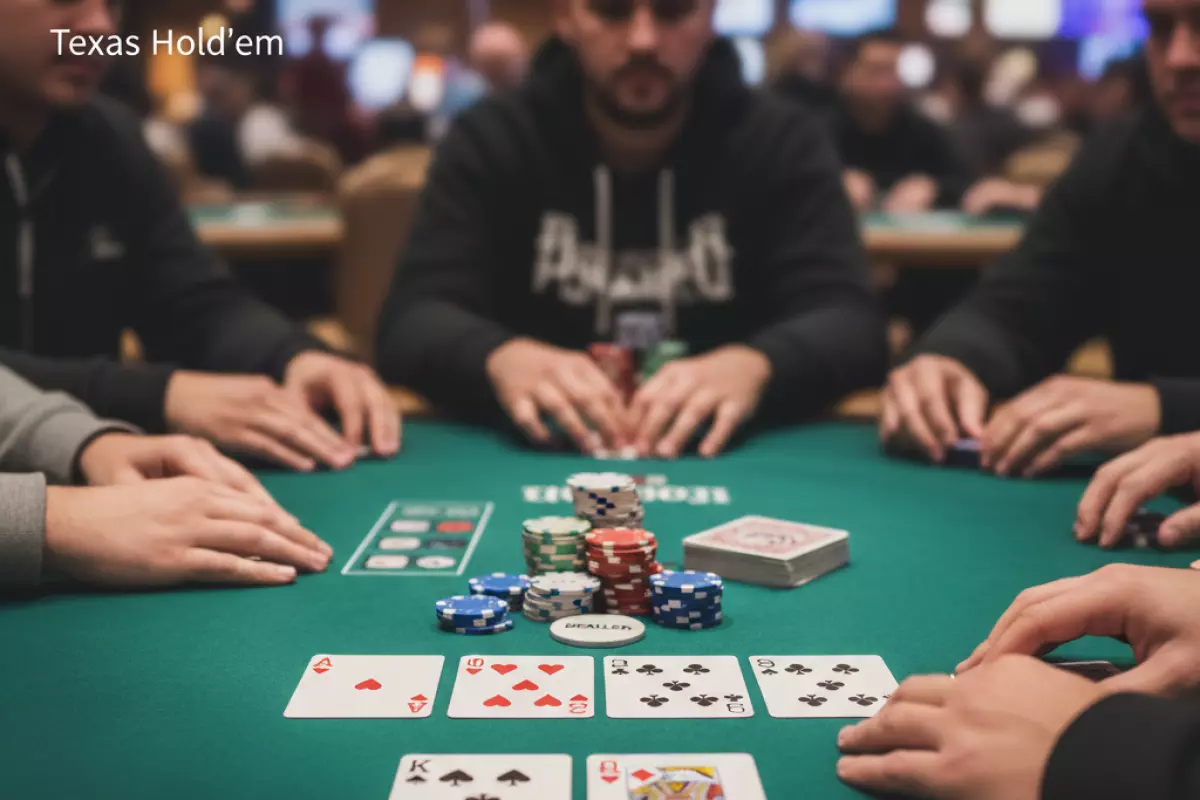
In card rooms and home games, you’ll usually see a handful of formats repeated because they’re easy to run live, have well-known rules, and create familiar betting patterns. The main differences come down to how many community cards are used, whether you’re dealt hole cards only, and how the betting rounds are structured.
Texas Hold’em
Texas Hold’em is the most widely spread live poker variant. Each player gets two private hole cards, then five community cards are dealt in stages (flop, turn, river). You make the best five-card hand using any combination of your two hole cards and the board.
Live play tends to move in a predictable rhythm: preflop action, then three postflop betting rounds. Because information is shared through community cards, reading opponents and tracking ranges becomes a big part of the gameplay.
Omaha (including Pot-Limit Omaha)
Omaha looks similar to Hold’em at first glance because it also uses five community cards, but players receive four hole cards. The key rule is that you must use exactly two of your hole cards and exactly three community cards to make your hand.
In many live rooms, the most common form is Pot-Limit Omaha (PLO), where the maximum bet is tied to the size of the pot. This creates larger pots and more drawing situations, so hand values can swing quickly from one street to the next.
Seven-Card Stud
Seven-Card Stud has no community cards. Players receive a mix of face-up and face-down cards over several betting rounds, building toward a seven-card total from which the best five-card hand is made.
Because some cards are exposed, paying attention to “dead” cards (cards you can see in other players’ upcards) matters a lot. Stud is often played as a fixed-limit game in live settings, which keeps bet sizing consistent.
Five-Card Draw
Five-Card Draw is straightforward and common in casual live poker games. Players are dealt five private cards, there’s a betting round, then a draw phase where you can discard and replace cards, followed by final betting and showdown.
With limited shared information, the game leans more on betting behavior and how many cards someone draws. It’s easy to learn, but the lack of community cards means fewer visible clues compared to Hold’em-style games.
Mixed games (dealer’s choice, HORSE-style rotations)
Mixed formats rotate through multiple variants on a schedule (for example, every orbit or every set number of hands). In a live setting, this can be run as dealer’s choice at a home table or as a fixed rotation in a card room.
These games reward adaptability: you’ll switch between different hand-building rules and betting structures, so it helps to confirm the current variant and limits before each deal.
| Game type | How hands are built | Common live betting structure | What to pay attention to |
|---|---|---|---|
| Texas Hold’em | 2 hole cards + 5 community cards; use any 5-card combo | No-Limit or Limit | Position, board texture, opponent ranges |
| Omaha (PLO) | 4 hole cards + 5 community cards; must use exactly 2 hole + 3 board | Pot-Limit | Draws, nut hands, equity swings |
| Seven-Card Stud | No community cards; 7 total cards per player (mix of up/down), best 5 play | Fixed-Limit | Visible upcards, dead cards, bring-in dynamics |
| Five-Card Draw | 5 private cards; draw/replace cards once (typical), best 5 play | Limit or No-Limit (home rules vary) | Draw counts, betting patterns, bluff frequency |
| Mixed games | Rotates by variant; rules change by round | Usually Fixed-Limit (varies) | Rule clarity, quick adjustments, game selection |
If you’re joining a live table for the first time, ask two practical questions before posting chips: what the betting structure is (limit, no-limit, pot-limit) and whether any house rules apply (straddles, running it twice, draw limits). Those details change how the same poker game plays in practice.
Poker hand rankings explained

In live poker, knowing which five-card combination beats another keeps the game moving and prevents awkward disputes at showdown. Most casino cash games and tournaments use the same hierarchy, and the best hand is always the highest-ranked five cards you can make from your available cards (your hole cards plus any community cards, depending on the variant).
Hands are compared first by category (for example, a flush beats a straight). If both players have the same category, the winner is decided by the highest relevant card ranks, and then by “kickers” (the remaining side cards) when applicable.
| Rank (high to low) | Hand type | What it means | How ties are broken |
|---|---|---|---|
| 1 | Royal flush | A-K-Q-J-10 all in the same suit | Always ties if identical suits don’t matter (most games); otherwise it’s simply the top possible straight flush |
| 2 | Straight flush | Five consecutive cards in the same suit | Highest top card of the straight wins (e.g., 9-high loses to J-high) |
| 3 | Four of a kind | Four cards of the same rank (e.g., four 7s) | Higher quads win; if equal, the kicker decides |
| 4 | Full house | Three of a kind plus a pair (e.g., 8-8-8 with K-K) | Higher three-of-a-kind wins; if equal, higher pair wins |
| 5 | Flush | Any five cards of the same suit, not in sequence | Compare highest card, then next highest, and so on |
| 6 | Straight | Five consecutive cards, suits don’t matter | Highest top card wins; A-2-3-4-5 is the lowest straight |
| 7 | Three of a kind | Three cards of the same rank plus two side cards | Higher trips win; then compare kickers in order |
| 8 | Two pair | Two different pairs plus one side card | Higher top pair wins; if tied, higher second pair; then kicker |
| 9 | One pair | One pair plus three side cards | Higher pair wins; then compare remaining cards highest to lowest |
| 10 | High card | No made hand; your best five cards are unpaired and not a straight/flush | Compare highest card, then next highest, and so on |
How showdowns are decided in live poker
At showdown, each player turns over their cards (in games with hole cards), and the dealer identifies the best five-card hand for each player. In community-card games like Texas Hold’em, you can use any combination of your two hole cards and the five community cards, but the final hand must be exactly five cards.
If two players make the same five-card hand, the pot is split. This is common when the board itself already forms the best possible hand for everyone (for example, a straight on the board where no one can improve it).
Key details players often miss
The ace has two roles: it can be high (A-K-Q-J-10) or low in the “wheel” straight (A-2-3-4-5). It cannot “wrap around” (Q-K-A-2-3 is not a straight). Also, suits are not ranked in most live poker rooms, so a flush is compared by card ranks, not by whether it’s hearts or spades.
Finally, remember that kickers matter only when the main part of the hand ties. For example, with one pair, if both players share the same pair rank, the highest remaining side card decides, then the next, until a winner is found or the hands are identical.
How live poker betting works

In a live poker room, the action moves in a fixed order and every decision you make changes the price of the pot. Betting isn’t just “putting chips in”; it’s a structured sequence of options that repeats across streets (preflop, flop, turn, river) until the hand ends by a fold or a showdown.
Most live games use a dealer button to mark position. The button rotates one seat after each hand, and the two players to the left post forced bets (the small blind and big blind) to start the pot. From there, players act one at a time, and you must respond to what’s already been wagered.
Blinds, antes, and the opening action
Before any cards are played, the table usually posts blinds, and some formats also add an ante (a small forced contribution from each player). These forced bets create immediate incentive to compete for the pot and define the minimum stakes for the hand.
Preflop action begins with the player “under the gun” (immediately left of the big blind) and continues clockwise. On later streets, the first active player to the left of the button acts first, which makes position a major factor in how often you can bet, call, or apply pressure with a raise.
Your options: check, bet, call, raise, fold
On your turn, what you can do depends on whether there’s already a wager in front of you. If no one has bet on that street, you may check (put in nothing) or bet (set the price). If someone has bet, you can fold (give up the hand), call (match the amount), or raise (increase it).
- Check: pass the action without adding chips when no bet exists.
- Bet: put chips in to start wagering on that round.
- Call: match the current bet to stay in the hand.
- Raise: increase the bet; opponents must respond to the new amount.
- Fold: discard your hand and forfeit any chips already committed.
Betting rounds and when they end
Each street has its own betting round. A round ends when every remaining player has either folded or put in the same amount for that street, and no further raises are pending. If everyone checks, the round ends immediately and the next community card is dealt (or the hand goes to showdown on the river).
At showdown, any players still in the hand reveal their cards in the order required by the room’s rules (often the last aggressor shows first). The best five-card hand wins the pot, unless side pots exist.
Bet sizing rules: no-limit, pot-limit, and fixed-limit
Live poker betting rules vary by game type, and the structure determines how big a wager can be. In no-limit, you can bet any amount up to your entire stack. In pot-limit, the maximum is tied to the current pot size. In fixed-limit, bet and raise sizes are predetermined, which reduces extreme pressure but increases the importance of thin value bets.
| Structure | What controls bet size | Typical impact on play |
|---|---|---|
| No-limit | Any amount up to all-in | Big swings; strong leverage from large bets and shoves |
| Pot-limit | Maximum equals the pot (after calling) | Limits extremes while still allowing sizable raises |
| Fixed-limit | Preset bet/raise amounts by street | More frequent calls; smaller mistakes, thinner edges |
| Spread-limit | Betting allowed within a stated range | Middle ground; reduces all-in pressure compared to no-limit |
All-ins, side pots, and what “covers” means
If you don’t have enough chips to call a bet, you can go all-in for your remaining stack. When stacks are different, the pot may split into a main pot (which all eligible players can win) and one or more side pots (which only players who matched the extra chips can contest).
You’ll also hear players say someone “covers” another player. That simply means they have an equal or larger stack, so they can apply maximum pressure because they can bet amounts the shorter stack can’t fully match.
Live table etiquette that affects betting
In-person play adds practical rules that keep betting clear. Verbal declarations are binding in many rooms (saying “call” or “raise” commits you), and acting out of turn can change the hand’s flow or result in a forced check. To avoid confusion, push chips forward in one motion and wait for the dealer to confirm the amount.
Finally, protect your hand and pay attention to the action. Live poker moves quickly, and missed bets, unclear chip movements, or misunderstanding the current amount to call can lead to costly mistakes even when you’re holding a strong hand.
Live dealer poker gameplay flow
In a live casino poker room, the hand follows a predictable rhythm: you place your wager on the interface, the dealer runs the round on a real table, and the system settles outcomes automatically. The main difference from video poker is that decisions happen in real time, often with a visible countdown, and your actions are tied to a physical deal.
Most live poker variants fall into two groups. In live poker vs other players (less common online), you compete for a pot and make multiple betting decisions. In casino-style live poker (very common), you play against the house using poker hand rankings, usually with one or two decisions such as “play/fold” or “draw/stand.” The steps below describe the typical flow you’ll see across both formats, with small rule differences depending on the game.
1) Join the table and understand the limits
Before the first hand, check the table limits and any side bet options. Limits affect not only your bankroll management but also whether you can use certain features like re-buys or multi-seat play (where allowed). If the game offers side bets, read what triggers a payout, because they often use different criteria than the main wager.
2) Place your initial bet before the deal
When the betting window opens, you select chip values and place your main wager in the correct betting box. A timer usually shows how long you have. Once the countdown ends, bets lock and the dealer begins dealing; late changes are not accepted.
3) Cards are dealt and shown according to the variant
The dealer deals real cards on camera, and the software overlays information such as player positions, hand labels, and totals. What you can see depends on the rules:
- Community-card games may reveal shared cards (like a flop/turn/river style board) while your own cards appear on-screen.
- Stud-style or house-banked games may show a dealer hand plus your hand, with some cards face down until later.
- Draw variants may deal a full hand first, then allow exchanges before the final reveal.
4) Make decisions during action windows
After the initial deal, the interface prompts you when it’s your turn. In casino-backed live poker, this is often a single decision such as “play” (placing an additional bet) or “fold” (ending the hand). In player-versus-player formats, you may have multiple betting rounds with actions like check, bet, call, raise, or fold.
Because the game is streamed, your choice must be made within the timer. If you don’t act, most platforms apply a default (commonly check/fold, depending on what’s legal). If you’re unsure, look for the on-screen help panel that summarizes allowed actions for that moment.
5) Dealer completes the round and resolves hands
Once all decisions are in, the dealer deals any remaining cards (community cards, dealer draw, or final streets) and reveals hidden cards as required. The system then evaluates the result using standard poker hand rankings, plus any game-specific rules such as dealer qualification (for example, the dealer must have at least a certain hand strength for some bets to pay).
6) Payouts, pushes, and side bet settlement
After the showdown, the platform automatically calculates winnings and returns chips to your balance. Outcomes can include:
- Win: your hand beats the dealer or wins the pot (depending on format).
- Loss: you’re beaten or you folded earlier.
- Push: a tie under the rules, often returning the main wager.
Side bets are usually settled independently of the main result. It’s possible to lose the primary wager but still cash a side bet if its condition is met (for example, a specific hand type appearing).
7) Prepare for the next hand
When the round ends, a new betting phase begins. This is the moment to adjust your stake, switch tables if the pace doesn’t suit you, or pause if you’re playing on a mobile connection. Live poker moves quickly, so treating each hand as a separate decision helps you avoid rushed clicks during the countdown.
Tips for playing live poker
In a casino or home game, you’re not just making decisions with cards and chips—you’re also managing pace, table dynamics, and information that doesn’t exist online. A few practical habits can prevent expensive mistakes and help you stay comfortable while you play.
Get the basics right: chips, action, and dealer procedure
Many live errors come from unclear actions. Make your intentions obvious, keep your chips organized, and follow the dealer’s lead on when to act. If you’re unsure about a rule (string bets, raise sizes, whether a chip toss is a call), ask the dealer before you put money in.
- Act in turn and keep your cards protected with a chip or card protector.
- Use clear verbal declarations (“call,” “raise,” “all-in”) when the situation could be ambiguous.
- Push chips forward in one motion to avoid a string-bet ruling.
- Know the “one chip” rule common in many rooms: tossing a single large chip without saying “raise” is usually treated as a call.
Choose the right game and seat
Your win rate in live poker is heavily influenced by game selection. Look for tables where pots are multiway, players see a lot of flops, and the atmosphere is relaxed rather than intensely competitive. If you have a choice of seats, consider position relative to the most aggressive players so you can act after them more often.
Also be honest about the stakes: if the buy-in makes you nervous, you’ll tend to play scared and miss profitable spots. Pick a limit where you can make calm decisions even after a few lost pots.
Adjust to live pacing and smaller sample sizes
Live hands arrive slowly, so patience matters. Avoid “manufacturing action” just because you’re bored; the cost of forcing marginal spots adds up. Since you’ll see fewer hands per hour, short-term results swing more, so focus on decision quality rather than quick outcomes.
Use the downtime well: track who limps too much, who folds to 3-bets, who overvalues top pair, and who bluffs rivers. Those observations become your edge in later hands.
Pay attention to players, not just cards
Physical reads are real, but they’re often subtle and player-specific. The most reliable information usually comes from betting patterns and timing rather than “Hollywood” tells. Watch how opponents handle chips when strong versus weak, how quickly they bet, and whether their story makes sense across streets.
Be careful not to overreact to a single twitch or sigh. When in doubt, default to the line that makes sense based on ranges and board texture, then use live observations as a small adjustment.
Build a simple plan for each hand
Before you bet, decide what you’re trying to accomplish: are you value betting, bluffing, or denying equity? Think one street ahead so you’re not guessing on the turn or river. In live poker games, where opponents call more often, thin value and disciplined bluff selection matter a lot.
A useful habit is to ask yourself: “What worse hands call me?” and “What better hands fold?” If neither answer is convincing, checking is often the best option.
Handle etiquette and avoid unnecessary conflict
Good etiquette keeps the game smooth and protects you from avoidable mistakes. Don’t discuss a hand while it’s still in progress, don’t slow-roll, and don’t splash the pot. If there’s a dispute, let the dealer call the floor; arguing rarely helps and can distract you from playing well.
Tip consistently within your comfort level, keep your phone use within house rules, and be mindful of acting quickly when it’s your turn—especially in time-raked games.
Stay in control of your session
Set a stop-loss and a time limit before you sit down, then stick to them. Live environments can make it easy to chase losses or keep playing when tired. If you notice frustration, rushed decisions, or a desire to “get even,” take a short break or end the session.
Finally, keep your bankroll and buy-in strategy conservative. The best way to keep improving is to stay in games you can afford while you learn the rhythms of live play.
Choosing the best live poker tables
Pick a table that matches your budget, comfort level, and the pace you want. In live poker, small differences in stakes, seating, and player mix can change how often you face tough decisions and how much variance you’ll feel over a session.
Start with stakes, buy-ins, and your risk limit
Choose limits where a normal downswing won’t push you into playing scared. If you’re unsure, sit in the lowest game that still feels meaningful, then move up only after you’ve logged enough hands to understand the room’s tendencies and your own win rate.
Also check the buy-in structure. Some rooms cap buy-ins tightly, which reduces deep-stack play; others allow large max buy-ins, which increases post-flop complexity and rewards stronger hand-reading.
Match the game format to your strengths
Not all live tables play the same, even at identical blinds. No-Limit Hold’em usually has the widest spread of skill levels, while Pot-Limit Omaha often creates bigger pots and faster bankroll swings. If you’re still learning, a slower, more familiar format makes it easier to focus on position, bet sizing, and showdown value.
| What to compare | What to look for at the table | Why it matters for gameplay |
|---|---|---|
| Stake level and buy-in cap | Comfortable blinds; buy-in that fits your plan | Controls risk and determines how deep post-flop decisions get |
| Table type (full-ring vs. short-handed) | More seats for tighter play; fewer seats for more hands | Changes opening ranges, position value, and frequency of confrontations |
| Player mix and style | More limping/calling; fewer aggressive regulars | Impacts profitability and how often bluffs get through |
| Pace and dealer efficiency | Steady dealing; minimal delays; clear action | More hands per hour and fewer mistakes or misreads |
| Rake and promos | Transparent rake; reasonable drop; clear jackpot rules | High rake can erase small edges, especially in low-stakes games |
| Seat position and stack depths | Position on loose players; stacks that suit your style | Good position improves decision quality; stack sizes shape implied odds |
Read the table before you sit
Watch a few orbits if possible. Look for frequent multiway pots, players who limp often, and showdowns that reach the river with weak holdings. Those are signs of a softer lineup where value betting matters more than fancy bluffs.
Pay attention to stack sizes too. A table full of short stacks can reduce post-flop maneuvering, while deeper stacks increase the importance of pot control, implied odds, and avoiding dominated hands.
Choose a seat with a plan
In live poker, seat selection is a real edge. A common approach is to sit with position on the most active players so you act after them on later streets. Acting last gives you more information, makes thin value bets easier, and helps you avoid paying off when the story doesn’t add up.
- Target position: try to have loose-aggressive or splashy players on your right.
- Avoid pressure: fewer strong, aggressive players on your left means fewer tough spots.
- Mind the stacks: sit where the biggest stacks are in spots you can play in position.
Factor in rules, rake, and house procedures
Small rule differences affect strategy. Check whether straddles are common, if there’s a button straddle, how raises are handled, and whether the room uses a time collection or a pot rake. In many low-stakes games, rake is the hidden difficulty setting: if it’s high, you’ll need a clearer edge and tighter discipline with marginal hands.
Finally, pick a table where the action is clear and disputes are rare. A well-run game with consistent dealing and attentive floor staff reduces errors, protects the integrity of the pot, and keeps your focus on decisions rather than logistics.