Casino Poker Games – Rules, Hands and Gameplay

 This article explains what casino poker is, the basic rules, and a hand rankings chart. It breaks down how betting works, compares house edge across variants, reviews popular casino poker types, flags common beginner mistakes, and shares practical playing tips.
Casino poker variants can seem confusing at first, so this guide explains the rules, hand rankings, and common gameplay you’ll encounter at live tables and online. It walks you through each round, shows how betting typically flows, and highlights which hands matter most. You’ll also learn how to avoid common mistakes and pick games that match your pace, experience level, and bankroll.
What casino poker means in casinos

In a casino, “poker” can mean two different formats that play very differently: a player-versus-player table where the house takes a fee, or a player-versus-house game that uses poker hand rankings but runs like a typical casino table game. Knowing which one you’re sitting down to affects the rules, the strategy, and even what “winning” looks like.
Two main formats you’ll see on the floor
The most common split is between poker room games (live tables where players compete against each other) and casino poker table games (house-banked games such as Caribbean Stud, Three Card Poker, Ultimate Texas Hold’em, and similar variants). Both use familiar hands like pairs, straights, and flushes, but the flow of play and the edge are not the same.
| Aspect | Poker room (player vs. player) | Casino table poker (player vs. house) |
|---|---|---|
| Who you’re competing against | Other players at the table | The dealer/house (your hand is compared to a dealer hand or a paytable) |
| How the casino earns | Rake per pot or time charge | Built-in house edge in the rules and payouts |
| Typical betting structure | Blinds/antes with betting rounds (limit, no-limit, pot-limit) | Fixed sequence of bets (ante, raise/call/fold steps), sometimes optional side bets |
| Skill vs. luck balance | Higher skill impact over time (position, ranges, reads, bet sizing) | More rule-driven decisions; strategy often boils down to correct fold/raise thresholds |
| What “winning” means | Taking chips from other players; long-term profit depends on beating the field plus fees | Beating the dealer or hitting payout conditions; long-term results depend on house edge and discipline |
Why the distinction matters for rules and gameplay
At a poker table in the card room, the dealer is neutral: they run the action, but they don’t “play a hand.” The key mechanics are betting rounds, reading opponents, and managing stack sizes. In contrast, casino poker variants are designed for fast resolution: you make a small number of decisions, the dealer follows fixed procedures, and payouts are determined by a comparison or a paytable.
This is also why you’ll hear different language. In a poker room, players talk about ranges, position, and pot odds. In house-banked poker games, the focus is usually on whether to fold or raise at the correct point, and whether optional side bets are worth it (often they carry a higher edge).
Fees, payouts, and what to watch for
In player-versus-player games, the main cost is the rake or time charge, which means you can play well and still struggle if the game is too tight or the fees are high. In casino poker table games, the “cost” is embedded in the payout structure, so even perfect play typically can’t flip the advantage in your favor, though it can reduce losses.
If you’re trying to identify what kind of poker you’re looking at, check the felt and signage: a paytable, dealer-qualification rules, or side-bet circles usually indicate a casino table poker variant. A board showing blinds, limits, and seat numbers usually points to a traditional poker room game.
Basic casino poker rules explained
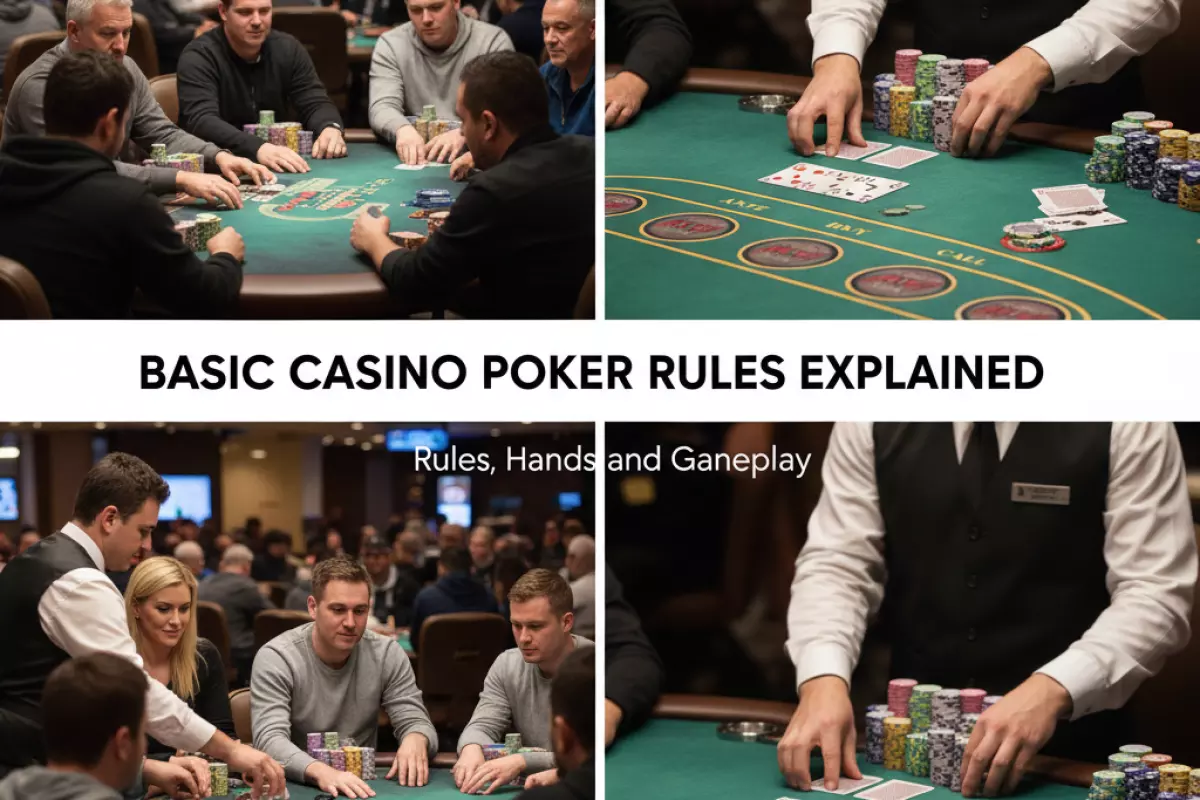
Casino poker comes in two main formats: games where you play against other players (like Texas Hold’em in a poker room) and games where you play against the house (common table games such as Caribbean Stud, Three Card Poker, and Casino Hold’em). The core ideas stay consistent—betting rounds, hand rankings, and clear rules for who wins—but the way money is won and lost differs a lot.
Player-versus-player vs. player-versus-house
In poker room games, the casino typically takes a small fee (a “rake” or time charge) and the remaining chips form the pot that players compete for. Your goal is to win other players’ bets by having the best hand at showdown or by getting opponents to fold.
In house-banked casino poker, you’re not trying to outlast a table of opponents. You place a wager on your own hand (sometimes with optional side bets), and the dealer’s hand is used as a benchmark. Payouts are set by a paytable, and some games include a dealer “qualification” rule that affects whether the main bet pays immediately.
How a typical hand plays out
Most casino poker variants follow a familiar flow: you place an initial bet, receive cards, decide whether to continue (often by making a “play/raise/call” bet), and then compare hands. Community-card games add shared cards in the middle of the table, while stud-style games keep most cards private.
- Place the opening wager (ante, blind, or both, depending on the game).
- Cards are dealt (face down, face up, or with community cards later).
- Decision point: check/call/raise in poker room games, or fold vs. make a required “play” bet in many house-banked games.
- Showdown: remaining hands are revealed and compared using standard rankings.
- Payouts are settled: the pot is awarded (player-versus-player) or bets are paid/collected by the dealer (player-versus-house).
Betting terms you’ll see at casino tables
The labels on the felt matter because they tell you what each wager does. An ante is the entry fee to receive cards. A blind is a forced bet that can pay based on your final hand strength in some games. A play (or raise) bet is the amount you must add to continue after seeing your cards. Optional side bets are separate wagers with their own payout rules, usually based on specific hand patterns.
- Ante: starts the hand; often required.
- Blind: paired with the ante in some games; may pay by paytable.
- Play/Raise: made after you see your cards to stay in the hand.
- Side bet: optional; resolved independently from the main wager.
Hand rankings: the universal reference point
Nearly all casino poker games use the familiar hierarchy from high card up to royal flush, with ties broken by the highest relevant cards (kickers). Some variants add small twists—like using only the best five-card hand out of seven in community-card formats—but the ranking order itself is usually standard. When in doubt, assume the game is evaluated on the best five-card combination you can make from the available cards.
Dealer qualification and what it changes
Several casino table poker games include a rule that the dealer must “qualify” with a minimum hand (for example, a certain high-card threshold). If the dealer does not qualify, your main wager may pay at reduced odds, or your ante may push (tie) while other parts of the bet still resolve. This is not a bonus; it’s simply a rule that changes how the main bet is graded when the dealer’s hand is too weak.
Common rules that vary by game
Before you sit down, check the placard or ask the dealer about a few points that frequently differ between variants. These details affect decisions and payouts more than most newcomers expect.
- Number of cards dealt (three, five, or seven-card evaluation with community cards).
- When you’re allowed to raise and whether raise sizes are fixed or variable.
- Whether the blind pays by paytable (some games pay extra for strong hands).
- How ties are handled (push, split pot, or specific tie-break rules).
- Side-bet rules and whether they’re based on your cards only or include dealer/community cards.
If you remember one practical rule: always separate “how to make the best hand” from “how the bet is paid.” The first is poker logic; the second is the casino’s ruleset, and it’s what determines whether a hand that looks strong actually produces the payout you expect.
Poker hand rankings chart

In casino poker games, the winner is determined by the strength of your five-card hand. Whether you’re playing a community-card format like Texas Hold’em or a dealer game like Caribbean Stud, the same ranking order is used, so learning it once pays off across many tables.
Hands are compared from highest to lowest. If two players make the same category (for example, both have a flush), the result is decided by the highest relevant cards, known as kickers. Suits are not ranked in standard poker, so hearts are not inherently “better” than spades.
| Rank (high to low) | Hand | What it means | How ties are broken |
|---|---|---|---|
| 1 | Royal Flush | A, K, Q, J, 10 all in the same suit | No kicker comparison; identical only if the same cards are possible (usually a split pot) |
| 2 | Straight Flush | Five consecutive cards in the same suit | Highest card in the straight wins |
| 3 | Four of a Kind | Four cards of the same rank | Higher four-of-a-kind wins; then the kicker |
| 4 | Full House | Three of a kind plus a pair | Higher three-of-a-kind wins; then the pair |
| 5 | Flush | Any five cards of the same suit, not consecutive | Compare highest card, then next-highest, and so on |
| 6 | Straight | Five consecutive cards, mixed suits allowed | Highest card in the straight wins |
| 7 | Three of a Kind | Three cards of the same rank | Higher trips win; then compare remaining kickers in order |
| 8 | Two Pair | Two different pairs plus one extra card | Higher top pair wins; then higher second pair; then kicker |
| 9 | One Pair | One pair plus three other cards | Higher pair wins; then compare kickers from highest to lowest |
| 10 | High Card | No pair and no better made hand | Compare highest card, then next-highest, and so on |
Key comparison rules used at casino tables
When players reach showdown in games like Hold’em or Omaha, everyone builds the best possible five-card combination from the available cards (their own plus the board). In stud-style games, it’s typically the best five from your seven, depending on the variant.
- Kickers matter: if the main hand category and primary ranks match, the remaining side cards decide the winner.
- Ace can be low in a straight: A-2-3-4-5 is the lowest straight (often called a “wheel”), and it loses to 2-3-4-5-6.
- Suits don’t break ties: if two hands are truly identical in rank and card values, the pot is split.
- Exactly five cards are evaluated: even if you can form multiple strong combinations, only the best five-card hand counts.
Quick examples to make the order intuitive
A flush beats a straight because it’s statistically harder to make five cards of the same suit than five consecutive ranks. Similarly, a full house beats a flush because pairing patterns (three plus two) are rarer than simply sharing a suit.
For tie-breaking, imagine two players both hold two pair: one has A-A and 9-9, the other has K-K and Q-Q. The hand with the higher top pair (A-A) wins, even though the second player’s lower pair (Q-Q) is higher than 9-9. The ranking always starts from the most important part of the made hand and works down to kickers.
How betting works in casino poker games

Wagering in casino poker comes down to two broad formats: you either play against other players with the house taking a fee, or you play directly against the casino with fixed paytables. The betting structure, what you’re allowed to do on each round, and how the casino earns its edge all depend on which format you’re sitting in.
Two main formats you’ll see on a casino floor
Player-versus-player (poker room games) includes Texas Hold’em, Omaha, and similar variants. You buy in for chips, post blinds or antes, and compete for pots. The casino typically takes a rake (a small portion of the pot) or charges a time fee.
Player-versus-casino (table “casino poker”) includes games like Three Card Poker, Ultimate Texas Hold’em, and Caribbean Stud. You place one or more bets against a paytable or dealer qualification rules, and payouts are determined by your final hand strength rather than by winning a pot from other players.
Betting rounds and common actions in poker-room games
In community-card poker, betting is split into rounds that follow the flow of the hand. Each round gives players a chance to add chips to the pot or exit the hand, and the options are limited by the table’s betting rules (no-limit, pot-limit, or fixed-limit).
- Check: stay in without adding chips if no one has bet in that round.
- Bet: put chips in first to set a price to continue.
- Call: match the current bet.
- Raise: increase the bet size (subject to game limits and minimums).
- Fold: give up the hand and any chips already committed.
Blinds (or antes) create an initial pot and force action. From there, bet sizing rules matter: in no-limit you can wager any amount up to your stack, in pot-limit you’re capped by the current pot size, and in fixed-limit bets and raises are set amounts.
How the house makes money: rake, fees, and side bets
In poker rooms, the casino’s income usually comes from a rake taken from most pots that reach a flop (or from a timed seat fee). This means the house isn’t “playing” the hand, but the cost of participation is built into each pot over time.
In casino table poker, the edge is built into the paytables and rules (for example, dealer qualification requirements or payout ratios that are slightly less than true odds). Many of these games also offer optional side bets; they can be fun, but they often carry a higher house edge than the main wager.
Typical betting flow in player-versus-casino poker
These games often use a staged betting system: you place an initial wager, receive cards, and then decide whether to continue by adding a required bet, or to fold and surrender the initial amount. The exact names vary (Ante/Play, Blind/Play, etc.), but the logic is consistent: later decisions are based on the strength of your hand and the cost to keep going.
Because payouts are predefined, you’ll usually see clear resolution rules such as “dealer must qualify with at least X-high” or “your hand must beat the dealer to win the main bet.” Ties (pushes) are common on certain bet types, and some wagers may win even if the dealer wins (for instance, a bonus based only on your hand).
Practical tips to avoid betting mistakes
Most errors come from misreading the betting limits or misunderstanding what a wager applies to. Before you sit down, confirm the table minimum/maximum, whether it’s no-limit/pot-limit/fixed-limit (in poker rooms), and which bets are mandatory versus optional (in casino table poker).
It also helps to track your stack in terms of big blinds (poker room) or in terms of how many full “hand cycles” you can afford (casino table poker). That keeps your decisions consistent and prevents accidental overbetting when the action speeds up.
House edge in casino poker variants

The built-in advantage in casino poker comes from the paytable, the rules (like whether ties push), and any mandatory side wagers. Unlike live poker against other players, these games are math-driven: if you play the correct strategy, your long-term loss rate is largely determined by the game’s design.
Two things matter most when you’re comparing variants: the base game edge (how the main wager performs with optimal play) and the volatility (how swingy results feel session to session). A game can have a relatively low casino advantage but still produce big up-and-down bankroll swings if most of the return is concentrated in rare premium hands.
What “house edge” means in casino poker
House edge is the average percentage of each unit bet that the casino expects to keep over the long run. If a game has a 2% edge, a player staking $10 per hand is expected to lose about $0.20 per hand on average, assuming correct decisions and no extra bets. That’s not a promise for a single session; it’s a long-run expectation across many hands.
In poker-style table games, the edge is usually created by one (or more) of these mechanisms: lower-than-true-odds payouts, forced additional bets to continue, dealer qualification rules, or bonus/side bets with steeper built-in margins.
Why the paytable and rules change the math
Small wording differences can move the casino advantage noticeably. For example, in some variants a tie might push, while in others certain ties lose or pay less. Similarly, a “dealer qualifies with Queen-high” rule changes how often the dealer’s hand counts, which affects how often the player’s ante is paid, pushed, or loses.
Paytables are the biggest lever. If a bonus payout for a straight or flush is trimmed, the game can look the same on the felt but return less over time. When you evaluate a table, treat the posted payouts as part of the rules, not a side detail.
Typical house-edge ranges by popular casino poker games
The exact numbers depend on the specific paytable and any optional wagers, but the ranges below reflect common casino offerings with solid, near-optimal play. Use them as a comparison tool rather than a guarantee for every table.
| Game / bet type | Common rule/paytable driver | Typical house-edge range (approx.) | Volatility feel |
|---|---|---|---|
| Casino Hold’em (main bet) | Community cards; fixed payouts; ties usually push | About 2% to 3% | Medium |
| Three Card Poker (Ante/Play) | Dealer qualification; Pair Plus is separate | About 3% to 4% | Medium |
| Three Card Poker (Pair Plus) | Bonus-only paytable on player hand | Often 6% to 8%+ | High |
| Caribbean Stud Poker | Fixed raise; progressive/bonus options vary | Often 5%+ (main game), higher with side bets | Medium to high |
| Pai Gow Poker | Commission (commonly 5%) and many pushes | Often ~2% to 3% (effective, table-dependent) | Low to medium |
| Ultimate Texas Hold’em (main bet) | Early bet sizing (4x/2x/1x) drives returns | Often ~2% to 3.5% | Medium to high |
| Let It Ride (main bets) | Choice to pull back bets; bonus paytable matters | Often ~3% to 4%+ | High |
Side bets: where the edge usually jumps
Optional wagers (progressives, “pair plus” style bonuses, trips/straight/flush bonuses, bad beat-style payouts) are designed to be exciting, but they commonly carry a higher casino advantage than the base game. They also increase variance because much of the return comes from rare outcomes.
If you’re trying to keep the built-in disadvantage lower, a simple rule of thumb is: treat side bets as entertainment spend, and size them smaller than your main wager. If you do play them, check the posted paytable first; two tables with the same game name can have very different long-run costs.
How to reduce the casino advantage in practice
You can’t remove the built-in edge, but you can avoid making it worse. The biggest leaks are usually decision errors (folding too often, raising in the wrong spots, mis-setting hands in Pai Gow) and routinely adding high-margin extras.
- Learn the core strategy for the specific variant (especially games with decisions like Ultimate Texas Hold’em, Let It Ride, and Pai Gow setting).
- Compare paytables before sitting down; small payout cuts can cost more than people expect.
- Be cautious with side bets, particularly progressives and bonus-only wagers, unless you’re comfortable with higher long-run cost and bigger swings.
- Track total amount wagered (including forced raises and bonuses), since the effective cost is tied to what you actually put at risk per hand.
Finally, remember that two players at the same table can face different expected results if one plays the correct decisions and the other “guesses.” In casino poker, good strategy doesn’t turn the game positive, but it can meaningfully lower the long-term loss rate and make your bankroll last longer.
Popular casino poker game types
Casino poker comes in two main formats: games where you play against the house using fixed paytables, and games where you play against other players with the casino taking a rake or time charge. The rules, betting flow, and even what “winning” looks like can change a lot depending on which format you sit down at.
House-banked poker (you vs. the dealer)
These are the most common “poker” tables on a casino floor because they run quickly and don’t need a full table of players. You’re trying to make a qualifying hand, beat the dealer’s hand, or both, depending on the variant. Payouts are based on the posted rules and paytables rather than a shared pot.
Caribbean Stud Poker is a classic example: you receive five cards, the dealer receives five (with one card exposed), and you decide whether to fold or raise based on your hand strength and the dealer’s upcard. The dealer must usually “qualify” (often with at least Ace-King high) for some parts of the bet to pay.
Let It Ride is built around keeping or pulling back bets as more community cards are revealed. You start with three bets and can choose to “let it ride” or withdraw portions as you see your hand develop. The key difference is that payouts are typically based on your final five-card hand, not on beating the dealer.
Three Card Poker uses three-card hands, so rankings shift slightly (a straight beats a flush). It’s fast, easy to learn, and usually offers both an “Ante/Play” game against the dealer and optional bonus wagers that pay for strong hands regardless of the dealer’s result.
Pai Gow Poker is slower and more strategic: you build two hands from seven cards (a five-card “high” hand and a two-card “low” hand). To win, both of your hands must beat the dealer’s corresponding hands; splitting one-and-one typically results in a push. House way rules may apply when the dealer sets their hand.
Player-versus-player poker (the pot game)
In poker rooms, the casino usually doesn’t act as an opponent. Instead, players compete for a pot, and the house earns money via a rake (a small cut of most pots) or a time-based seat fee. This format rewards long-term decision-making: position, bet sizing, reading ranges, and managing variance matter as much as knowing hand rankings.
Texas Hold’em is the most widely spread version. Each player gets two private cards, five community cards are dealt across three streets (flop, turn, river), and you make the best five-card hand. No-limit betting is common, which means you can wager all your chips at any time—creating big swings and high pressure decisions.
Omaha looks similar to Hold’em but plays very differently: you receive four private cards and must use exactly two of them with exactly three community cards. Because more cards are in play, strong draws happen often and “second-best” hands can be expensive if you overvalue them.
Seven-Card Stud (and Stud Hi-Lo variants) are less common today but still appear in mixed games. There are no community cards; instead, players receive a mix of face-up and face-down cards across multiple betting rounds. Paying attention to exposed cards is a major part of the strategy.
Quick comparison: what changes from game to game
| Game type | Who you play against | Cards used | How you win | Typical pace |
|---|---|---|---|---|
| Three Card Poker | Dealer (house-banked) | 3-card hands | Beat dealer and/or hit bonus hand payouts | Fast |
| Caribbean Stud | Dealer (house-banked) | 5-card hands | Dealer qualification + comparing hands | Medium |
| Let It Ride | Paytable (house-banked) | 5-card hands with community cards | Payout based on final hand strength | Medium |
| Pai Gow Poker | Dealer (house-banked) | 7 cards split into 5+2 | Win both hands; split usually pushes | Slow |
| Texas Hold’em | Other players (poker room) | 2 hole + 5 community | Win the pot by best hand or making others fold | Medium |
| Omaha | Other players (poker room) | 4 hole + 5 community (use 2+3) | Win the pot; draws and strong hands are common | Medium |
If you’re choosing what to learn first, focus on the betting structure and the win condition. A casino table game may be solved by understanding the optimal “play or fold” thresholds and the paytable, while a poker room game is about adjusting to opponents, stack sizes, and table dynamics over many hands.
Common beginner mistakes in poker
New players often lose money not because they don’t know the hand rankings, but because they apply them in the wrong situations. Poker is a game of incomplete information, so decisions about position, bet sizing, and opponent tendencies matter as much as the cards themselves.
Playing too many starting hands
Calling “just to see a flop” is one of the fastest ways to bleed chips. Weak hands look playable, but they usually make second-best pairs and weak draws that can’t stand pressure. A tighter range also makes your strong hands harder to read and easier to get paid.
As a practical rule, tighten up from early position and loosen slightly on the button, where you act last and can control the size of the pot more often.
Ignoring position and acting order
Position is a built-in advantage: acting later lets you see what others do before you commit chips. Beginners frequently treat the same hand as equally strong from every seat, which leads to tough post-flop spots and expensive “guessing.”
When you’re out of position, you’ll face more bets and raises without knowing where you stand. That’s why hands that are fine on the button can be marginal from under the gun.
Misunderstanding pot odds and chasing draws
Drawing hands are profitable only when the price is right. A common leak is calling large bets with a flush draw or straight draw without enough odds to justify it, especially when the draw is not to the nuts.
If you’re routinely calling big bets hoping to “get there,” you’re paying too much for your equity. Learn to compare the cost of a call to the approximate chance of improving, and remember that future betting (implied odds) can help or hurt depending on the situation.
Bet sizing that gives away information
Many beginners bet small with strong hands to “keep opponents in” and bet big with bluffs to “make them fold.” This pattern becomes obvious quickly. Better players will fold when you’re strong and call when you’re weak, which is the opposite of what you want.
Aim for consistent sizing with the same type of action. For example, use similar bet sizes for value bets and bluffs on the same board texture, so your opponents can’t easily narrow your range.
Overvaluing one-pair hands
Top pair feels powerful, but it’s not an automatic stack-off hand. On coordinated boards (connected cards, possible flushes), one pair shrinks in value because many turn and river cards change who is ahead.
Pay attention to how many players are in the pot and how much aggression you’re facing. Multiway pots and heavy betting often mean your single pair is in danger, even if it’s top pair.
Failing to adjust to table dynamics
Playing the same strategy against every opponent is a costly habit. Some players call too much, others fold too often, and many change gears based on tilt or stack size. If you don’t adapt, you’ll miss easy value and bluff in the wrong spots.
| Opponent type | Common tendency | Simple adjustment |
|---|---|---|
| Calling station | Calls with weak pairs and draws; folds rarely | Value bet more; bluff less; size up with strong hands |
| Tight-passive | Plays few hands; avoids big pots without strong holdings | Steal more pots; apply pressure on scary boards |
| Aggressive bluffer | Bets and raises frequently; over-represents strength | Call down with solid bluff-catchers; trap selectively |
| Solid regular | Balanced ranges; punishes predictable lines | Stay disciplined; avoid marginal spots; focus on position |
Tilting and chasing losses
Emotional decisions turn small mistakes into big ones. After a bad beat, beginners often widen their range, bluff too much, or try to “win it back” quickly. That usually increases variance and reduces decision quality.
If you feel rushed, angry, or distracted, take a short break or set a stop-loss for the session. Protecting your mindset is part of protecting your bankroll.
Not managing bankroll and game selection
Even good players hit downswings, and new players experience them more often. Sitting in games that are too big for your bankroll forces you to play scared or gamble when behind.
Choose stakes where a few lost buy-ins won’t affect your decisions, and prioritize softer tables over “proving yourself” at tougher ones. In casino poker rooms, the easiest edge often comes from picking the right game and seat.
Tips for playing casino poker
Most casino poker variants reward disciplined decision-making more than creativity. Because you’re often playing against the house (or against a dealer hand) rather than a table of opponents, the best results usually come from choosing the right games, understanding the paytables, and avoiding side bets that quietly increase the cost of playing.
Pick the right game and learn its paytable
Rules and payouts vary a lot between casino poker games such as Caribbean Stud, Three Card Poker, Ultimate Texas Hold’em, or video poker. Two tables with the same game name can still pay differently for key hands, which changes the long-term value of certain decisions. Before you sit down, check how the highest hands are rewarded, how ties are handled, and whether there are any special bonuses for straights, flushes, or premium hands.
| What to check | Why it matters | Quick example of impact |
|---|---|---|
| Main bet paytable | Determines the baseline return and volatility | A reduced payout on full houses/flushes in video poker lowers expected value noticeably over time |
| Dealer qualification rules | Changes how often you push, win, or lose | In games where the dealer must “qualify,” some weak dealer hands can turn into pushes instead of losses |
| Bonus payouts (if any) | Can offset variance or, sometimes, be a trap | A fair bonus table can add value; a stingy one encourages over-betting for small rewards |
| Side bet odds and payouts | Side bets often have higher house edge | A tempting “progressive” side bet may pay rarely, making bankroll swings much larger |
Use a simple bankroll plan
Casino poker can swing quickly, especially in games with big bonus payouts. Decide your session budget before you start, and choose a base bet that lets you comfortably handle downswings. A practical approach is to size your main wager so you can withstand a streak of losses without being forced into bigger, riskier bets to “get even.”
- Set a fixed session amount you can lose without affecting other plans.
- Keep your main bet consistent; avoid increasing stakes after losses.
- If the game has mandatory raises (common in some formats), make sure your bankroll covers those extra bets too.
Know the “default” strategy and stick to it
Many casino poker games have a mathematically preferred play for common situations: when to fold, when to call/raise, and when to hold or draw. Memorizing a few key thresholds usually beats improvising. If you’re unsure in the moment, it’s often better to follow a conservative baseline than to chase long-shot draws or pay extra bets with marginal hands.
Video poker is the clearest example: correct hold/discard decisions are the difference between a decent return and a costly one. In table games with decision points, the same idea applies: make the standard play repeatedly rather than “feeling” your way through close calls.
Treat side bets as entertainment, not a plan
Side bets can be fun, but they typically come with a higher house edge and higher variance than the main wager. If you enjoy them, keep them small and occasional, and don’t let them replace the main game where the rules and payouts are more stable. A good rule is to only place optional bets when you’re comfortable with the possibility that they’ll drain your session faster.
Manage speed and focus
Fast rounds increase the number of decisions you make, which can amplify both mistakes and losses. Play at a pace where you can read the paytable, confirm your hand ranking, and double-check any extra bets. If you notice fatigue or frustration, take a short break; casino poker rewards consistency, and tired play tends to drift into loose calls and unnecessary risks.
Keep expectations realistic
Even with solid play, short sessions are noisy: you can run hot or cold without it meaning much. Judge your decisions by whether they matched the rules and the paytable, not by the last few outcomes. Over time, disciplined strategy, sensible bet sizing, and selective use of bonuses are what keep the game enjoyable and your losses controlled.