Live Blackjack Rules, Strategy and Gameplay

 This article explains what live blackjack is and how it works, how it differs from online blackjack, and the key table rules. It covers card values and gameplay flow, basic live strategy, odds and house edge, common mistakes, and how to choose the best live tables.
Live dealer blackjack online can feel like a real table, but small rule details and table habits often shape your results. This guide explains the core rules, common variations, and the round flow from placing bets to payouts, then connects that to practical decisions such as when to hit, stand, double, or split, helping you play with fewer surprises and more confidence.
What live blackjack is and how it works

Live dealer blackjack is a real-time version of the game where you play online while a human dealer runs the table from a studio (or sometimes a casino floor). You see the cards dealt on video, place bets through an interface, and your decisions are sent instantly to the dealer and the game system.
The core goal stays the same as classic blackjack: build a hand total closer to 21 than the dealer without going over. What changes is the delivery. Instead of a computer-generated deal, the cards are physically drawn from a shoe, and the pace is guided by a real person with a fixed decision window for players.
How a live blackjack round plays out
Each round follows a predictable sequence so everyone at the table can act in order. The software handles timing, bet tracking, and payouts, while the dealer handles the physical dealing and table procedure.
- Betting opens: you choose your stake (and any available side bets) before the countdown ends.
- Initial deal: the dealer gives two cards to each active player position and two to the dealer (usually one face up, one face down, depending on the rules).
- Player decisions: you select actions such as hit, stand, double, split, or surrender (if offered). Choices must be made before the timer runs out.
- Dealer plays: after all player hands are resolved, the dealer reveals the hole card and draws according to house rules (for example, hitting until 17 or higher).
- Settlement: the system calculates outcomes and credits wins automatically, including blackjack payouts and pushes.
What you see on screen and what the system does
The video stream shows the dealer, the table layout, and the physical cards. At the same time, the interface displays your betting options, hand totals, available moves, and a timer so you know how long you have to act.
To keep the game consistent, the platform typically uses camera recognition to read each card as it hits the felt. That data feeds the on-screen graphics and ensures results are settled correctly, even when multiple players are seated at the same table.
Seats, betting spots, and game speed
Most tables have a limited number of seats, but many also allow “bet behind,” meaning you can place a wager on an occupied seat and follow that player’s decisions. This is useful when seats are full, though it also means you don’t control the strategy choices for that hand.
Live tables tend to move at a steady rhythm: faster than a slow in-person casino table, but usually slower than fully automated online blackjack. The decision timer is the main reason—if you don’t act in time, the system will apply a default action (commonly stand) to keep the round moving.
Why rules can differ from table to table
Even though the gameplay feels familiar, live blackjack rules can vary by provider and table. Differences commonly include the number of decks, whether the dealer hits or stands on soft 17, doubling rules, resplitting limits, and whether surrender is available. These details matter because they affect the house edge and which strategy chart fits the table you’re playing.
How live blackjack differs from online blackjack

The biggest change is the presence of a real dealer and a real table streamed to your screen. Instead of a fully automated interface, you’re playing in a studio or casino environment where cards are dealt on camera and your decisions are transmitted to the dealer in real time.
Game flow and pace
Live tables move at a human rhythm: the dealer shuffles, deals, and waits for player actions within a set timer. That timer matters strategically because you must make decisions promptly, and it also affects how many hands you can play per hour compared with many RNG-based blackjack games, which can be much faster.
Because other players are often seated at the same table, the round can take longer than a solo digital session. You’re not “sharing cards” in a way that changes the math of basic strategy, but you are sharing the pace and the order of play.
Rules, options, and table limits
Both formats use the same core goal (beat the dealer without busting), but the surrounding rule set can differ more in live rooms. Live blackjack commonly posts its rules on the table info panel, and small variations can meaningfully change the house edge—especially dealer behavior on soft 17, doubling rules, splitting limits, and whether surrender is offered.
| Feature | Live blackjack | Standard online (RNG) blackjack |
|---|---|---|
| Dealing method | Physical cards dealt by a human dealer on camera | Cards generated by software (random number generator) |
| Decision timing | Action timer; round continues after all players act | Often instant decisions; usually faster hands per hour |
| Rule availability | May vary by table; some options (like surrender) can be table-specific | Often offered in multiple variants; rules can be tightly defined per game title |
| Bet limits | Typically tied to a specific table; may include higher-limit rooms | Wide range of limits across many game versions, including very low stakes |
| Social element | Chat with dealer/players; more “casino-like” atmosphere | Usually solo play; no dealer interaction (or limited UI messages) |
Strategy impact: what changes and what doesn’t
Basic strategy remains the foundation in both formats: hit, stand, double, and split decisions are still driven by your hand versus the dealer’s upcard and the specific rules in play. What can change is how comfortable it feels to execute that strategy under time pressure and with other players watching the table.
Card counting is a common question. In live blackjack, physical cards are used, but many tables deal from continuous shufflers or reshuffle frequently, which reduces the practical value of tracking the composition. In RNG blackjack, counting isn’t applicable in the traditional sense because each hand is effectively independent.
User experience and practical considerations
Live play tends to feel more transparent because you can see the dealing process, but it also depends on stream quality and stability. A laggy connection can make the action timer feel tight, so it’s worth choosing a table where the video feed is smooth and the interface is easy to read.
Finally, etiquette is slightly different. In a live room, chat and table behavior can affect your focus. If you want a quieter, faster session, a standard digital blackjack table may suit you better; if you value the dealer interaction and a real-table vibe, the live format is closer to a casino experience.
Live blackjack table rules

At a real-time dealer table, the rules are enforced by the software and the dealer’s procedure, so your main job is to understand what actions are available, when you’re allowed to take them, and how bets are handled. Most variations follow familiar casino standards, but the details (like whether the dealer hits soft 17) can change the best decisions.
Table limits, seating, and timing
Before you place a chip, check the minimum and maximum stakes shown on the interface. Limits apply per hand, and if you split, you’ll usually need to match your original bet for each new hand. Some tables also allow side bets with their own limits and payout rules.
Live games run on a timer. You typically get a short window to place bets, then another window to act on your hand. If you don’t act in time, the system will usually choose a default (often “stand”), which can be costly in spots where hitting is clearly correct.
Card values and the goal
Number cards count as their face value, face cards count as 10, and aces count as 1 or 11. The goal is to beat the dealer’s hand without going over 21. A hand over 21 is a bust and loses immediately, even if the dealer later busts.
A “blackjack” is an ace plus a 10-value card as your first two cards. It’s a special hand with a premium payout at many tables, but the exact payout and whether it’s offered at all depends on the rule set.
What you can do on your turn
Your options depend on your first two cards, the dealer’s upcard, and the table’s restrictions. The standard actions are:
- Hit: take another card.
- Stand: keep your total and end your turn.
- Double: double your bet, take exactly one more card, then stand.
- Split: if you have a pair, split into two hands by placing a second equal bet.
- Surrender (if offered): forfeit half your bet and end the hand immediately.
Not every live dealer blackjack table offers surrender, and doubling/splitting can be limited (for example, “double on 9–11 only” or “no double after split”). Always check the on-screen rules panel for the exact constraints.
Dealer procedure and why it matters
The dealer follows fixed house rules. Common differences include whether the dealer hits or stands on soft 17 (a hand totaling 17 with an ace counted as 11), and how blackjack is paid (for example, 3:2 versus 6:5). These details affect both your expected return and the correct strategy choices.
Most live tables use a shoe with multiple decks, and the dealer will reshuffle at a set point. Because the game is streamed, you’ll see the dealing process, but you won’t be able to influence pace or shuffle timing.
How outcomes and payouts are settled
After all players act, the dealer completes their hand according to the house procedure. If you bust, your wager is lost right away. Otherwise, your result is compared to the dealer:
- If your total is higher than the dealer’s without busting, you win.
- If the dealer busts and you haven’t, you win.
- If totals match, it’s a push and your stake is returned.
- If the dealer’s total is higher (or you bust), you lose.
Blackjack payouts and side-bet payouts are calculated automatically. If the dealer also has blackjack, most tables treat it as a push against a player blackjack, but some rule sets handle this differently (for example, “dealer blackjack wins” on certain promotional tables). When in doubt, rely on the posted rules rather than assumptions.
Common rule variations to look for
Two tables can feel identical yet play differently because of a few small rule switches. These are the ones worth checking every time you join a new game:
| Rule detail | Typical options you may see | What it changes for players |
|---|---|---|
| Blackjack payout | 3:2, 6:5, or even 1:1 | Lower payouts reduce long-term return and make perfect play less effective. |
| Dealer on soft 17 | Stand (S17) or Hit (H17) | H17 generally favors the house and shifts some borderline decisions. |
| Doubling rules | Any two cards; 9–11 only; double after split allowed/not allowed | Fewer double spots mean fewer chances to press an edge on strong hands. |
| Splitting rules | Resplit allowed/not allowed; split aces get one card only; hit split aces allowed/not allowed | Restrictions can significantly affect how profitable splitting is in key matchups. |
| Surrender | Offered/not offered; early or late surrender | Surrender can reduce losses in the worst situations when it’s available. |
If you’re playing for solid decision-making rather than guessing, treat the table rules as part of the game. A quick scan of payouts, soft-17 behavior, and double/split limits will tell you whether you should adjust your strategy chart and whether the table is worth staying at.
Card values and gameplay flow
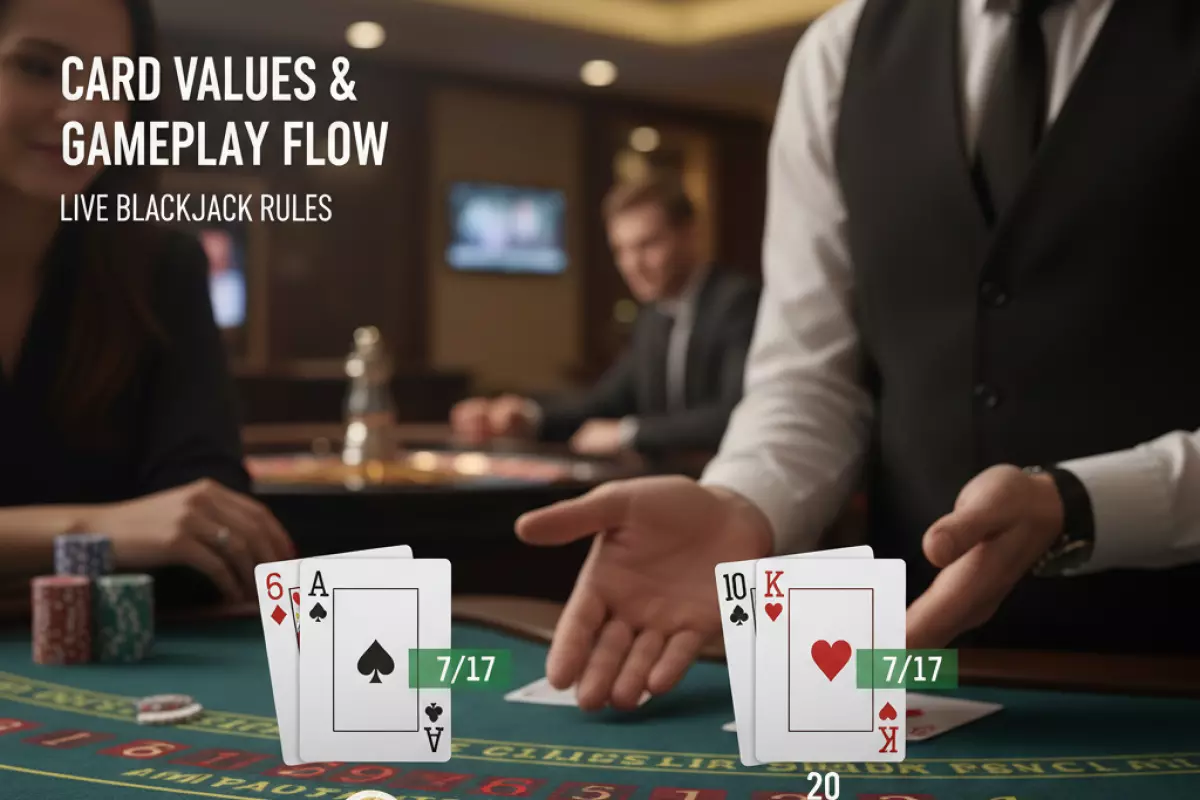
In live blackjack, everything starts with how each card contributes to your hand total and how that total is judged against the dealer’s. The goal is simple: finish with a higher total than the dealer without going over 21.
Card values (including aces)
Number cards (2 through 10) count as their face value. Face cards (Jack, Queen, King) each count as 10. The Ace is flexible: it can count as 1 or 11, whichever is better for your hand at that moment.
This flexibility is why you’ll hear the terms soft and hard totals. A soft hand includes an Ace counted as 11 (for example, A+6 = soft 17). A hard hand either has no Ace or has an Ace that must count as 1 to avoid busting (for example, A+6+10 = hard 17).
What “blackjack” means
A “blackjack” is a two-card 21 made with an Ace plus any 10-value card (10, J, Q, or K). It’s different from reaching 21 with three or more cards, which is simply a total of 21 and not the same hand category.
In most live tables, a natural blackjack is paid at a premium (commonly 3:2, sometimes 6:5). The key gameplay point is that a natural 21 is resolved immediately unless the dealer can also make blackjack, in which case it becomes a push.
Round structure at a live dealer table
A live blackjack round follows a consistent sequence, even though the pace can feel faster than in a standard RNG game because the dealer is dealing in real time. Your decisions are time-limited, and the table typically moves on as soon as all players have acted.
- Place your bet before the betting timer ends.
- Initial deal: you receive two cards; the dealer receives two cards (usually one upcard visible and one hole card hidden, depending on the variant).
- Check for blackjack: if you have a natural 21, the hand may be settled right away unless the dealer can match it.
- Player decisions: you choose actions such as hit, stand, double, split, or surrender (if offered), in table order.
- Dealer plays: after all players finish, the dealer reveals the hole card and draws according to fixed rules (for example, hitting until 17 or higher).
- Settlement: hands are compared and paid out as win, loss, or push.
How outcomes are decided
Once all cards are out, results are based on totals and bust status. If your hand exceeds 21, you bust and lose immediately, regardless of what the dealer later draws. If you don’t bust, your total is compared to the dealer’s final total.
- Win: your total is higher than the dealer’s without exceeding 21, or the dealer busts while you don’t.
- Loss: you bust, or the dealer’s total is higher without exceeding 21.
- Push: you and the dealer finish with the same total (including both having blackjack).
Common player actions and what they change
Your available moves depend on the casino rules and the moment in the hand. “Hit” adds a card to improve your total; “stand” ends your action. “Double” increases your bet (usually by 100%) in exchange for committing to take exactly one more card, which is why it’s often used when you’re likely to improve with a single draw.
“Split” applies when your first two cards are a pair; it creates two separate hands, each with its own follow-up decisions and typically its own additional bet. If “surrender” is offered, it lets you forfeit the hand early for a partial loss, which can be useful in specific high-risk matchups.
Because live blackjack runs on a real dealing rhythm, it helps to recognize your hand type (soft vs. hard), the dealer’s upcard, and your allowed actions quickly. That’s the practical foundation for making strategy decisions without rushing when the decision timer starts.
Basic blackjack strategy in live games

In a live dealer setting, good decisions come from a simple goal: get as close to 21 as possible without busting, while reacting to the dealer’s upcard. Because the rules are fixed and the dealer plays by strict procedures, you can reduce guesswork by following a consistent decision framework rather than “going with a feeling.”
The foundation is basic strategy: a set of mathematically tested plays for every common hand. It does not guarantee a win in a single round, but it does lower the house edge over time compared with random hitting and standing. In live games, it also helps you play at a steady pace, which matters when the timer is running.
Start with the three hand types
Most decisions become easier when you classify your hand correctly. Live blackjack interfaces usually show your total, but you still need to recognize what kind of total it is, because the best move changes.
- Hard totals: no Ace counted as 11 (or an Ace that must be counted as 1). Example: 16 (10+6).
- Soft totals: an Ace counted as 11, so you can’t bust with one hit. Example: A+6 (soft 17).
- Pairs: two cards of the same rank that may be split. Example: 8+8.
Core decision rules you can apply quickly
These guidelines cover the most frequent situations and help you avoid the biggest long-term mistakes. They assume standard rules where the dealer stands on 17; if your table differs (for example, dealer hits soft 17), the optimal choices can shift slightly.
When to stand: Stand on hard 17 or higher. Also, stand on hard 13–16 when the dealer shows 2–6, because the dealer is more likely to bust.
When to hit: Hit hard 11 or less. Hit hard 12–16 when the dealer shows 7–A, because standing leaves you losing too often against strong dealer upcards.
When to double down: Double is strongest when you have an advantage and only want one more card. Common doubles include 11 vs most dealer upcards, 10 vs 2–9, and 9 vs 3–6. With soft hands, doubling A+7 (soft 18) vs 3–6 is often profitable, while soft 13–17 can be good doubles vs 4–6 depending on the exact total.
When to split: Always split Aces and 8s in most rule sets. Never split 10s. Splitting 2s, 3s, 6s, 7s, and 9s depends on the dealer’s upcard, but the general idea is to split against weaker dealer cards (2–6) and avoid it against strong ones (7–A) unless the pair is Aces or 8s.
Insurance and even money: usually a pass
Insurance is a side bet that the dealer has blackjack when showing an Ace. For most players, it’s a negative-value wager, so the practical default is to decline it. “Even money” on a player blackjack against a dealer Ace is effectively the same choice as taking insurance; unless you are making decisions based on card composition, it’s typically better to let the hand resolve normally.
Live-game habits that protect your edge
Live tables add real-world friction: countdown timers, chat, and occasional distractions. A few habits keep your play consistent with your strategy.
- Check the rules panel before sitting down: number of decks, dealer hits/stands on soft 17, double options, and surrender availability.
- Decide before the timer gets low: pre-plan your move based on your hand type and the dealer upcard.
- Avoid “tilt” adjustments: changing your decisions because of recent losses usually increases mistakes more than it helps.
- Keep bankroll and bet size separate from strategy: basic decisions (hit/stand/double/split) should not change because you “need a win.”
Common mistakes to avoid at the live table
The biggest leaks are predictable: standing too often on weak totals, refusing to split 8s, and skipping doubles when the math supports them. Another frequent error in live dealer blackjack is misreading a soft total as hard (or vice versa), which leads to overly cautious stands or unnecessary hits.
If you want a simple takeaway, prioritize correct play on the high-impact spots: hard 12–16 decisions versus dealer 2–A, doubling 9–11 appropriately, and splitting Aces and 8s. Getting those right consistently will do more for your long-run results than any “system.”
Blackjack odds and house edge
The math in live dealer blackjack comes down to two things: the probability of outcomes (win, lose, push) and the built-in advantage created by the rules. Unlike many casino games, your decisions can shift the expected return, so understanding where the edge comes from helps you play more efficiently.
In most common live blackjack setups, the casino’s advantage is relatively small compared with games like roulette. Still, it’s real, and it grows quickly when you deviate from sound decisions or when table rules are less favorable (for example, reduced payouts on a natural blackjack).
What “house edge” means in practical terms
House edge is the casino’s average advantage over the long run, expressed as a percentage of your total amount wagered. For example, a 0.5% edge means that over a very large number of hands, you’d expect to lose about 0.50 units for every 100 units wagered, assuming you play close to optimal strategy.
This is not a prediction for a single session. Short-term results swing because blackjack has variance: you can win or lose for hours while still being “on track” with the underlying probabilities.
Where the casino advantage comes from
The biggest built-in advantage is that the dealer acts after the player. If you bust, you lose immediately, even if the dealer later busts too. Beyond that, specific rule choices change the expected value hand by hand.
- Blackjack payout: 3:2 is stronger for players than 6:5, which increases the casino advantage noticeably.
- Dealer action on soft 17: Dealer stands on soft 17 (S17) is better for players than dealer hits soft 17 (H17).
- Doubling rules: Being allowed to double on more totals (or after splits) improves your expectation.
- Splitting rules: Re-splitting and whether you can hit/double after splitting aces affects value.
- Surrender availability: Late surrender can reduce losses in a few high-risk spots.
- Number of decks and penetration: More decks and less penetration generally increase the casino’s advantage, especially for card counters.
Typical rule impacts at a glance
The exact numbers vary by ruleset and strategy, but the direction is consistent: some rules shave the casino edge down, others push it up. The table below summarizes common live blackjack rules and how they usually affect expected return.
| Rule / condition | Typical effect on player expectation | Why it matters |
|---|---|---|
| Blackjack pays 3:2 | Improves player return | Naturals are a key profit source; better payout lowers the casino advantage. |
| Blackjack pays 6:5 | Worsens player return (often significantly) | Reduces payoff on one of the most valuable outcomes, raising the house edge. |
| Dealer stands on soft 17 (S17) | Improves player return | Dealer stops more often on weak soft totals, reducing dealer improvement draws. |
| Dealer hits soft 17 (H17) | Worsens player return | Dealer gets extra chances to upgrade soft 17 into stronger totals. |
| Double after split allowed (DAS) | Improves player return | Lets you press advantage on strong post-split hands. |
| Late surrender offered | Improves player return | Allows you to cut losses in a few unfavorable matchups (e.g., certain 16 vs 10 situations). |
| Fewer decks / deeper penetration | Usually improves player return (especially for counting) | More information about remaining cards can be leveraged; also slightly shifts some baseline probabilities. |
Odds you’ll actually feel during play
From a player’s perspective, the most important “odds” are tied to decision points: when to hit, stand, double, or split. Basic strategy aims to minimize expected loss by choosing the action with the best long-run value for your hand versus the dealer upcard.
Two examples of how probability drives decisions:
Doubling is recommended when the chance of improving your total (and winning more often) outweighs the risk of losing a larger bet. Standing becomes correct when hitting is more likely to bust than to meaningfully improve your winning chances given the dealer’s visible card.
How strategy changes the edge
Rule quality sets the baseline, but your choices determine how much of that baseline you give back. Playing close to basic strategy typically keeps the casino advantage low under fair rules. Consistent mistakes (like standing too often on stiff hands or failing to split/double in the right spots) increase the expected loss rate over time.
If you want one practical takeaway for live tables: prioritize games with 3:2 payouts, avoid 6:5 when possible, and follow a solid decision chart. That combination does more for your long-run results than chasing short-term streaks.
Common mistakes in live blackjack
Most errors at a live dealer table come from treating it like a fast slot-style game instead of a rules-driven card game. The pace, the chat, and the “real-time” feel can push players into rushed decisions that quietly increase the house edge.
Misplaying basic decisions under pressure
The biggest leak is deviating from sound blackjack decisions because a hand “feels” risky or because other players comment in chat. In live play, you’ll see more social pressure than in RNG blackjack, but the math doesn’t change.
Common examples include standing on 16 vs. a dealer 10 out of fear of busting, failing to double 11 vs. a dealer 6 because it “seems greedy,” or splitting pairs at the wrong times. If you’re unsure, slow down and follow a basic strategy chart for the specific rules in use (number of decks, dealer hits/stands on soft 17, surrender availability).
Ignoring table rules and payout details
Live tables can differ in small ways that have a big impact: blackjack may pay 3:2 or 6:5, the dealer may hit soft 17, and side rules like late surrender or double-after-split may be allowed or not. Players often assume all tables are identical, then wonder why results “feel worse.”
Before sitting down, check the key rules on the table info panel. A single rule change can shift the expected value enough to matter over a long session, even if your decisions are otherwise solid.
| Mistake | Why it hurts | What to do instead |
|---|---|---|
| Playing 6:5 blackjack without noticing | Reduces payout on natural blackjacks, increasing the house edge | Prefer 3:2 tables when available, especially for longer sessions |
| Forgetting whether dealer hits soft 17 (H17) or stands (S17) | Changes optimal plays and slightly worsens conditions under H17 | Confirm H17/S17 and use the matching strategy guidance |
| Assuming doubling and splitting rules are standard | Restrictions remove profitable options and alter correct decisions | Check “double on any two,” “double after split,” and split limits |
| Overvaluing side bets | Many side bets carry a much higher house edge than the main game | Treat side bets as entertainment; keep stakes small or skip them |
Chasing losses and changing stakes emotionally
Live blackjack makes it easy to tilt: you see the dealer, you watch other players win, and it can feel personal when a run goes badly. A common mistake is increasing bets to “get even,” or dropping to tiny bets and then making reckless doubles or splits to compensate.
Set a session budget and a simple staking plan before you start. If you choose to vary your bet size, do it for a reason you can explain (and stick to your limits), not because the last few hands were frustrating.
Misunderstanding “flow,” seat position, and other myths
Players often blame other seats for “taking the dealer’s bust card” or believe that joining mid-shoe changes outcomes in a predictable way. In standard live dealer blackjack, each hand is an independent decision given the cards currently in play; other players’ choices don’t change what is mathematically correct for your hand.
Focus on decisions you control: your hit/stand/double/split choices and the table conditions. Worrying about “table flow” is a distraction that can lead to worse play.
Timing errors unique to live dealer games
Because actions are time-limited, some players misclick, run out of time, or place bets late and end up with defaults they didn’t intend. This is especially costly on hands where doubling or splitting is the correct move.
- Use a stable connection and avoid switching networks mid-session.
- Decide your action as soon as your cards appear, not at the last second.
- If the interface offers it, enable confirmations for doubles/splits to prevent accidental taps.
Overcomplicating card counting expectations
Some players try to count cards in live games without accounting for practical limits: frequent shuffles, cut card depth, and the speed of dealing can reduce any potential edge. Counting also requires strict bet spreads and discipline, which many players abandon when the session becomes emotional.
If you’re not prepared to track counts accurately and adjust play correctly, you’re usually better off focusing on clean basic strategy, choosing favorable rules, and managing your bankroll carefully.
Choosing the best live blackjack tables
Pick a live blackjack game by starting with the rules and limits, not the lobby thumbnail. Small rule differences can change the house edge, and table limits determine whether your bankroll can handle normal swings without forcing bad decisions.
Start with the rules that affect the house edge
Before you sit down, open the table info and check the rule set. In live dealer blackjack, casinos often run several variants side by side, and the “standard” option is not always the most favorable.
| What to check | Why it matters in live blackjack | Player-friendly direction |
|---|---|---|
| Blackjack payout | A 6:5 payout increases the casino advantage compared with 3:2. | Choose 3:2 whenever available. |
| Dealer stands or hits soft 17 (S17/H17) | Dealer hitting soft 17 slightly improves dealer outcomes on borderline hands. | S17 is generally better for players. |
| Doubling rules | Limits on doubling reduce profitable spots (especially after splits). | Double on any two cards; double after split allowed. |
| Splitting rules | Restrictions (e.g., no resplit aces) reduce value on strong split situations. | Resplitting allowed; reasonable split limits. |
| Surrender availability | Late surrender can cut losses in a few high-disadvantage matchups. | Late surrender offered. |
| Number of decks / penetration | More decks and shallow penetration can slightly worsen odds and reduce counting viability. | Fewer decks and deeper penetration are preferable. |
| Side bets | Most side bets carry a much higher house edge than the main game. | Treat as entertainment; avoid if optimizing EV. |
Match table limits to your bankroll and goals
Limits aren’t just about affordability; they influence whether you can follow basic strategy consistently. If the minimum bet is too high, normal variance can push you into “chasing” losses or skipping doubles and splits you should take.
As a practical guideline, look for a minimum stake that lets you comfortably play a full session while still doubling and splitting when the strategy calls for it. If you’re planning to use a mild progression or vary bets, make sure the maximum bet won’t cap you at the worst time.
Consider game format: standard tables vs. speed vs. unlimited seats
Different live dealer formats fit different players. Standard tables feel closest to a casino, but pace depends on other players. Speed tables reduce downtime, which increases hands per hour and can increase both your potential results and your variance in the same time window.
Unlimited-seat or “one-to-many” games can be convenient when tables are busy, but they may come with different side bet menus, UI timing, or occasional rule tweaks. Always re-check the info panel rather than assuming it matches the last table you played.
Evaluate the dealer interface and decision time
A clean layout and predictable timers matter more than people expect. If the decision window is short, you’re more likely to misclick or rush difficult hands (like soft totals and split decisions). Choose a table where you can comfortably act without feeling pressured.
Also check whether the table supports features you rely on, such as clear hand history, visible discard tray/shoe, and straightforward controls for split and double. These don’t change the math, but they reduce avoidable mistakes.
Look for fairness signals and table transparency
Live blackjack should make the dealing process easy to follow. Good tables show continuous video, consistent shuffling procedures, and clear card placement. If camera angles frequently obscure the shoe or the dealer’s actions, it’s reasonable to switch to a more transparent table.
A quick checklist before you join
- Confirm 3:2 blackjack payout and review S17/H17.
- Verify doubling and splitting options (especially double after split).
- Check minimum/maximum bets and whether they fit your session plan.
- Skip side bets if your priority is lower house edge.
- Test the interface: timer length, button placement, and clarity of the stream.
If you’re unsure between two live blackjack tables, choose the one with the cleaner rules and limits you can sustain. Comfort and consistency usually beat chasing a “hot” table, because correct decisions over many hands are what actually protect your edge.