Caribbean Stud Poker Rules, Payouts and Gameplay

 This article explains what Caribbean Stud Poker is, how gameplay works, and the step by step round structure. It covers the hand rankings used, the payout table, house edge and odds, basic beginner strategy tips, and how playing Caribbean Stud online works.
Learn how Caribbean Stud Poker works before you play by understanding the rules, payouts, and round flow. The basics are easy, but the dealer must qualify and the pay table can change outcomes quickly. Know what happens from placing your ante to choosing whether to raise, then compare hands at showdown and collect the correct payout.
What Caribbean Stud Poker is

This casino table game is a five-card, poker-style contest played against the dealer rather than other players. You’re trying to finish with a stronger hand than the dealer using standard poker rankings, and the round is decided by a simple choice after you see your cards: continue by raising, or fold and give up your initial bet.
Unlike many poker variants, there’s no bluffing, no betting rounds, and no changing the size of your wager multiple times. Each player receives five face-down cards, the dealer gets four face-down plus one face-up card, and the outcome is based on comparing completed five-card hands.
How it differs from regular poker
In traditional poker, you compete against other players and the pot size is driven by a sequence of bets, raises, and folds. In Caribbean Stud, the structure is fixed: you place an Ante, look at your hand, and then either fold or make a single Raise (often called the “Call”) at a set multiple of the Ante.
Another key difference is the dealer “qualification” rule used in many versions. Even if you have the better hand, the dealer may need to meet a minimum hand strength to qualify for a full comparison and payout on the Raise portion. This rule is one of the reasons the game feels more like a casino pit game than a player-versus-player poker session.
Core elements you’ll see at the table
The game usually revolves around two main wagers: the Ante (your starting bet) and the Raise (your decision bet after seeing your cards). Many tables also offer an optional side bet, commonly called a progressive or bonus wager, which pays based on your hand strength rather than on beating the dealer.
- Ante: mandatory opening bet to receive cards.
- Raise/Call: a fixed multiple of the Ante made after you review your hand.
- Dealer upcard: one dealer card shown face-up that can influence your fold-or-raise decision.
- Optional side bet: separate wager with its own payout schedule, independent of the main hand result.
What a typical round looks like
A hand moves quickly because there’s only one decision point. After the deal, you evaluate your five-card hand in light of the dealer’s upcard. If you fold, the round ends for you and the Ante is lost. If you raise, the dealer reveals the remaining cards, and hands are compared using standard poker rankings.
If the dealer doesn’t qualify (where that rule applies), the outcome is usually handled in a specific way: the Ante may pay at even money while the Raise is returned, or the rules may vary slightly by casino. When the dealer qualifies, your hand either wins, loses, or ties (pushes), and payouts follow the table’s posted rules.
How Caribbean Stud gameplay works

Caribbean Stud is a casino table game where you play a five-card poker hand against the dealer, not against other players. You make one key decision after seeing your own cards: either fold and give up your initial bet, or raise and continue to showdown.
Placing your bets before any cards are dealt
Each round starts with an Ante bet. Many tables also offer an optional side bet (often called a progressive or bonus) that pays based on your hand strength, regardless of what the dealer has. The side bet is separate from the main game and doesn’t affect whether you should raise or fold.
Dealing and what you can see
You receive five cards face up (or otherwise fully visible to you), while the dealer gets five cards with one card face up and the rest face down. Unlike some poker variants, there are no community cards and no drawing; your hand is final once dealt.
Your decision: fold or raise
After looking at your five cards and the dealer’s upcard, you choose between:
- Fold: you end the hand and lose your Ante (the side bet, if placed, is still settled by its own rules).
- Raise: you place a Raise bet that is typically 2× the Ante and proceed to the dealer’s hand reveal.
Dealer qualification and why it matters
Once you raise, the dealer turns over the remaining cards. In most rule sets, the dealer must “qualify” with at least Ace-King high (or better). Qualification determines how the Ante is handled, but your Raise bet is still resolved based on who has the better poker hand.
Here’s the usual flow after the dealer reveals:
- If the dealer does not qualify: your Ante is typically paid at even money, and your Raise is returned (a push).
- If the dealer qualifies: your hand is compared to the dealer’s hand; the better hand wins.
Showdown: comparing hands and getting paid
If the dealer qualifies and your hand beats the dealer, the Ante is commonly paid at 1:1, while the Raise is paid according to the game’s paytable (for example, higher payouts for straights, flushes, and stronger hands). If the dealer qualifies and beats you, you typically lose both the Ante and the Raise. If hands tie, the standard result is a push on both main bets.
Any optional bonus/progressive wager is settled independently based on your cards (and sometimes on specific outcomes like a royal flush), so it can pay even on hands where you fold or lose the main contest.
Step by step round structure

Each hand of Caribbean Stud Poker follows a fixed sequence: you place your bets, receive five cards, decide whether to continue, and then compare your hand against the dealer’s. The round is quick once you know what triggers the dealer to “qualify” and how the final payout is determined.
1) Place your bets before any cards are dealt
You start by placing an Ante. Many tables also offer an optional side bet (often called a progressive or bonus bet). The side bet is settled independently from the main game, so it can win or lose regardless of what happens with your Ante and Play bet.
Once betting is closed, no additional chips can be added to the Ante.
2) Deal five cards to you and five to the dealer
You receive five cards face up. The dealer also receives five cards, typically with one card exposed and four face down (the exact display can vary by casino or software, but the decision point is the same).
At this stage, there is no drawing or exchanging cards. Your five-card poker hand is final.
3) Decide: Fold or Play
After viewing your cards, you choose one of two actions:
- Fold: you give up the hand and lose your Ante (the side bet, if placed, is resolved by its own rules).
- Play: you continue by placing a Play bet, usually equal to 2x the Ante.
This decision is the key strategic moment. In most rule sets, you should only continue with hands that are strong enough to beat the dealer often enough to justify the extra wager.
4) Dealer reveals the hand and checks for qualification
Once all players have acted, the dealer turns over the four hidden cards to make a five-card hand. Then the dealer is checked to see if they qualify.
In standard Caribbean Stud Poker rules, the dealer qualifies with Ace-King high or better. That means the dealer must have at least A-K as the top two cards (or any pair or stronger hand). If the dealer has less than A-K high, they do not qualify.
5) Settle the Ante and Play bets based on qualification and hand comparison
There are two different settlement paths depending on whether the dealer qualifies.
If the dealer does not qualify: the Ante is paid (commonly at even money), and the Play bet is returned as a push. Your hand strength does not need to be compared to the dealer’s for the qualification result to apply, although some venues still reveal the comparison for transparency.
If the dealer qualifies: your hand is compared to the dealer’s hand using normal poker rankings (from high card up to straight flush). Outcomes are handled as follows:
- If your hand is higher: the Ante is typically paid at even money, and the Play bet is paid according to the posted paytable.
- If the dealer’s hand is higher: you lose both the Ante and the Play bet.
- If the hands tie exactly: both the Ante and Play bet usually push (returned).
6) Understand what gets paid at a flat rate vs. by paytable
Most versions pay the Ante at a fixed rate (often 1:1) when you win against a qualifying dealer, while the Play bet uses a payout schedule that increases with stronger hands. The exact odds can vary by casino, so it’s worth checking the table signage before you sit down.
Side bets (if offered) are evaluated separately and usually pay based only on your hand, not on whether the dealer qualifies or whether you win the main comparison.
7) Start the next hand
After bets are settled, all cards are collected, and a new round begins with a fresh Ante (and optional side bet). Because there are no draw decisions, hands move quickly and the main rhythm is: bet, receive five cards, choose fold or raise, then resolve against the dealer.
Poker hand rankings used in the game
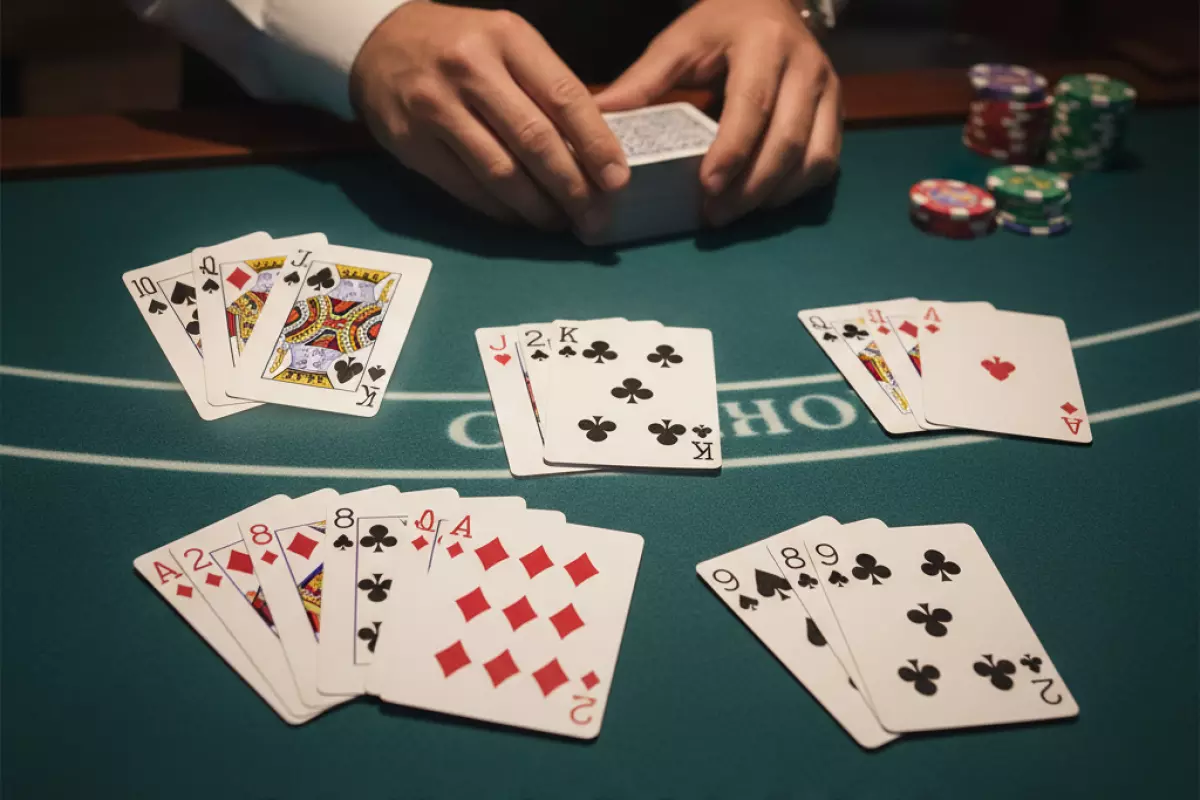
Caribbean Stud uses standard five-card poker hand order to compare your hand against the dealer’s. The higher-ranking hand wins, and if both hands are the same type, the usual tie-breakers (highest relevant cards) decide the result.
Unlike some poker variants, suits have no ranking value here. A flush is judged by the fact that all five cards share a suit, not by whether it’s spades or hearts.
Hand order from highest to lowest
The game follows the familiar hierarchy below, evaluated using five cards:
- Royal Flush: A, K, Q, J, 10 all in the same suit.
- Straight Flush: Five consecutive cards in the same suit (e.g., 9-8-7-6-5 suited).
- Four of a Kind: Four cards of the same rank (e.g., four 7s).
- Full House: Three of a kind plus a pair (e.g., 8-8-8 and K-K).
- Flush: Any five cards of the same suit, not in sequence.
- Straight: Five consecutive ranks, suits mixed (e.g., Q-J-10-9-8).
- Three of a Kind: Three cards of the same rank (e.g., J-J-J).
- Two Pair: Two different pairs plus a fifth card (e.g., A-A and 4-4 with a 9 kicker).
- One Pair: One pair plus three other cards.
- High Card: No made hand; the highest card plays.
How ties are decided (quick guide)
If both you and the dealer make the same category of hand, the winner is determined by comparing the highest relevant ranks first, then moving to the next card(s) as needed. For example, with two pair, the higher top pair is compared first, then the second pair, and finally the kicker if still tied.
Aces can be high or low in a straight (A-K-Q-J-10 is highest; A-2-3-4-5 is the lowest straight). In most house rules, A-2-3-4-5 is treated as a valid straight, but it does not “wrap” (Q-K-A-2-3 is not a straight).
Dealer qualification and why it matters
Hand ranking determines who wins, but Caribbean Stud also has a dealer “qualifying” rule that affects payouts. In many versions, the dealer must have at least Ace-King high (or better) to qualify. If the dealer doesn’t qualify, the ante is typically paid at even money, and the raise is returned, while side bets (if any) are settled separately under their own paytables.
Caribbean Stud payout table explained
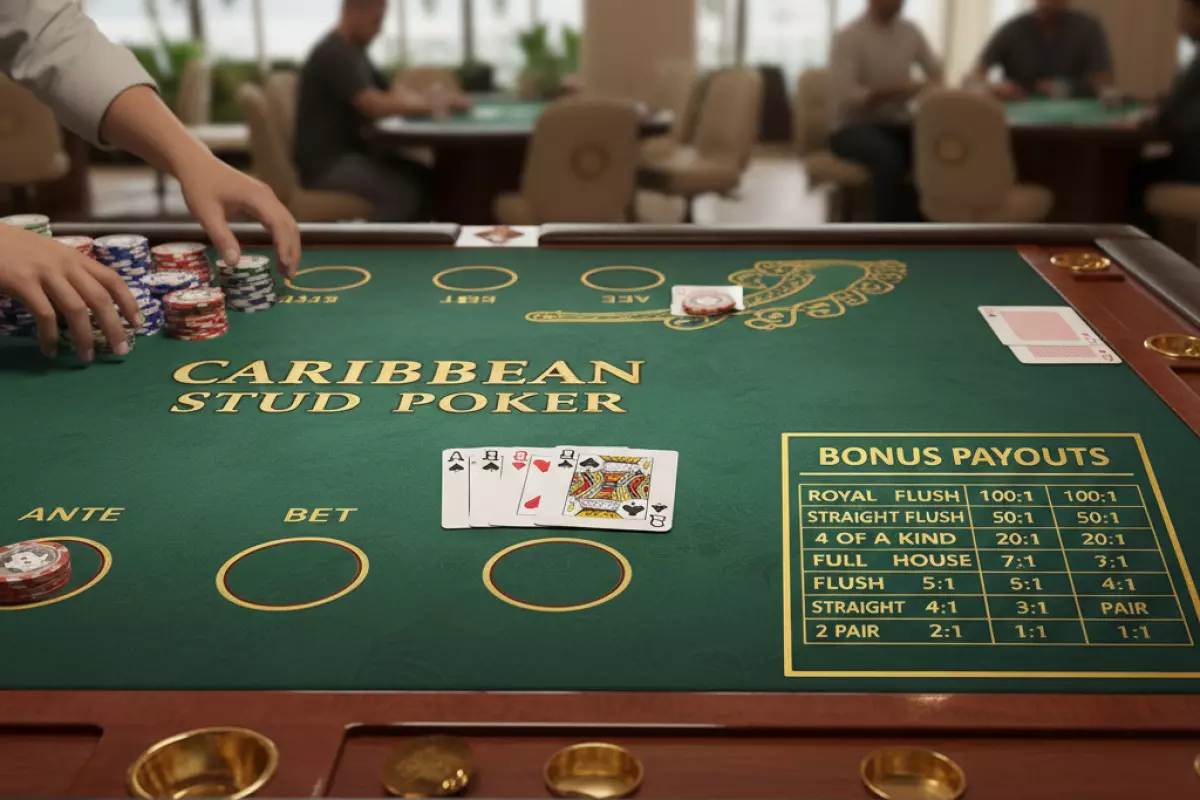
The paytable in Caribbean Stud Poker tells you how much your Ante and any optional Bonus wager return when you make a qualifying hand. Most casinos use a fixed schedule for the main game, but the side bet (when offered) can vary a lot, so it’s worth checking the felt or the rules card before you sit down.
Ante and Call: what gets paid and when
The core bet is the Ante. After you see your five cards, you either fold (losing the Ante) or call by placing a Call bet that is typically 2× the Ante. If you call, your hand is compared to the dealer’s hand, but the dealer must meet a minimum to “open” (commonly Ace-King or better).
Two separate things can happen on the main wager:
- Dealer does not qualify: your Ante is usually paid even money, and the Call bet is returned (no win, no loss on the Call).
- Dealer qualifies: if you beat the dealer, the Ante pays even money and the Call bet pays according to the hand-ranking payout schedule; if you lose, you lose both Ante and Call.
Typical main-game payout schedule (Call bet)
When the dealer qualifies and you win, the Call bet is paid by the strength of your hand. The exact numbers can differ by venue, but the following table reflects a common Caribbean Stud Poker paytable used for the main game.
| Player hand (when you win) | Typical payout on the Call bet | What happens to the Ante |
|---|---|---|
| High card / One pair | 1:1 | Paid 1:1 |
| Two pair | 2:1 | Paid 1:1 |
| Three of a kind | 3:1 | Paid 1:1 |
| Straight | 4:1 | Paid 1:1 |
| Flush | 5:1 | Paid 1:1 |
| Full house | 7:1 | Paid 1:1 |
| Four of a kind | 20:1 | Paid 1:1 |
| Straight flush | 50:1 | Paid 1:1 |
| Royal flush | 100:1 | Paid 1:1 |
Notice the structure: the Ante is straightforward (even money when you win and the dealer qualifies), while the Call bet is where the “big” multiples appear. That’s why a strong made hand matters more than simply beating the dealer by one card.
How to read payout ratios correctly
A ratio like 5:1 means you win five units for every one unit you wagered on that bet, and you also get your original stake back. For example, if your Call bet is $20 and your winning hand is a flush paying 5:1, the win on the Call is $100 and you keep the $20 Call chip as well. The Ante is resolved separately (usually +$10 if your Ante was $10 and the dealer qualified).
Bonus/side bet payouts: why they differ
If the table offers a Bonus wager (sometimes called a progressive or jackpot side bet), it typically pays based only on your hand, regardless of whether the dealer qualifies or even beats you. The trade-off is that side bets usually have a higher house edge and the paytable can be very different from one casino to another.
When you’re comparing options, focus on two practical questions: what is the minimum paying hand for the bonus, and how top-heavy the payouts are (for example, whether most of the return is concentrated in rare hands like straight flushes and royals).
House edge and odds in Caribbean Stud
The math in this game is driven by two things: how often the dealer qualifies with at least Ace-King, and how frequently your hand ends up strong enough to justify raising. Because you must decide before seeing the dealer’s cards, the long-run cost comes mostly from paying the ante when you fold and from the times you raise into a better dealer hand.
Under standard rules (dealer qualifies with Ace-King or better and the usual paytable), the casino advantage is typically around 5% on the ante when you play with near-optimal strategy. Your actual results can swing a lot in the short term because outcomes are “lumpy”: many hands end quickly with a fold, while wins and losses after a raise are larger because the raise is usually 2× the ante.
How the dealer qualifying rule affects your odds
Dealer qualification is a key reason Caribbean Stud feels different from other poker table games. If the dealer does not qualify, you don’t get paid on the raise (it pushes), but you usually still get paid even money on the ante. That sounds good, but it also means a chunk of hands produce small wins while your losing hands after a raise are still full-size losses, which shapes the overall expectation.
In practice, the dealer qualifies most of the time. When the dealer fails to qualify, it reduces volatility on the raise portion (since it becomes a push), but it doesn’t eliminate the built-in edge because you still face many situations where folding is correct and costs you the ante.
Why the paytable matters more than most players expect
The payout schedule on the raise is where the game’s value really lives. Small changes to what a flush, straight, or full house pays can noticeably move the expected return, because those hands are rare but high-impact when they occur. If a casino uses a reduced paytable, the built-in advantage increases even if all other rules look the same.
Most standard versions pay even money on the ante when you win, while the raise pays according to your final hand strength (with the dealer qualifying). If you’re comparing tables, the quickest “sanity check” is to look at the top end (flush and above) and confirm it matches the standard schedule posted on the felt.
What “odds” look like in real play
Your decision is binary: fold and lose the ante, or raise (usually 2×) and take your hand to showdown. That structure means the typical hand is not a slow grind of small edges; instead, you’ll see lots of small losses (folds) mixed with occasional bigger wins and bigger losses (raised hands).
As a rule of thumb, raising with marginal hands tends to be expensive because you’re committing extra money when the dealer’s qualifying range and random five-card strength will often beat one-pair type holdings. Conversely, folding too often is also costly because you surrender the ante in spots where you have a reasonable chance to win at showdown.
Strategy choices that move the edge
Using a consistent, math-based raise/fold approach is the main way to keep the casino advantage near its typical level. The biggest mistakes come from “curiosity calls” (raising with weak high-card hands) and from folding hands that are clearly ahead of the dealer’s likely qualifying range.
- Over-raising increases losses because the raise is larger than the ante and you’ll often be behind at showdown.
- Over-folding quietly drains bankroll through repeated ante losses, even when your hand has decent equity.
- Ignoring paytable differences can turn a playable game into a significantly worse one without changing the rules you see.
Side bets and their impact on expected value
If your table offers an optional progressive or bonus wager, treat it as a separate game. These side bets usually have a much higher house advantage than the base ante/raise structure, because they pay for rare events (like very strong hands) and collect many small losses in between. They can be fun for volatility, but they typically worsen your long-run expectation compared to sticking to the main bet only.
Basic strategy tips for beginners
In Caribbean Stud, your main decision is whether to fold or raise after seeing your five-card hand. Because you’re not trying to outplay other players, the goal is simple: raise with hands that are strong enough to beat the dealer often, and fold when your hand is unlikely to improve your long-term results.
Use the standard “raise or fold” rule of thumb
The most common beginner-friendly guideline is: raise with Ace-King or better, and fold with anything worse. “Ace-King” here means a hand with at least an Ace and a King (not necessarily suited) that is not already a made hand like a pair.
This rule works because high-card hands below A-K tend to lose too often against the dealer’s final hand, while A-K and above have enough showdown value to justify the 2x raise in most situations.
Quick checklist: when raising is automatic
If you have any made hand, you generally raise without overthinking it, since your hand already has real value and can also improve.
- Any pair or better (pair, two pair, three of a kind, straight, flush, full house, four of a kind, straight flush)
- Any hand stronger than Ace-King high (for example, Ace-Queen is usually a fold, but Ace-King is the common cutoff)
How to handle “Ace-King high” hands more carefully
Not all A-K high hands are equal. A practical refinement many players use is to raise with A-K high when you have some extra help, such as:
- A-K with a third card of decent rank (for example, A-K-Q or A-K-J)
- A-K with some suitedness or connected cards that give you realistic improvement chances
If your A-K is very weak (for example, A-K-7-4-2 rainbow), folding is often reasonable. The difference is small, but this tweak can reduce marginal raises that don’t perform well.
Remember the dealer must qualify
The dealer typically needs Ace-King high or better to qualify. This matters because when you raise and the dealer doesn’t qualify, your raise bet is usually paid at 1:1, and the ante pushes (exact handling depends on the table rules). As a result, raising with hands that are likely to beat a non-qualifying dealer can be less risky than it first appears.
Treat the side bet as optional entertainment, not “strategy”
The progressive or bonus side bet in Caribbean Stud is based only on your hand, not on beating the dealer. It can pay big on rare hands, but it usually comes with a higher house edge than the main ante/raise game. If you’re learning the rules and want steadier results, consider skipping the side bet until you’re comfortable with the core fold/raise decision.
Bankroll and pace tips that actually help
Because the raise is typically 2x the ante, your swings can be larger than they look. Keep your base ante small enough that a short losing run won’t force you to abandon solid decisions.
- Choose an ante size that lets you comfortably make the raise many times without stress.
- Avoid “chasing” by increasing the ante after losses; it doesn’t improve the math.
- Play at a steady pace so you don’t misread your hand (misidentifying a straight or flush is a common beginner mistake).
Playing Caribbean Stud online
Online Caribbean Stud is built around the same core decisions as the casino table: place the Ante, optionally add the progressive side bet, review your five-card hand, then choose to fold or make the Play (raise) bet. The main difference is pace and presentation—software handles shuffling, dealing, and payout calculations, so your focus stays on the fold/raise choice and bankroll control.
How a typical round works on a digital table
Most platforms keep the layout familiar: your five cards are shown face up, and the dealer has one card exposed until you act. You’ll usually see the paytable and the dealer-qualification rule (commonly “Ace-King or better”) on the screen, which matters because if the dealer doesn’t qualify, the Ante is paid and the Play bet is returned.
Set your stake for the Ante (and choose a side bet if offered).
Cards are dealt: you receive five cards; the dealer shows one upcard.
Decide: fold (lose the Ante) or raise by placing the Play bet (typically 2x Ante).
Dealer reveals the full hand; qualification is checked.
Payouts resolve: Ante and Play are settled based on qualification and hand comparison; bonuses (if any) are applied.
Choosing between fold and raise in online play
Your decision is still made with incomplete information: you see only one dealer card. A practical approach is to treat the game as a “raise with decent value, fold weak trash” format. Strong made hands (pairs and above) are usually straightforward raises, while marginal high-card hands depend on whether your best five cards have enough strength and structure to compete.
Because the interface often highlights hand rank automatically, it’s easy to play too quickly. Take a moment to confirm what your best five-card hand actually is (especially with two pairs vs. a low pair, or when you have a potential straight/flush that isn’t completed).
Live dealer vs. RNG: what actually changes
Caribbean Stud is offered both as RNG (computer-dealt) and live dealer (real cards streamed). The rules and payouts are usually the same, but the experience isn’t. RNG tables are faster and better for short sessions; live dealer games slow things down and feel closer to a physical casino, with more time to think and clearer “table” rhythm.
| Feature | RNG (digital dealing) | Live dealer |
|---|---|---|
| Pace | Very fast; more hands per hour | Slower; closer to casino tempo |
| Decision time | Often shorter timers; quick auto-resolve | Usually more time to act |
| Game feel | Clean UI, instant results | Human dealer, physical cards on camera |
| Best for | Practice, speed, small breaks | Immersion, slower bankroll management |
Side bets and progressive jackpots online
Many online versions include a progressive side bet that pays based on your hand only, independent of the dealer’s result. This can be appealing if you like occasional big-hit potential, but it also changes variance: you’ll see longer stretches of small losses punctuated by rare payouts. Before enabling it, check whether the progressive bet has a fixed amount, whether it can be toggled each hand, and what hand ranks trigger awards.
If a table offers multiple side bets, don’t assume they share the same paytable. Even small differences in bonus payouts can change how “swingy” the session feels, especially when you’re playing quickly.
Practical tips for smoother online sessions
Confirm the paytable before you start; online rules can vary slightly by provider.
Watch for dealer qualification so you understand why the Play bet is returned on some hands.
Use consistent bet sizing if you’re learning; it makes results easier to interpret.
Slow down on borderline hands; the UI can make folding/raising feel automatic.
Set a session limit (time or bankroll) because faster dealing increases volatility.
Once you’re comfortable with the flow, online Caribbean Stud becomes a simple rhythm: manage your stake, make disciplined fold/raise decisions, and treat side bets as optional variance rather than a default part of the main game.