Video Poker Rules, Strategy and Payouts Explained

 This article explains what video poker is and how it works, walks through gameplay step by step, and breaks down hand rankings. It covers paytables, payouts, RTP and odds, popular variations, beginner strategy basics, and tips for playing online.
Playing video poker well takes more than luck. You need a solid grasp of the rules, smart decisions on which cards to hold or draw, and an understanding of how pay tables affect your long-term results. This guide explains hand rankings, common hold strategies, and how to find machines with better payouts, helping you manage risk, avoid costly mistakes, and play with a clear plan.
What video poker is and how it works

Video poker is a casino card game that blends the pace of a slot machine with the decision-making of five-card draw. You play against a fixed paytable rather than a dealer, and your results depend on two things: the cards you’re dealt and the choices you make about which cards to keep.
Each hand starts with five cards on the screen. You then choose which cards to hold and which to discard. The machine replaces the discarded cards with new ones, and the final five-card hand is evaluated using standard poker rankings. If your hand matches a paying combination shown on the paytable, you’re paid according to your bet size.
The basic flow of a hand
The gameplay loop is simple, but the decisions can be surprisingly deep. A typical round looks like this:
- Choose your denomination and number of coins/credits to bet.
- Press Deal to receive five cards.
- Select the cards you want to hold.
- Press Draw to replace the unheld cards.
- The final hand is scored and paid based on the paytable.
Why the paytable matters
Unlike many casino games, the payout schedule is visible before you play. That paytable determines the game’s theoretical return and also changes optimal strategy. Two machines that look similar can play very differently if, for example, one pays more for a Full House or Flush than another.
Most versions also offer a higher payout for a Royal Flush when you bet the maximum number of coins. That “max-coin bonus” is why strategy guides often recommend betting max when your bankroll allows it, especially on games where the top jackpot is boosted.
How winning hands are evaluated
Hands are ranked using familiar poker categories such as Pair, Two Pair, Three of a Kind, Straight, Flush, Full House, Four of a Kind, Straight Flush, and Royal Flush. Many common variants start paying at Jacks or Better, meaning a single pair must be Jacks, Queens, Kings, or Aces to qualify for a payout.
It’s important to note that the machine doesn’t “compete” with you. There’s no bluffing, no dealer hand to beat, and no changing odds based on what other players do. Your expected results come from the paytable and the probabilities of improving your hand on the draw.
Randomness and fairness in the deal
Cards are generated by a random number generator (RNG). Conceptually, it’s like drawing from a freshly shuffled deck for each hand, even though you’re seeing it on a screen. Your hold/discard choices affect which new cards you receive on the draw, but they don’t change the underlying randomness of the next cards produced by the RNG.
Because outcomes are probability-driven, short sessions can swing wildly. Over a large number of hands, results tend to track closer to the game’s long-term return, assuming correct play for that specific paytable.
How video poker gameplay works step by step

Video poker plays like a fast, self-dealt version of five-card draw: you place a bet, get five cards, choose which to keep, and the machine replaces the rest. Your final hand is then checked against the paytable to determine the payout.
1) Choose the game and read the paytable
Start by selecting a variant (such as Jacks or Better, Deuces Wild, or Bonus Poker). Before you bet, look at the paytable on the screen because it defines which hands pay and how much. Two machines with the same game name can still have different payouts, which changes the best strategy and the long-term return.
2) Set your bet size (and understand why max coins matter)
Next, choose your coin value and the number of coins/credits per hand. Many machines offer a higher payout for a royal flush when you bet the maximum credits (often 5). That doesn’t mean you must always bet max, but it’s important to know that betting fewer credits can reduce the top prize disproportionately.
3) Deal the initial five-card hand
Press Deal/Draw to receive five cards. At this point, nothing is paid yet (unless you’re playing a special format that evaluates the first hand, which is uncommon). Your job is to decide which cards to hold to maximize expected value based on the paytable and the rules of the variant.
4) Hold the cards you want to keep
Tap or click cards to mark them as “held.” The core decision in video poker is balancing made hands (like a pair) against potential draws (like four to a flush or an open-ended straight draw). In wild-card games, holding decisions change significantly because wilds can complete premium hands more easily.
- Identify any paying hand already present (pair or better, depending on the game).
- Check for strong draws (four to a royal, four to a flush, open-ended straight, etc.).
- Compare options using the paytable logic: some draws are worth more in bonus-style games.
- Lock in your holds before drawing.
5) Draw replacement cards
Press Draw. The machine replaces every unheld card with a new one from the remaining deck. This is the equivalent of the dealer giving you new cards in a live draw poker game; you only get one draw, so your holds should reflect the best single-draw expectation.
6) Hand evaluation and payout
After the draw, the machine evaluates your final five-card hand against the paytable. If it matches a paying category, you’re awarded credits based on your bet size and the listed payout. If it doesn’t qualify, you lose the wager for that hand and can deal again.
7) Repeat with consistent decisions
Video poker is a high-volume game, so results swing in the short run. What you can control is decision quality: using the same sound approach each hand, paying attention to the paytable, and avoiding “gut feel” holds that conflict with the math of the variant.
Common player controls you’ll see on-screen
Most machines and apps use the same basic buttons, even if the layout differs:
- Bet One / Bet Max: adjusts credits wagered per hand.
- Deal / Draw: starts the hand and then performs the replacement draw.
- Hold: toggled per card to keep it for the draw.
- Paytable / Info: shows payouts and sometimes hand rankings or rules.
Video poker hand rankings explained

Most video poker games use standard poker hand order, but the payout table is what tells you which hands are actually paid and how much. Your goal is to build the highest-paying five-card hand after the draw, and knowing the ranking makes it easier to decide what to hold and what to discard.
Hand evaluation is straightforward: the machine checks your final five cards against the paytable from top to bottom. The first matching category is the one that pays, so a hand that qualifies for multiple categories is always paid as the highest one.
How the machine evaluates your final hand
After you choose which cards to keep, the game replaces the discarded cards and then scores the result. Suits only matter for flush-based hands; otherwise, ranking is based on card values (A is high in most games, and can be low only in A-2-3-4-5 straights).
- Order matters: the game checks from the top prize down to the lowest paying hand.
- Paytable matters: some variants pay only from a certain minimum (for example, “Jacks or Better”).
- Five-card result only: unlike some live poker situations, there’s no “best five out of seven” here—your final five cards are the hand.
Standard hand rankings (highest to lowest)
| Rank | Hand | What it means | Quick example |
|---|---|---|---|
| 1 | Royal Flush | A-K-Q-J-10, all the same suit | A♠ K♠ Q♠ J♠ 10♠ |
| 2 | Straight Flush | Five consecutive cards, same suit (not royal) | 9♥ 8♥ 7♥ 6♥ 5♥ |
| 3 | Four of a Kind | Four cards of the same rank | Q♦ Q♣ Q♥ Q♠ 3♦ |
| 4 | Full House | Three of a kind plus a pair | 8♠ 8♦ 8♣ K♥ K♣ |
| 5 | Flush | Any five cards of the same suit (not consecutive) | A♦ J♦ 9♦ 6♦ 2♦ |
| 6 | Straight | Five consecutive cards, mixed suits allowed | 10♣ 9♦ 8♠ 7♣ 6♥ |
| 7 | Three of a Kind | Three cards of the same rank | 5♣ 5♦ 5♥ Q♠ 2♣ |
| 8 | Two Pair | Two different pairs plus one kicker | A♣ A♦ 4♠ 4♥ 9♣ |
| 9 | One Pair | A single pair (often must be Jacks or better to pay) | J♠ J♦ 8♣ 6♥ 2♠ |
| 10 | High Card / No Pay | No qualifying hand (depends on the game) | A♠ Q♦ 9♣ 6♠ 3♥ |
Hands that change depending on the game variant
The biggest differences between video poker titles usually show up at the lower end of the ranking, where some hands pay in one game but not in another. Always read the screen’s paytable before you play, because it defines what counts as a “winning hand.”
Common examples include:
- Jacks or Better: the lowest paying hand is a pair of Jacks, Queens, Kings, or Aces (pairs of Tens and below do not pay).
- Bonus/Double Bonus games: four of a kind may pay different amounts depending on the rank (for example, Aces can pay more than other quads).
- Deuces Wild: 2s act as wild cards, and the hand list is often rearranged (you may see “Five of a Kind” and “Wild Royal”).
Why rankings matter for strategy
Knowing the order helps you avoid common mistakes, like breaking a made hand for a lower-probability upgrade that doesn’t justify the risk. For instance, holding a made flush is usually stronger than chasing a straight flush unless the paytable and your exact cards make the draw clearly profitable.
It also helps with quick decisions on partial hands: four cards to a flush, four to an open-ended straight, and high pairs are evaluated differently because they lead to different top-end outcomes. Once you’re comfortable with the hierarchy, you can use the paytable to judge which holds give you the best expected return.
Paytables and how payouts work
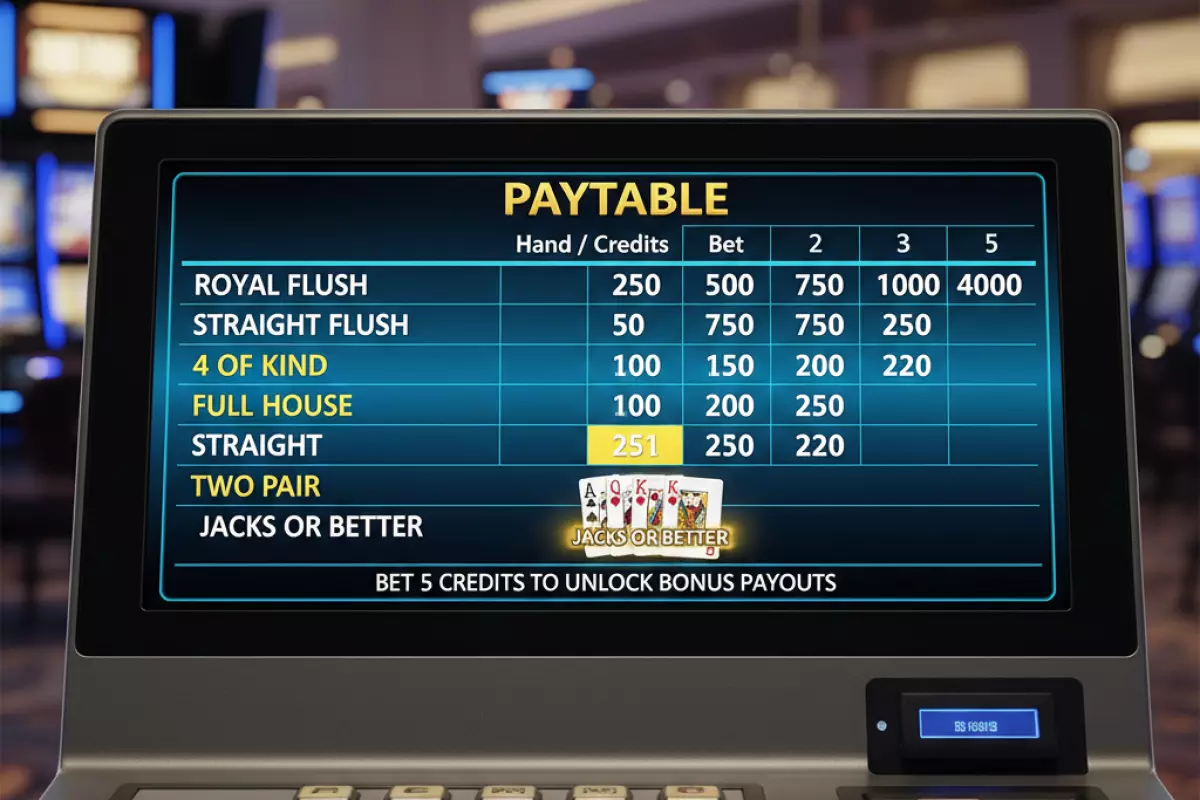
The payout chart is the “price list” for every winning hand in a video poker game. It tells you exactly how many credits you’ll be paid for a Pair, Two Pair, Straight, Flush, Full House, and so on, based on how many credits you bet. Because different machines can use different charts, two games with the same name can have very different returns.
Most games scale linearly: if a hand pays 6 credits for a 1-credit bet, it usually pays 12 for 2 credits, 18 for 3 credits, and 30 for 5 credits. The big exception is the top jackpot hand (typically a Royal Flush), which often gets a bonus at the maximum bet.
How credits, coin-in, and payouts connect
Video poker results are shown in credits, not dollars. Your stake per hand is “credits bet,” and your win is “credits paid.” To convert to money, multiply credits by the credit value (for example, $0.25, $1, etc.).
Here’s the basic relationship:
- Bet per hand = number of credits you wager (often 1 to 5).
- Coin-in = bet per hand × number of hands played.
- Payout = credits awarded by the winning hand × credit value.
Example: if you play $0.25 credits and bet 5 credits, each hand costs $1.25. If you hit a hand that pays 25 credits, that win is 25 × $0.25 = $6.25.
Why “max bet” matters (the Royal Flush bonus)
On many machines, the Royal Flush pays disproportionately more when you bet the maximum number of credits. A common structure is 250 credits for 1 credit bet, but 4,000 credits for a 5-credit bet (instead of the “linear” 1,250). That extra boost can materially change the game’s long-term return, so playing fewer than the max can reduce your expected value even if everything else stays the same.
If you’re managing bankroll and don’t want to bet max, it’s worth knowing you’re not just betting smaller—you may also be giving up the best-paying part of the chart.
How to read a paytable quickly
Most charts list hands from highest to lowest. To compare two machines, focus on the hands that occur most often and the ones that swing the return the most.
- Frequent hands (like Two Pair and Jacks or Better) heavily influence your steady, day-to-day results.
- Mid-tier hands (Straight, Flush, Full House) often separate “good” and “bad” versions of the same game.
- Top jackpot (Royal Flush) affects volatility and is usually best at max credits.
Common Jacks or Better paytable variants (and what they imply)
Jacks or Better is the classic example where small changes in the chart change the overall return. The shorthand names below refer to the 1-credit payouts for the key hands.
| Common name | Key 1-credit payouts (Full House / Flush) | What it generally means for you |
|---|---|---|
| 9/6 Jacks or Better | 9 / 6 | Often considered the “strong” baseline version; better long-run return with correct strategy. |
| 8/5 Jacks or Better | 8 / 5 | Lower return than 9/6; you’ll feel it over time even though the game looks similar. |
| 7/5 Jacks or Better | 7 / 5 | Typically a noticeably weaker schedule; the house edge is higher. |
| 9/5 Jacks or Better | 9 / 5 | Mixed: good Full House but reduced Flush payout; usually worse than 9/6 overall. |
How payouts are calculated on the machine
The game evaluates your final 5-card hand after the draw, matches it to the chart, and pays the corresponding number of credits. If your final hand doesn’t qualify as a winner (for example, you end with a low pair in Jacks or Better), the payout is zero and you lose the credits you bet on that hand.
In multi-hand versions (like Triple Play), your bet is placed per hand. If you bet 5 credits and play 3 hands at once, you’re wagering 15 credits total each round, and each hand is scored and paid independently.
RTP and odds in video poker
Video poker is one of the few casino games where you can estimate your long-run results with reasonable accuracy. Two ideas matter most: the return to player (how much a paytable gives back over time) and the probabilities of making each hand. Put together, they explain why some machines are “better” than others and why correct decisions can measurably improve outcomes.
What RTP means (and what it doesn’t)
RTP is the expected percentage of total wagers a game returns over a very large number of hands, assuming optimal play for that specific paytable. For example, a 99% return means that, in theory, $99 comes back for every $100 wagered over the long run. In the short run, results can swing widely because hands like a straight flush or royal flush are rare but pay a lot.
It also helps to separate expected value from “guaranteed results.” A high-return machine reduces the house edge, but it does not prevent losing sessions. Variance (the size of the typical ups and downs) is driven mainly by the paytable and how top-heavy the payouts are.
How paytables drive your expected return
The paytable is the biggest lever. Two games with the same rules can have very different expected returns if the payouts for key hands change. Small-looking differences—like paying 8 instead of 9 for a full house—can shift the edge enough to matter over thousands of hands.
In most common variants, the hands that most strongly influence the long-run return are:
- Full house and flush payouts (these occur often enough that small changes add up).
- Four of a kind payouts (less frequent, but still impactful).
- Royal flush payout and whether there is a max-coin bonus (often a major part of the total expected value).
Typical hand frequencies (5-card draw video poker)
Odds depend on the variant and your decisions, but it’s still useful to know the general scale of how often hands show up. The table below lists widely cited approximate probabilities for final hands in standard 5-card draw video poker (with optimal play changing the exact numbers by game).
| Final hand | Approx. probability (about 1 in …) | What it implies for bankroll swings |
|---|---|---|
| Royal flush | 40,000+ | Very rare; big part of long-run return when the top award is strong |
| Straight flush | 9,000+ | Rare; meaningful boost when it hits |
| Four of a kind | 400–450 | Key “swing” hand; drives a lot of session volatility |
| Full house | 80–90 | Common enough that paytable differences noticeably affect expected return |
| Flush | 75–85 | Also common; often paired with full house as a major RTP driver |
| Straight | 75–90 | Mid-frequency hand; contributes steady value |
| Three of a kind | 45–55 | Frequent; important for keeping results from being too “all-or-nothing” |
| Two pair | 20–25 | Very frequent; a major source of small-to-medium returns |
| One pair (any) | 2–3 | Most common outcome; in many games only certain pairs qualify for a payout |
How strategy changes the odds
Unlike slots, your hold/discard choices affect the distribution of outcomes. Good strategy increases the chance of finishing with paying hands and, just as importantly, improves the average payout of the hands you do make. That’s why most video poker variants have two “returns”: one for perfect play and a lower one for typical casual play.
In practical terms, solid decision-making usually comes down to a few principles:
- Prioritize hands with higher expected value, not just the ones that “feel close.”
- Keep made paying hands when breaking them would cost more value than the draw can realistically gain.
- Value high-card draws appropriately (for example, suited high cards can be better than chasing low, disconnected cards).
House edge, expected loss, and a simple way to estimate cost
Once you know the return percentage, you can estimate the house edge as 100% − RTP. To estimate the long-run cost of play, multiply your total amount wagered by the house edge. For example, if you wager $1,000 in total on a game returning 98.5%, the theoretical loss is about $15. This doesn’t predict what happens tonight, but it’s a reliable way to compare machines and manage expectations.
The short version: choose the best paytable you can find, play it with correct strategy, and remember that rare premium hands heavily influence results. That combination gives you the clearest picture of your true odds in video poker.
Popular video poker game variations
Different video poker titles use the same core flow (bet, deal, hold, draw), but they change the paytable, the value of certain hands, or whether you can draw extra cards. Those rule tweaks shift both the best strategy and the game’s long-term return, so it’s worth knowing what you’re sitting down to play.
Below are the most common versions you’ll see in casinos and online lobbies, along with what makes each one distinct and how it affects decision-making.
Jacks or Better
Jacks or Better is the baseline game most strategy charts are built around. The “minimum paying hand” is a pair of jacks (or better), which keeps the paytable straightforward and the learning curve manageable.
Strategy is largely about protecting made hands (like a paying pair) while balancing the value of strong draws (four to a flush, four to a straight, high-card combinations). Because it’s the reference point for many players, it’s also the easiest variant to compare against when judging whether another machine is “tight” or “generous.”
Bonus Poker
Bonus Poker keeps the same hand rankings as Jacks or Better, but increases payouts for certain four of a kind results (typically aces and/or high kickers). To compensate, it often trims value from other hands such as full houses or flushes.
The practical impact is that your decisions lean a bit more toward lines that can produce quads, especially when the alternative is a marginal made hand. You still won’t throw away strong winners, but you may notice more situations where chasing a higher-ceiling outcome becomes correct.
Double Bonus and Double Double Bonus
These games push the “quad-heavy” idea further. Double Bonus usually pays more for four aces, while Double Double Bonus adds extra premiums for four aces with specific kickers (and sometimes other quad categories with kickers too).
Because more of the return is concentrated in rare hands, bankroll swings are typically larger. Your optimal holds can change in subtle ways: some borderline choices in Jacks or Better become clear “go for the quads” plays here, while some steady-paying hands are slightly devalued by the paytable trade-offs.
Deuces Wild
Deuces Wild replaces the usual “pair of jacks to win” structure by making all 2s wild. That single rule changes everything: many hands become easier to make, and the paytable typically removes two pair and often reduces other mid-tier payouts to keep the game balanced.
Strategy revolves around counting how many wild cards you have and aiming for premium outcomes like four of a kind, straight flushes, and five of a kind (a hand you won’t see in non-wild games). Holding decisions can look counterintuitive at first, because breaking made hands is sometimes correct when wild cards give you a strong path to higher-paying results.
Joker Poker
Joker Poker adds a single joker as a wild card, usually with a lower minimum paying hand (often kings or better). Compared with Deuces Wild, the wild-card frequency is lower, so the game sits somewhere between standard poker and full wild-card chaos.
You’ll often prioritize keeping the joker with cards that can build premium hands, but the “right” hold depends heavily on the specific paytable: some versions reward straights and flushes differently, which can flip close decisions.
Multi-hand video poker (Triple Play, Five Play, Ten Play)
Multi-hand formats deal one initial hand, then replicate it across multiple hands for the draw. You choose holds once, and that hold applies to every hand. This doesn’t change the math of a single hand, but it does change your experience: results cluster, and you can win (or lose) several bets at once.
It’s a good format for practicing consistent holds, because it immediately “tests” your decision across multiple draws. The trade-off is higher cost per round, since you’re effectively betting on several hands simultaneously.
Pick-a-variant cheat sheet
If you’re unsure what to try next, these quick comparisons help match a game to your goals and risk tolerance.
| Variant | What changes | What it means for strategy | Typical volatility |
|---|---|---|---|
| Jacks or Better | Standard paytable; pair of jacks qualifies | Balanced play between made hands and draws | Medium |
| Bonus Poker | Higher quad payouts; trims elsewhere | Slightly more value in quad-oriented lines | Medium to high |
| Double Bonus / Double Double Bonus | Even more emphasis on premium quads (often with kickers) | More spots where chasing quads is correct | High |
| Deuces Wild | All 2s are wild; paytable and hand values shift | Wild-card logic; many “break the hand” holds become right | High |
| Joker Poker | One joker wild; usually lower qualifying pair | Paytable-sensitive; joker drives premium-hand chasing | Medium to high |
| Multi-hand (3/5/10 play) | One hold decision applied to multiple draws | Same optimal holds, but bigger per-round exposure | Depends on base game; feels higher per round |
Whatever version you choose, always read the paytable before you play. Two machines with the same name can pay differently, and in video poker, small paytable differences can meaningfully change both the best strategy and your long-term results.
Basic video poker strategy for beginners
Good play in video poker comes from making the best decision on every deal, not from guessing or chasing losses. Your goal is to choose which cards to hold so you maximize expected value over time, using the paytable and the five cards you were dealt.
Start with the paytable (it changes the “right” hold)
Two machines can look identical and still require slightly different choices because the payouts differ. Before you play, scan the paytable and note the top hands (especially the full house and flush payouts). Small changes there can shift close decisions, such as whether to keep a low pair or chase a four-card flush.
As a beginner, it helps to stick to one common variant (like Jacks or Better) and learn one set of priorities. Switching game types and paytables mid-session makes it harder to play accurately.
A simple decision order you can follow every hand
When you’re unsure what to hold, use a consistent checklist. The idea is to protect made hands first, then prefer strong draws, and only then keep “hopeful” partials like a single high card.
- Hold any made hand (pair or better). Don’t break it unless you’re following a known exception for your specific paytable.
- Hold strong draws to premium hands, such as:
- 4 to a royal flush
- 4 to a straight flush
- 3 to a royal flush (especially suited high cards)
- Prefer high-probability draws:
- 4 to a flush
- Open-ended 4 to a straight (e.g., 5-6-7-8)
- 3 to a flush with two high cards (situational, but often reasonable)
- If nothing else fits, keep value cards:
- A single high card (J, Q, K, A) is usually better than holding random low cards
- Two suited high cards can be better than one high card because they can build flush/royal possibilities
- Otherwise, draw five new cards. Holding “almost something” (like two unsuited low cards) typically reduces your return.
Common beginner mistakes (and the safer alternative)
Breaking a paying hand to chase a bigger one is the most frequent leak. For example, tossing a made two pair to chase a flush feels exciting, but it often lowers your expected return unless you have a very specific, high-value draw (like 4 to a royal) and the paytable supports it.
Overvaluing inside straights (gutshots like 5-6-8-9) is another trap. These complete less often than open-ended straight draws, so they usually shouldn’t beat a better option like a flush draw, a high pair, or strong suited high-card combinations.
Keeping too many cards can quietly hurt you. If you hold three random cards “just in case,” you reduce the number of new cards you see, which lowers the chance to improve into a paying hand. When you don’t have a clear plan (made hand or meaningful draw), it’s often better to hold fewer cards or none.
How to think about pairs and high cards
In many paytables, a high pair (Jacks or better) is a key milestone because it already pays and can grow into trips, a full house, or quads. With a high pair, you typically hold the pair and draw three.
With a low pair (2s through 10s), you still usually keep it, because improving to three of a kind or better is a major driver of long-term value. The main exceptions come from very strong four-card draws (again, paytable-dependent), but beginners are better off defaulting to “keep the pair.”
If you have no pair, high cards matter because they can form a paying pair and also combine into premium draws when suited. Two suited high cards (like A♠ K♠) are often more useful than two unsuited high cards, because they keep both pair potential and flush/royal paths alive.
Keep your strategy practical
Perfect play requires memorizing a detailed hand-ranking chart, but you can get most of the benefit by learning a stable priority system and avoiding the big errors. If you want to improve quickly, pick one game, take a screenshot of its paytable, and practice deciding what to hold before you press “Draw.” Consistency is what turns video poker from a guessing game into a skill-based routine.
Playing video poker online
Digital video poker keeps the same core rules as the casino version: you’re dealt five cards, you choose which to hold, and the rest are replaced to form a final hand. The main differences are practical ones—how you pick a paytable, set your stake, and use built-in tools (like hand history) to stay consistent with strategy.
Before you place a bet, check the paytable and confirm which variant you’re about to play (for example, Jacks or Better, Deuces Wild, or Bonus Poker). Your expected return depends far more on the paytable and rules than on the look of the game screen.
Choose the right paytable (it matters more online)
Online lobbies often list several versions of the same game, and two “Jacks or Better” titles can pay very differently. A small change—like reducing the payout for a full house or flush—can noticeably lower the long-term return. Treat the paytable as the ruleset you’re actually playing.
| What to check | Why it matters | What “good” usually looks like |
|---|---|---|
| Game variant | Strategy and payouts change by variant | You know the exact title (e.g., Jacks or Better vs Deuces Wild) |
| Top-hand payout (royal flush) | Big driver of overall return, especially with max coins | Royal pays a premium at max bet (common in many versions) |
| Full house / flush payouts | Small reductions here can cut RTP over time | Higher numbers relative to similar games in the lobby |
| Betting format | Some games reward max-coin play more than others | Clear coin value, coin count, and total bet shown before you deal |
| Rules and features | Auto-hold, hints, and speed settings affect decision quality | You can slow the game down and disable distracting prompts |
Set your stake and pace to match variance
Even with solid strategy, results swing because video poker has variance—long stretches without premium hands are normal. Online play can feel faster, which increases the number of hands per session and can make bankroll swings feel sharper.
Pick a coin size and number of coins that you can comfortably sustain through downswings. If the paytable gives a higher royal flush payout only at max coins, decide upfront whether you’re committing to max-coin play or choosing a smaller, steadier bet size.
Use online tools without letting them replace thinking
Many apps and casino platforms offer conveniences like one-click holds, “auto-hold” for made hands, or optional hints. These can reduce misclicks, but they can also lock you into suboptimal habits if you rely on them blindly. If you use a hint feature, treat it as a learning aid and verify it against a trusted strategy chart for your exact paytable.
Hand history and session summaries are useful for spotting patterns—like consistently breaking the wrong two-pair or chasing inside straights too often. Reviewing a small sample after a session can improve decision-making more than simply playing more hands.
A simple pre-session checklist
- Confirm the variant and read the paytable line by line before the first deal.
- Decide your total session budget and a stopping point for the day.
- Choose a pace you can play accurately; speed is rarely your friend.
- Keep a strategy reference for the exact game (especially for wild-card variants).
Most importantly, treat each hand as a small math problem: the best hold depends on the paytable and the cards in front of you, not on what “feels due.” That mindset translates well to online play, where convenience and speed can otherwise nudge you into autopilot.