Jacks or Better Video Poker Rules and Strategy

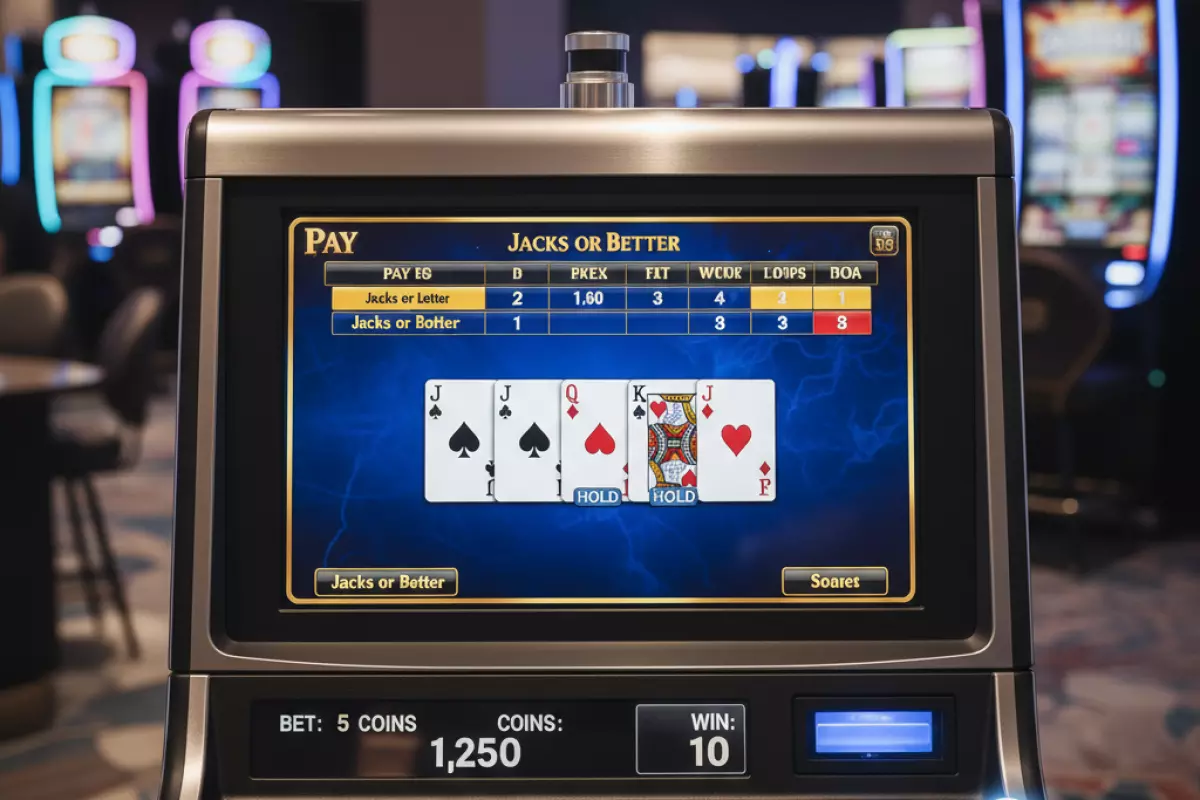 This article explains what Jacks or Better video poker is, how the deal and draw work, and the minimum hand needed to win. It breaks down the paytable, payouts, RTP, and odds, then covers basic strategy, common beginner mistakes, and how to play online.
To play Jacks or Better video poker well, learn how the rules drive payouts and decisions. The game seems simple, but choices like which kickers to hold or when to break a low pair can separate casual play from steady results. This guide covers hand rankings, pay table basics, and a practical core strategy to help protect your bankroll and improve long term returns.
What Jacks or Better video poker is

Jacks or Better is a classic video poker game that blends the pace of a slot machine with the decision-making of five-card draw poker. You’re dealt five cards, choose which to keep, and then draw replacements for the rest. The final five-card hand is evaluated against a paytable, and your payout depends on the hand you make.
The “Jacks or Better” part refers to the minimum hand that pays: a pair of jacks, queens, kings, or aces. Lower pairs (tens and below) don’t return anything, which is why the game rewards hands that are either stronger made hands or strong draws that can develop into them.
How a round works
Each hand follows the same simple loop: place a bet, receive five cards, hold any number of them, and draw to complete the hand. The key difference from slots is that your choices affect the outcome, so correct holds and discards matter over time.
- Choose your bet size (often 1–5 credits).
- Press Deal to receive five cards.
- Select the cards you want to hold.
- Press Draw to replace the unheld cards.
- The machine pays according to the final hand and the paytable shown.
What “better” means in practice
Because only pairs of jacks or higher qualify as the lowest paying hand, many borderline situations come down to whether you should keep a low pair or chase a higher-value draw. For example, a low pair is a made hand but not a paying one, while a four-card flush or an open-ended straight draw can be worth pursuing depending on the paytable and the cards involved.
This threshold also shapes the overall feel of the game: you’ll see plenty of non-paying hands, but you’re frequently drawing to hands that can pay, and occasional big hits (especially a royal flush) drive much of the long-term return.
Common hand categories you’ll see
Most versions use standard poker hand rankings, but payouts vary by machine. In typical Jacks or Better, the paytable starts at “Jacks or Better” (one pair of jacks or higher) and goes up through two pair, three of a kind, straight, flush, full house, four of a kind, straight flush, and royal flush.
- Paying minimum: one pair of jacks, queens, kings, or aces.
- Frequent mid-range results: two pair, three of a kind, straights, and flushes.
- High-value outcomes: full house, four of a kind, straight flush, and royal flush.
Why it’s considered a “skill-influenced” casino game
While the deal and draw are random, the hold decision is yours, and that decision changes your expected return. Two players can start with the same five cards and end up with different results because they held different combinations. Over many hands, using solid strategy reduces losses and can bring the game close to the theoretical return shown by the best paytables.
In other words, the game is easy to learn but has meaningful depth: understanding which draws are strongest, when to break a made hand, and how the paytable affects choices is what separates casual play from disciplined play.
How Jacks or Better gameplay works

In Jacks or Better video poker, you play a five-card poker hand against a paytable, not against a dealer or other players. The goal is to finish with a qualifying hand (typically a pair of jacks or higher, or any stronger poker hand) after one optional draw.
Each round follows a simple rhythm: place your bet, receive five cards, choose which cards to keep, draw replacements for the rest, and then get paid based on the final hand. Because you control the hold/discard decision, your choices have a direct impact on the game’s return.
Round flow: from bet to payout
- Choose your bet size (usually 1 to 5 credits). The number of credits affects the payout amount, and many machines offer a boosted payout for a royal flush at the maximum bet.
- Deal: you receive five cards.
- Hold: select any cards you want to keep. Unheld cards will be replaced.
- Draw: the machine replaces the discarded cards with new ones from the remaining deck.
- Evaluate: the final five-card hand is compared to the paytable. If it meets a listed hand, you’re paid; otherwise, the bet is lost.
What “Jacks or Better” means in practice
The name refers to the minimum winning hand: a pair of jacks, queens, kings, or aces. A pair of tens or lower typically does not pay in this variant, even though it is a legitimate poker hand. Everything above a high pair (two pair, three of a kind, straight, flush, full house, four of a kind, straight flush, royal flush) pays according to the machine’s posted schedule.
That paytable matters because it changes the value of certain decisions. For example, some versions pay more for a full house and flush (often called “full-pay” by players), which slightly shifts optimal holds compared with tighter tables.
Hands are ranked like standard poker
The hand rankings are the familiar five-card poker rankings, with one key difference from many table games: there’s no dealer qualification and no head-to-head comparison. You either land on a paying hand listed on the machine or you don’t.
In most Jacks or Better paytables, the payout ladder starts at “Jacks or Better” (one high pair) and climbs up to the rarest outcomes like a royal flush. The machine evaluates your final hand only after the draw, so the main skill is choosing the best holds to maximize your expected return.
Why the hold decision is the whole game
Once the initial five cards are dealt, your only control is which cards you keep. Holding the right cards balances two competing goals: completing made hands (like a flush you already have) versus chasing higher-value draws (like four cards to a royal flush).
Good play often means resisting “almost wins” that look tempting but have weak long-term value. For instance, breaking up a low pair to chase a long-shot straight can be a losing habit, while keeping a high pair is usually correct because it already qualifies for a payout and can improve to two pair, trips, or a full house.
Common machine rules and small variations
Most games use a standard 52-card deck and a single draw. Beyond that, the main differences you’ll see are in the paytable numbers and how the maximum bet affects the top prize. Always read the paytable before you play, because two machines labeled the same can still pay differently.
- Betting structure: typically 1–5 credits; top-end hands scale with the bet, and the royal flush often gets a premium at 5 credits.
- Paytable variation: full house and flush payouts are the most common differences and can noticeably affect overall return.
- No wild cards: unlike Deuces Wild, this version usually has no wilds, so hand odds and strategy are more straightforward.
Once you’re comfortable with the deal-hold-draw cycle and you understand the paytable, strategy becomes a matter of consistently choosing holds that give the best expected value over many hands, not trying to “predict” the next card.
Minimum hand requirement explained

In Jacks or Better, the “minimum hand” is the lowest-ranking pair that qualifies for a payout. If your final hand is below that threshold, the result is treated as a loss even if you ended with a pair of small cards. This rule is what separates the game from versions that pay on any pair.
The standard qualifier is simple: a pair of Jacks, Queens, Kings, or Aces (often written as “Jacks or Better”). Any pair from Tens down to Deuces does not pay, and neither do high-card hands with no pair.
What counts as a winning hand (and what doesn’t)
To get paid, your five-card hand after the draw must meet or exceed the qualifying rank. That includes the minimum pair and all stronger poker hands like two pair, three of a kind, straights, flushes, full houses, four of a kind, and straight flushes.
Hands that look “made” but still lose are the ones that fall short of the qualifier. A pair of 10s is the most common example: it’s a real pair, but it’s not a paying hand in this game. The same applies to any lower pair, even if you held it from the original deal.
- Pays: Pair of Jacks or higher, two pair, three of a kind, straight, flush, full house, four of a kind, straight flush, royal flush.
- Does not pay: Any pair of Tens or lower, and any “nothing” hand (no pair).
Why the qualifier matters for strategy
This payout threshold changes what you should hold. Because low pairs don’t return anything, you often treat them as a starting point rather than a “finished” hand. For example, a low pair can still be worth keeping because it improves your chances of reaching two pair, trips, a full house, or quads—but you shouldn’t confuse it with a guaranteed payout.
It also explains why high cards are valuable. When you’re choosing between chasing a draw and keeping unpaired cards, holding J-Q-K-A (especially suited or connected) can be strong because it can form the minimum paying pair while also supporting straights and flushes.
Common situations players misread
Newer players often assume “any pair is good,” then wonder why the credit meter doesn’t move. Remember that the machine evaluates only the final five cards after the draw, and it pays only if that result meets the minimum rank.
Another frequent mistake is overvaluing a low pair when better draws exist. A pair of 4s might be worth holding in many cases, but if you also have four cards to a flush or a strong straight draw, the best play can change depending on the paytable and the exact cards. The key is recognizing that the low pair itself is not a payout target—it’s a stepping stone.
Jacks or Better paytable and payouts
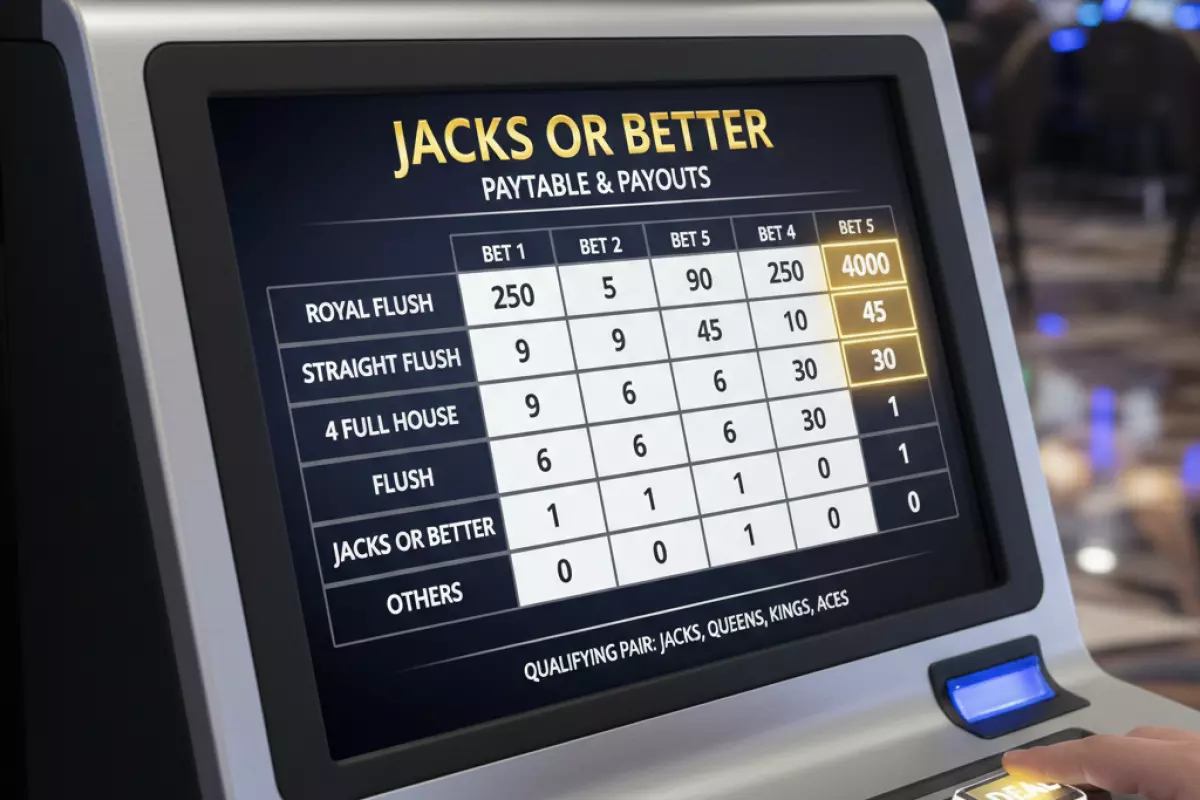
The payout schedule tells you how much each winning hand returns for a given bet size. In Jacks or Better, the “qualifying” pair is jacks, queens, kings, or aces; pairs below jacks don’t pay and are treated as losing hands.
Most machines show wins as “for 1” (per coin) and scale linearly up to the maximum bet. The common exception is the royal flush, which usually receives a bonus when you wager the full five coins, making max-bet play important for long-term value.
Typical full-pay (9/6) payout table
A widely used benchmark is the so-called 9/6 version, named for paying 9 coins for a full house and 6 coins for a flush (per coin bet). This is often considered the best standard pay schedule you’ll see in many venues.
| Hand | Payout (per 1 coin) | Payout (per 5 coins) |
|---|---|---|
| Royal flush | 250 | 4000 |
| Straight flush | 50 | 250 |
| Four of a kind | 25 | 125 |
| Full house | 9 | 45 |
| Flush | 6 | 30 |
| Straight | 4 | 20 |
| Three of a kind | 3 | 15 |
| Two pair | 2 | 10 |
| Jacks or better (one pair) | 1 | 5 |
How to read the pay schedule on a machine
Start by checking the full house and flush lines. If you see 9 for a full house and 6 for a flush (per coin), you’re looking at the classic full-pay version. If either of those numbers is lower, the game’s expected return drops, and optimal strategy shifts slightly.
Next, confirm how the royal flush is handled at max bet. Many games pay 250 per coin for 1–4 coins, but jump to 4000 for 5 coins. That “top-bet bonus” is a key reason many players prefer betting five coins when their bankroll allows it.
Why small paytable changes matter
Video poker is sensitive to paytable tweaks because the most frequent winners (like a single high pair and two pair) help smooth out variance, while the rare hands (especially the royal) drive a big portion of the long-run return. Reducing full house or flush payouts is one of the most common ways a machine becomes less favorable without looking dramatically different.
As a quick sanity check, compare a few lines before you sit down: full house, flush, and four of a kind. Those categories heavily influence how “generous” the schedule is, and they’re easy to spot at a glance on the screen.
RTP and odds in Jacks or Better

Return to player (RTP) tells you how much of your total wagers a Jacks or Better machine gives back over the long run, assuming you play with correct strategy. It is not a promise for a short session; it is a mathematical average that becomes more reliable only across a very large number of hands.
The other half of the picture is variance: video poker can swing up and down because big payouts (especially the royal flush) are rare but heavily influence results. Two players can use the same optimal decisions and still have very different outcomes over a few hundred or even a few thousand hands.
How paytables drive your expected return
Your expected value is mainly determined by the paytable, especially the payout for a full house and a flush. Small-looking differences (like paying 9 instead of 8 for a full house) can meaningfully change the long-term return, even though the rules and hand rankings stay the same.
For example, the well-known “full pay” version is commonly called 9/6 Jacks or Better (9 for a full house, 6 for a flush). Many other versions reduce one or both of those payouts, lowering the RTP even if everything else looks identical at a glance.
| Common paytable name | Full house / Flush payout | Typical RTP with optimal play (approx.) | What it means for your edge |
|---|---|---|---|
| Full pay (9/6) | 9 / 6 | 99.54% | Very low house edge; best widely known baseline |
| 8/6 | 8 / 6 | 98.39% | Noticeably worse; full house cut hurts the return |
| 9/5 | 9 / 5 | 98.45% | Flush cut hurts; similar drop to 8/6 overall |
| 8/5 | 8 / 5 | 97.30% | Both key payouts reduced; much higher house edge |
These percentages assume you follow solid Jacks or Better strategy. If you routinely make “intuitive” holds (like chasing inside straights too often), the effective return drops further, sometimes by more than the paytable difference you were trying to optimize.
Why playing max coins matters
Most machines pay a disproportionate jackpot for a royal flush when you bet the maximum (typically 5 coins). The rest of the paytable usually scales linearly with coin size, but the royal commonly jumps to a much larger top prize at max bet.
Because the royal is such a big contributor to long-run value, not betting max coins typically reduces your expected return even if your decision-making is perfect. If you need to lower variance, it is usually better to reduce denomination (for example, switch from $1 to $0.25) rather than playing fewer coins.
Understanding the “odds” you actually face
In video poker, the relevant odds are the probabilities of finishing with each hand category after the draw, given optimal holds. Those probabilities are not fixed like in a single-deal table game, because your choices change the distribution of outcomes.
That said, a few practical truths help set expectations:
- High pairs and two pair show up relatively often and keep your bankroll moving, but they do not drive most of the long-run return.
- Three of a kind, straights, and flushes are less frequent and provide the mid-tier “spikes” that stabilize results over time.
- Four of a kind and straight flushes are rare and can dominate a session’s profit or loss.
- The royal flush is extremely rare, but its payout is so large (at max coins) that it meaningfully affects the game’s overall expected value.
RTP vs. short-session reality
A machine with a strong theoretical return can still produce losing sessions, sometimes many in a row, because outcomes are clustered around common hands while the biggest payouts arrive infrequently. This is why bankroll management matters: you are not “due” for a royal, and a cold stretch does not indicate the payback has changed.
If you want the best long-run odds in Jacks or Better, focus on two levers you can control: choose the best paytable available and play a consistent, correct strategy. Everything else is mostly noise from variance.
Basic strategy for Jacks or Better
Play decisions in Jacks or Better come down to one idea: keep the cards that give you the highest expected return and discard the rest. That usually means prioritizing made hands, then strong draws (especially those that can become a royal flush), and only then “high-card” holds like a single Jack, Queen, King, or Ace.
Because pay tables vary, the exact best hold can shift in a few edge cases. Still, the core approach below is reliable for standard games such as 9/6 (9 for a full house, 6 for a flush), and it will keep you close to optimal play even if the machine is slightly different.
Start with a simple decision order
A practical way to avoid mistakes is to evaluate your hand in a consistent sequence. Check for made hands first, then for premium draws, then for lesser draws, and finally for high-card holds. If more than one option applies, choose the higher-ranked one from the list below.
-
Keep any paying made hand (pair of Jacks or better, two pair, three of a kind, straight, flush, full house, four of a kind, straight flush, royal flush). In most cases you hold the entire made hand; breaking it is rarely correct.
-
Hold four cards to a royal flush. This draw is so valuable that it often beats holding smaller made hands like a low pair.
-
Hold four cards to a straight flush (including open-ended and inside variations). These draws combine strong payout potential with decent hit frequency.
-
Hold three of a kind (keep all three). Drawing two cards gives you chances at a full house or quads.
-
Hold four cards to a flush. A flush completes often enough to be a top-tier draw.
-
Hold four cards to a straight (especially open-ended). Inside straights are weaker but still commonly correct when no better draw exists.
-
Hold two pair (keep both pairs). You’re mainly drawing one card to fill up to a full house.
-
Hold a high pair (Jacks, Queens, Kings, Aces). This is already a paying hand; draw three to improve.
-
Hold three cards to a royal flush (suited A-K-Q / A-K-J / A-Q-J / K-Q-J). These are the most valuable three-card draws.
-
Hold a low pair (Tens through Deuces) when you don’t have a better premium draw. Low pairs are not paying yet, but they’re a solid base to improve into two pair, trips, or better.
-
Hold two suited high cards (like A-K suited, K-Q suited). Suited high cards can develop into a flush, straight, or top pair.
-
Hold a single high card (J, Q, K, or A) if nothing stronger applies. This is a fallback play, not a goal.
-
Otherwise, draw five new cards. If your hand has no pair, no strong draw, and no useful high-card hold, a full redraw is usually best.
Common “don’t break it” rules (and the main exceptions)
Most errors come from breaking a made hand to chase something unlikely. As a baseline, keep paying hands intact and let the draw do the work.
-
Don’t break a flush to chase a straight or three-card royal. The made flush is typically worth more than speculative redraws.
-
Don’t break a straight to chase a flush draw unless you also have a very strong overlapping draw (rare in practice).
-
Don’t split two pair; keep both pairs and draw one.
-
Main exception: if you have a low pair and also four to a royal, you generally drop the pair and keep the four-card royal draw.
How pay tables change a few priorities
Strategy is built on the payouts. When the full house and flush payouts are reduced (for example, 8/5 instead of 9/6), flush-related holds lose some value and you lean slightly more toward straight and high-card-based options. When the game is “full-pay” (9/6), you can be more confident that holding strong flush draws and made flushes is correct.
The key takeaway is simple: always check the pay table before you play. If the flush or full house is shorted, expect a few close decisions to flip, even though the overall framework above still works well.
Quick reference: what to hold in typical situations
| What you’re dealt | Usual best hold | Why it’s preferred |
|---|---|---|
| A made paying hand (Jacks or better, two pair, trips, straight, flush, etc.) | Keep the entire made hand | Lock in value; improvement chances remain without sacrificing the payout |
| Four cards to a royal flush | Hold the four-card royal draw | Highest-value draw in the game |
| Four cards to a straight flush | Hold the four-card straight flush draw | Strong payout potential with multiple ways to complete |
| Low pair plus four to a royal | Drop the pair; keep four to the royal | The royal draw outweighs the small equity of the low pair |
| No pair, four to a flush | Hold four suited cards | Flush completion rate makes this a top draw |
| No pair, four to a straight | Hold the four-card straight draw | Good hit frequency; often best when no flush/royal draw exists |
| No pair, two suited high cards | Hold the suited high cards | Can improve via high pair, flush, or some straight paths |
| No pair, no strong draw, one high card | Hold the single high card | Best of weak options; aims for a high pair |
| No pair, no draw, no high cards | Discard all five | Keeping random low cards rarely beats a full redraw |
If you want to tighten your play further, the next step is learning a few “tie-breakers” (for example, which three-card royal draws outrank certain straight draws). But for most players, consistently following the decision order above delivers the biggest improvement with the least memorization.
Common beginner mistakes
Most early losses in Jacks or Better come from small, repeated decision errors rather than bad luck. Because the game’s best play is math-driven, a few habits can quietly drag down your long-term return even if you “feel” like you’re playing well.
Playing the wrong pay table (and not noticing)
The biggest strategy mistake often happens before you even hit “Deal”: choosing a weak payout schedule. Jacks or Better pay tables vary a lot, and the difference shows up directly in expected value. If you learn correct holds for one version but sit down at a lower-paying one, you can’t “strategy” your way back to the same return.
A quick reality check is to look at how much the machine pays for a full house and a flush. Those two numbers tell you a lot about whether you’re on a strong or mediocre game.
| Pay table label (common shorthand) | Full house / Flush payout | What it means for beginners |
|---|---|---|
| 9/6 (often called “full-pay”) | 9 / 6 | Best baseline to learn on; strategy charts usually assume this version. |
| 8/6 | 8 / 6 | Still playable, but your edge shrinks; small errors hurt more. |
| 8/5 | 8 / 5 | Noticeably worse returns; avoid if you have alternatives. |
| 7/5 (and lower) | 7 / 5 | Low-return game; even perfect decisions won’t overcome the pay table. |
Breaking made hands for “something bigger”
New players often throw away a paying hand to chase a straight, flush, or full house. In Jacks or Better, that’s usually a leak. If you already have a made hand, it often has more value than the draw you’re imagining, especially when the made hand is two pair, a high pair, or better.
A common example is splitting two pair to chase a full house. It feels reasonable, but it reduces your guaranteed payout and relies on hitting a relatively narrow outcome.
Misplaying high pairs and low pairs
Confusion around pairs causes a lot of incorrect holds. A pair of jacks or better is already a paying hand, so it should almost never be broken. Low pairs (2s through 10s) are different: they don’t pay by themselves, so you’re often deciding between improving the pair versus drawing to a strong four-card hand (like a four-card flush).
The fix is to treat “high pair” as a protected asset and “low pair” as a building block whose best use depends on what else you were dealt.
Overvaluing suited “pretty cards”
Hands like K-Q suited or A-J suited look powerful, so beginners keep them too often even when a better option exists. Two suited high cards can be good, but they are not automatically better than a paying pair, a strong four-card draw, or certain three-card royal/straight-flush draws.
Try to think in terms of outcomes: how many ways does this hold make a paying hand, and how big are those payouts? That mindset prevents you from “falling in love” with attractive-looking starting cards.
Chasing inside straights too often
Inside straight draws (gutshots) are a classic trap. They hit less frequently than open-ended straights, and in Jacks or Better the payoff for a straight usually doesn’t justify breaking better structures to chase a gutshot.
If you find yourself repeatedly holding four cards to an inside straight while ignoring a high pair, a four-card flush, or a better draw, you’re likely giving up value over time.
Ignoring kicker value and card removal effects
Small details matter in close decisions. For example, holding A-K (unsuited) is generally stronger than holding K-Q (unsuited) because the ace improves your top-pair and high-card outcomes. Similarly, when you keep certain ranks, you remove those cards from the deck, which changes the odds of pairing or completing draws.
You don’t need to calculate everything at the machine, but you should recognize that “similar-looking” holds can have different expected returns depending on ranks and suits.
Using the wrong strategy chart for the game you’re playing
Many players memorize a single set of rules and apply it everywhere. Strategy priorities can change with the pay table (especially around full house/flush values) and with special features like a different royal flush payout. Even a small mismatch can flip borderline choices.
If you’re using a chart, make sure it matches the exact Jacks or Better version on the screen, including the royal flush payout for max-coin play.
Betting patterns that sabotage bankroll
Jacks or Better has variance, and beginners often make it worse by changing bet size impulsively after a few losses or wins. Another frequent error is not betting the maximum number of coins when it’s required to get the full royal flush payout; that single detail can significantly reduce long-term value.
A steadier approach is to pick a denomination and coin level you can sustain for your session, then stick to it. Consistency makes your results reflect the game’s math rather than emotional swings.
Rushing decisions and misclicking holds
Speed is an underrated source of mistakes. Clicking “Draw” too quickly, failing to hold the right cards, or accidentally discarding a pair happens more than people admit, and it’s pure negative value.
- Pause for one second before drawing to confirm your holds.
- Count your held cards and re-check suits when you’re drawing to a flush.
- If the machine highlights held cards, use that visual check every hand.
If you want a simple improvement plan: start by selecting a strong pay table, then focus on never breaking paying hands without a clear reason, and finally tighten up your draw selection (especially gutshots and “pretty” suited highs). Those three changes alone usually eliminate most beginner leaks in video poker.
Playing Jacks or Better online
Digital video poker is the same five-card draw game you know from a casino floor, but the pace is faster and the rules are enforced automatically. That makes it easier to focus on decision-making: which cards to hold, when to draw, and how the paytable affects your long-term return.
The biggest difference between real-world machines and browser/app versions is consistency. Online, the shuffle and deal are handled by a random number generator (RNG), and payouts are calculated instantly based on the paytable shown on-screen. Your edge comes from choosing good tables and sticking to solid hold/draw strategy.
Start with the paytable, not the graphics
In Jacks or Better, the paytable determines how forgiving the game is. Two games can look identical but play very differently if, for example, the full house or flush payouts are reduced. Before you place a bet, locate the payout chart and confirm the values for key hands like full house and flush, since these have an outsized effect on expected return.
If you’re learning, slow down and use the “hold” phase to double-check your decision. Most online interfaces let you click/tap cards to hold, then press “draw.” Misclicks happen, so it’s worth building a habit of visually confirming which cards are locked before drawing.
Bet sizing and the “max bet” issue
Many versions reward a maximum coin bet with a higher payout for a royal flush. This doesn’t change the odds of being dealt a royal, but it changes the value of the rare times it happens. If your bankroll can handle the variance, using max coins is usually the standard approach; if not, reduce stakes and accept the smaller top prize rather than overextending.
- Play smaller denominations if you want to keep the max-coin royal payout while controlling risk.
- Avoid chasing losses; video poker variance can produce long stretches without premium hands.
- Set a stop point (time, hands played, or budget) so the faster online pace doesn’t quietly increase your spend.
Using auto-play and speed settings responsibly
Auto-play, turbo mode, and quick-deal options can be convenient, but they also reduce the time you have to think. If you’re practicing strategy, keep the speed moderate and avoid auto-hold features until you’re confident they match optimal play for the specific paytable you’re using.
When you do increase speed, treat it like moving up in difficulty: only do it once your hold decisions are consistent. A small strategy leak repeated over hundreds of fast hands can outweigh the benefit of playing more rounds.
Quick checklist for choosing a solid online game
| What to check | Why it matters |
|---|---|
| Paytable values (especially full house and flush) | Small changes here can noticeably reduce expected return over time. |
| Royal flush payout at max coins | Max-bet bonuses can shift the best staking approach for the game. |
| Game rules (wild cards, jokers, bonus variants) | Strategy changes significantly if it’s not true Jacks or Better. |
| Interface controls (hold confirmation, speed, auto-play) | Fewer misclicks and better pacing help you apply correct decisions. |
Practice approach: accuracy first, volume second
A practical way to improve is to play in short sessions and review the hands you were unsure about. Focus on common decision points: low pairs versus four-to-a-flush, high-card combinations, and when to break a made hand to chase a stronger draw (which depends heavily on the paytable).
Finally, remember that online play can feel more casual because it’s on a phone or laptop, but the math is the same. Treat each hand as a small strategic puzzle, and you’ll get more value from the game than simply clicking “deal” as fast as possible.