Slot Volatility Explained – Low, Medium and High Variance

 This article explains what slot volatility means, compares low vs high volatility slots, shows how it affects payout size and frequency, and clarifies volatility vs RTP. It gives examples, outlines how casinos calculate variance, how players pick slots, and debunks common myths.
A slot’s volatility tells you whether wins tend to arrive as frequent small hits or as rarer, larger spikes. This guide explains low, medium, and high variance, what hit rate and payout swings typically feel like, and how to choose the right style for your bankroll, session length, and risk tolerance so you can play with clearer expectations before you spin.
What slot volatility means

In slots, volatility (also called variance) describes how a game tends to distribute its payouts over time. It doesn’t tell you whether a slot is “good” or “bad,” and it doesn’t change the long-term house edge. Instead, it’s about the shape of the ride: how often you’re likely to hit wins, how big those wins usually are, and how long your balance might swing up or down between them.
Think of it as the game’s payout rhythm. Two slots can have the same RTP, yet feel completely different because one pays small amounts frequently while the other stays quiet for longer and then lands a bigger hit. That difference in “feel” is largely explained by variance.
Volatility vs. RTP: what changes and what doesn’t
RTP (return to player) is the theoretical average a slot returns over a very large number of spins. Volatility is about short-term outcomes: the likelihood of long losing stretches, the frequency of small wins, and the chance of rare, high-value payouts.
A practical way to separate them is: RTP is the long-run expectation; volatility is the short-run experience. If you’re choosing a game for a specific session length or bankroll, variance often matters more than RTP because it influences how quickly your balance can fluctuate.
How low, medium, and high variance typically behave
Low-volatility slots tend to pay out more often, usually in smaller amounts. Sessions can feel steadier, with fewer dramatic swings, but you may see fewer “wow” moments because the game’s payback is spread across many modest wins.
Medium volatility sits in the middle: wins are reasonably frequent, and the game can still deliver meaningful spikes. Many popular titles land here because it balances entertainment with the possibility of a standout bonus or feature hit.
High-volatility slots are built around less frequent but larger wins. That often means longer dry spells and sharper bankroll swings, with the trade-off that a bonus round or top combination can move the needle significantly when it finally lands.
- Win frequency: how often any payout happens (not the same as profit).
- Win size distribution: whether payouts cluster around small returns or include rare big hits.
- Downswings: how long a game can go without a meaningful win.
- Upswings: how quickly a session can jump when a feature connects.
Why it matters for your session
Variance affects pacing and risk. If you have a limited bankroll or you prefer longer play time, a lower-volatility game often keeps you in the action because smaller wins can offset part of your spend. If you’re comfortable with bigger swings and you’re chasing the chance of a large payout, higher variance may fit your goals better, as long as you accept that many sessions won’t deliver that peak moment.
It also influences how you interpret results. A long losing run on a high-volatility slot can be normal, not a sign the game is “due.” Likewise, a streak of frequent small wins on a low-volatility title doesn’t mean you’ve found an advantage; it’s simply how that payout pattern is designed.
How casinos and providers label it
There’s no single universal standard for volatility labels. Providers may use terms like “low/medium/high,” a scale (for example, 1–5), or descriptors such as “frequent wins” versus “big win potential.” When the label is missing, you can often infer variance by looking at the paytable and features: games with very high maximum wins and bonus-heavy mechanics commonly lean higher, while titles with lots of small line hits and modest top prizes often play lower.
Low volatility vs high volatility slots
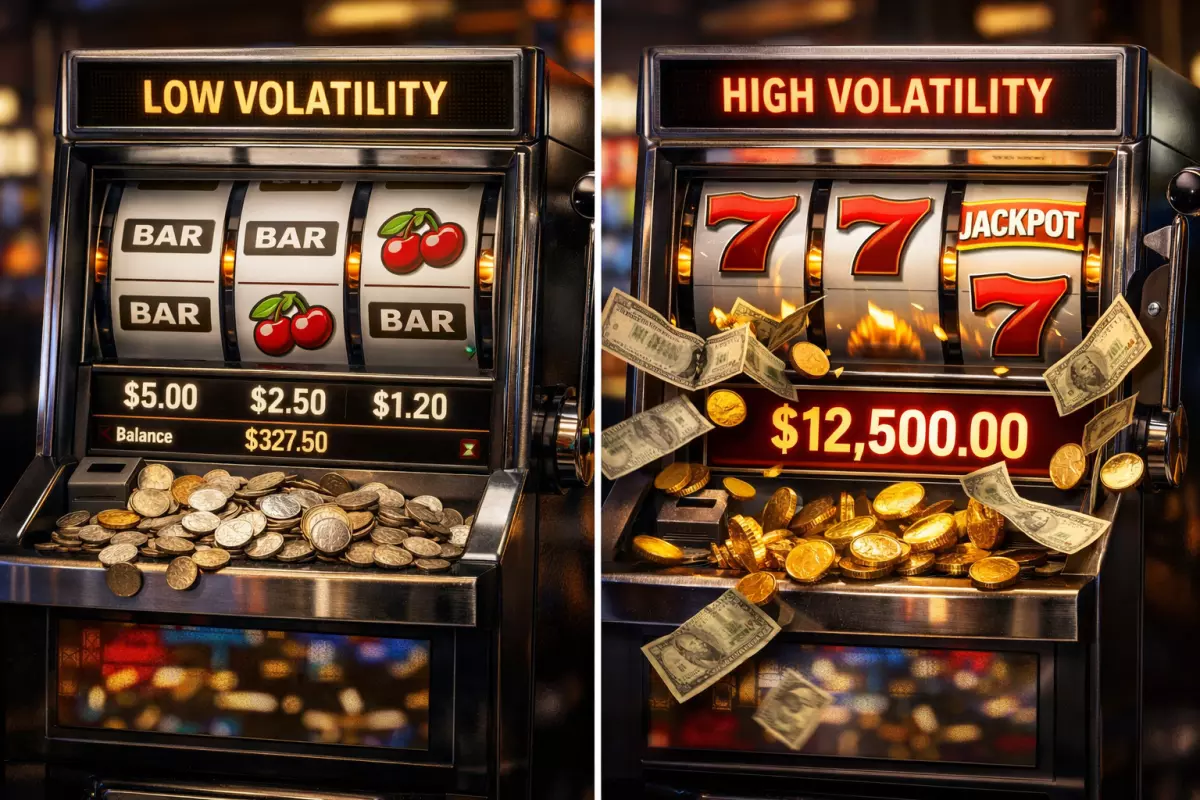
The biggest practical difference between low-variance and high-variance games is how your bankroll experiences the same RTP: one tends to pay back in smaller, steadier chunks, while the other concentrates returns into rarer, larger hits. Neither is “better” in general; it depends on whether you value longer playtime and frequent feedback, or you’re comfortable with dry spells in exchange for a shot at a big win.
Volatility describes how payouts are distributed over time, not the long-term average. Two slots can advertise similar RTP, yet feel completely different because one produces many small wins and the other saves most of its value for bonus rounds and top prizes.
How low volatility typically plays
Low volatility slots usually deliver frequent small-to-medium wins, which can help smooth out swings. You’ll often see more “keep you afloat” spins where a portion of your bet returns, even if it doesn’t meaningfully grow the balance. This style can be easier to manage if you’re playing with a limited bankroll and want more consistent session pacing.
That said, frequent wins don’t guarantee profit. Many of those hits may be modest and can still trail your total stake over time, especially if the game relies on lots of low-value outcomes.
How high volatility typically plays
High volatility slots tend to cluster a larger share of their payout potential into less frequent events: bonus features, big multipliers, or rare symbol combinations. Sessions can include long stretches of minimal returns, followed by a sudden spike that changes the result quickly.
This profile suits players who can tolerate variance and are specifically chasing higher peaks. The trade-off is psychological and financial: you need to be comfortable seeing your balance drop for extended periods while waiting for the game’s “value moments” to land.
| What you notice | Lower volatility (lower variance) | Higher volatility (higher variance) |
|---|---|---|
| Win frequency | More frequent small wins | Less frequent wins overall |
| Typical session swing | Smoother balance changes | Bigger up-and-down swings |
| Where the value sits | Spread across base game and minor features | Concentrated in bonuses, multipliers, and rare outcomes |
| Risk of long losing streaks | Lower (but not eliminated) | Higher, sometimes very noticeable |
| Best fit for | Budget-focused play, steadier pacing | Chasing big hits, accepting dry spells |
Choosing based on bankroll and goals
If your main goal is to stretch your balance and enjoy more frequent feedback, a lower-variance slot is often the more comfortable option. If your goal is to give yourself a realistic chance at a standout win in a single session, higher variance may align better, provided you size your bets conservatively.
A practical way to decide is to match the game’s variance to your tolerance for losing streaks. If a run of 50–100 spins with little to show for it would push you to increase bets or chase losses, you’ll likely have a better experience with a steadier payout pattern.
Common misconceptions
“High volatility means higher RTP.” Not necessarily. RTP is the long-run expected return; volatility is the shape of the ride getting there.
“Low volatility means you can’t win big.” Lower variance games can still have strong top prizes, but they typically reach those peaks less dramatically, and the overall distribution is more even.
“More wins means you’re ahead.” A slot can pay often while still returning less than you’ve wagered, especially when many wins are smaller than the bet size.
How slot volatility affects payouts

Volatility (also called variance) shapes how often a slot pays and how big those wins tend to be. Two games can share the same RTP on paper, yet feel completely different in play because their payouts are distributed differently across spins.
Think of it as the slot’s “risk profile.” Lower variance usually spreads returns across many small-to-medium hits, while higher variance concentrates more of the return into fewer, larger wins. That difference changes your bankroll swings, your session length, and how realistic it is to hit a big payout in a short run.
Frequency vs. size: the core trade-off
The main effect is a trade-off between hit rate and win size. A game can’t reliably deliver frequent wins and also reserve most of its value for huge jackpots without adjusting something else (like making those big wins extremely rare).
- Low volatility: more regular payouts, smaller average win amounts, steadier balance changes.
- Medium volatility: a mix of smaller hits and occasional stronger wins, with moderate swings.
- High volatility: longer losing stretches are common, but the wins that do land can be much larger.
What it means for your bankroll and session length
Variance directly affects how quickly your balance can rise or fall. With low variance, you’ll typically get more “breathing room” because small wins arrive often enough to slow down losses. With high variance, a bankroll can drop fast during dry spells, even if the slot is fair in the long run.
Session length is often the practical difference players notice first. If you’re betting the same amount per spin, a low-variance slot usually supports longer play time, while a high-variance one may require a larger bankroll (or smaller bets) to survive the downswings long enough to reach the bigger-paying outcomes.
How bonus features and jackpots shift the payout distribution
Many of the biggest changes in payout behavior come from features. When a game puts a large share of its potential return into free spins, multipliers, expanding symbols, or a bonus pick round, it often becomes more “spiky.” That’s because a meaningful portion of value is locked behind events that don’t trigger often.
Jackpots and very high max wins tend to push a slot toward higher variance, since the math has to allocate some probability to those top-end results. In practice, that can mean more spins with little or no return, balanced by rare but impactful hits.
Why RTP doesn’t tell the whole story
RTP describes the expected return over a very large number of spins, but it doesn’t describe the path your balance takes to get there. Volatility fills that gap by describing the shape of results: whether returns arrive smoothly or in bursts.
That’s why two slots with identical RTP can feel opposite. One might pay back in frequent small chunks, while the other “holds” most of its value for occasional feature wins or rare high multipliers.
| Volatility level | Typical payout pattern | Common bankroll experience | Best suited for |
|---|---|---|---|
| Low | Frequent small wins; fewer extreme outcomes | Smaller swings; longer sessions on the same budget | Players who prefer steadier play and lower risk |
| Medium | Balanced mix of small hits and occasional bigger wins | Noticeable ups and downs without constant droughts | Players who want variety without extreme variance |
| High | Infrequent wins; larger payouts concentrated in rare events | Long losing streaks possible; sharp spikes when wins land | Players chasing bigger payouts and comfortable with risk |
| Very high (often “extreme”) | Most value tied to bonus rounds and top multipliers | High chance of short sessions unless bankroll is managed carefully | Players accepting high risk for the chance of very large wins |
If you want to match volatility to your budget, a simple rule helps: the higher the variance, the more important it is to lower your bet size or increase your bankroll to handle the rough patches. That doesn’t change the game’s long-term expectation, but it can make the short-term ride manageable.
Volatility vs RTP explained

RTP and volatility describe different parts of how a slot behaves. RTP (return to player) is the long-run percentage of all stakes a game is designed to pay back across an enormous number of spins. Volatility (variance) is about how that return tends to arrive: whether wins show up often in smaller amounts or less often in bigger bursts.
A useful way to think about it is that RTP is the destination, while variance is the road you take to get there. Two games can have the same theoretical return and still feel completely different in a short session because their payout patterns are built differently.
RTP: the long-run average
RTP is a mathematical expectation, not a promise for a single session. If a slot has 96% RTP, it does not mean you will get back 96% of what you wager in an hour, a day, or even a week. It means that, over a very large sample of spins across many players, the game is designed to return about 96 units for every 100 units staked, with the remaining portion representing the house edge.
Because it’s an average, two players can experience opposite outcomes in the short term on the same RTP: one can run hot and finish up, while another can lose quickly, even if both play the same stake size.
Volatility: the distribution of wins
Volatility describes the swinginess of results. Low variance slots tend to pay smaller wins more frequently, which can make the balance move more smoothly. High variance games may go through longer losing stretches but occasionally produce larger payouts that make up a bigger share of the total return.
This is why “how a slot feels” is usually more tied to volatility than to RTP. A high-volatility title can be stressful on a small bankroll even when its RTP is solid, simply because the game may require more spins to reach its occasional bigger hits.
| Aspect | RTP | Volatility (variance) |
|---|---|---|
| What it measures | Average percentage returned over the long run | How wins are spread out (frequency vs size) |
| Best for answering | “What is the game’s theoretical cost?” | “How bumpy might my session be?” |
| Short-session impact | Limited; outcomes can deviate widely from the average | High; strongly shapes streaks and bankroll swings |
| Typical player experience | Often invisible moment-to-moment | Noticeable: steadier play vs long dry spells and spikes |
| What it does not tell you | How often you’ll win or how big wins tend to be | The long-run return percentage |
Can a high RTP slot still be risky?
Yes. A game can have a high theoretical return and still be tough on your balance if it’s high volatility. In that setup, a large share of the RTP may be concentrated in rarer events (big bonus rounds, high multipliers, top symbol lines). If you don’t hit those within your session length, your results can look much worse than the stated RTP.
On the flip side, a lower-variance slot with a slightly lower RTP can sometimes feel “friendlier” in short play because it returns smaller amounts more regularly, reducing the chance of long losing streaks.
How to use both numbers when choosing a slot
RTP helps you compare the game’s theoretical value, while volatility helps you match the game to your bankroll and patience for swings. If you want longer playtime and frequent small hits, lean toward low or medium variance. If you’re comfortable with bigger fluctuations and are chasing occasional large payouts, high variance may fit better.
- Prioritize RTP when comparing similar games and you care about long-run cost.
- Prioritize volatility when your bankroll is limited or you want a specific session “feel.”
- Consider both together: a high-volatility slot usually needs a larger bankroll buffer to handle downswings, even at the same RTP.
Examples of different volatility levels

Volatility (also called variance) is easiest to understand when you picture how a slot typically pays: does it drip-feed small wins, land in the middle with occasional spikes, or stay quiet for long stretches and then hit hard? Below are practical, game-like scenarios that show what “low”, “medium”, and “high” usually feel like in real play.
Low volatility: frequent small payouts, smaller swings
Low variance slots tend to return wins more often, but those wins are usually modest. Your balance moves in smaller steps, which can make sessions feel steadier even though outcomes are still random.
A typical pattern might look like this: you’re betting $1 per spin and you see regular $0.20–$1.50 returns, with the occasional $3–$8 hit. Bonus features may trigger fairly often, but they usually pay in the lower-to-mid range rather than delivering huge multipliers.
- What you notice: lots of “keep you going” hits and fewer long losing streaks.
- Common use case: stretching a bankroll or playing with tighter session limits.
- Trade-off: big, memorable wins are less likely compared with higher variance games.
Medium volatility: a mix of dry spells and meaningful hits
Medium variance is the middle ground: you’ll still get some regular wins, but you should also expect noticeable downswings. When the slot does connect, the payouts tend to feel more substantial than in low volatility titles.
In practice, you might go 10–25 spins with little happening, then land a feature or a solid line hit that pays 10x–40x your bet. Bonuses may not appear constantly, but they can meaningfully change the session when they do.
- What you notice: a rhythm of quieter stretches followed by “catch-up” wins.
- Common use case: players who want a chance at stronger payouts without extreme droughts.
- Trade-off: the bankroll can still dip quickly if a feature doesn’t land for a while.
High volatility: longer losing runs, bigger payout potential
High variance slots are defined by uneven results. You can spin for a long time with minimal returns, and then a single hit (often in a bonus) can make up a large portion of the session’s total winnings.
A realistic scenario could be betting $1 per spin and seeing many $0–$0.50 outcomes for extended periods, with rare events paying 50x, 100x, or more. Some sessions may end without a standout hit; others may be dominated by one big win.
- What you notice: bigger emotional swings and more “all about the bonus” sessions.
- Common use case: chasing higher peaks and accepting that many sessions won’t deliver them.
- Trade-off: you can burn through a budget quickly if the major payouts don’t show up.
| Volatility level | Typical win frequency | Typical payout size | What a session often feels like |
|---|---|---|---|
| Low | Higher (hits show up regularly) | Small to moderate | Steadier balance changes, fewer long dead stretches |
| Medium | Moderate | Moderate, with occasional larger spikes | Some dry runs, then meaningful wins that can stabilize the session |
| High | Lower (wins can be sparse) | Large when it lands, often feature-driven | Long quiet periods punctuated by rare, session-defining hits |
| Very high (extreme) | Low to very low | Very large potential, highly concentrated | Many sessions feel unremarkable; a few deliver outsized results |
One important nuance: two slots can share the same RTP and still feel completely different because volatility shapes when returns tend to arrive. If you’re comparing games, look at how often the bonus triggers, how much of the RTP is locked inside features, and whether the paytable relies on rare high multipliers.
How casinos calculate slot variance
Variance (often called volatility) is estimated from the game’s math model rather than from a few sessions of play. The core idea is simple: casinos and studios look at how widely outcomes can swing around the average return, and how often those swings happen, using large-scale simulation and probability calculations.
Start with the paytable and hit frequencies
The calculation begins with the slot’s building blocks: reel strips (or RNG symbol weights), paylines/ways, paytable values, bonus rules, and any special features like multipliers or expanding wilds. From these, the designer can derive the probability of each winning event and its payout size. A game with many small wins clustered near the average tends to be lower variance, while a game where most of the return is concentrated in rare big hits tends to be higher variance.
Use expected value and dispersion, not “feel”
Every slot has an expected return (RTP), but RTP alone doesn’t describe risk. To quantify swinginess, analysts look at how results spread out around that average. In practice, they evaluate the distribution of outcomes per spin (or per bet cycle) and compute dispersion metrics such as variance and standard deviation. A higher standard deviation indicates that results deviate more from the mean, which usually translates into longer dry spells and sharper spikes when wins land.
Model base game and bonus features separately, then combine
Modern slots often split their return between the base game and features (free spins, hold-and-win, respins, pick bonuses). Each part can have a very different win profile. Designers estimate the contribution of:
- Base game (regular spins): typically more frequent, smaller payouts.
- Bonus triggers: defined by trigger probability and expected bonus value.
- Bonus payout spread: how often the feature pays low, medium, or extremely high outcomes.
Those components are then combined into a single overall distribution. A slot can have a “busy” base game yet still be high variance if most of its RTP is locked behind rare, high-paying bonus outcomes.
Run Monte Carlo simulations at scale
Even when probabilities can be derived analytically, studios typically validate volatility with simulation. They run millions (often billions) of spins to observe the full range of outcomes, including very rare events like max wins. From the simulated results, they estimate practical measures players notice, such as average losing streak length, frequency of 0x spins, and the likelihood of hitting certain win multiples within a given number of spins.
| Metric used in testing | What it measures | What “higher” usually implies |
|---|---|---|
| Standard deviation (per spin or per bet cycle) | How widely outcomes deviate from the average return | Bigger bankroll swings; less predictable sessions |
| Hit rate | How often any win occurs (including small wins) | More frequent payouts, but not necessarily lower volatility |
| Bonus/feature trigger frequency | How often free spins or other features start | Longer waits between “meaningful” events if trigger rate is low |
| Return concentration | How much of RTP comes from the top X% of outcomes | If concentrated in rare wins, the game behaves more high variance |
| Risk of ruin (bankroll stress tests) | Chance a bankroll hits zero before reaching a target time/spin count | Higher chance of busting during normal-length play |
Translate math into a volatility label
Players usually see a simple “low/medium/high” badge, but internally the result is numeric. Different studios use different thresholds, and some publish a volatility index or “risk level” rather than raw variance. The label is essentially a mapping from the computed dispersion and tail risk (rare big wins) into a category that’s easier to understand.
One important nuance: two games can share the same RTP and still feel completely different. The categorization depends on the shape of the payout distribution, not just the average. That’s why a slot with frequent 0.2x–1x hits can still be medium-to-high variance if the big part of its return is tied to infrequent bonus peaks.
How players choose slots by volatility
Volatility (also called variance) is one of the quickest ways players narrow down which slot to play because it shapes the rhythm of wins and losses. Some people want steady, smaller payouts that keep the balance moving, while others prefer longer quiet stretches with a chance at a much bigger hit.
The practical approach is to match the game’s risk level to your budget, your patience for downswings, and what you consider “a good session.” A slot can have the same RTP as another and still feel completely different if its payouts are distributed differently.
Start with your session goal: entertainment time vs. big-win hunting
If your main goal is to play longer and avoid sharp bankroll drops, lower variance games tend to fit better because they usually pay out more often in smaller chunks. If you’re comfortable with fewer wins and you’re specifically chasing a standout payout, high variance slots are designed around that kind of experience.
Medium volatility is the middle ground many players settle into: it can provide enough frequent wins to feel active, while still leaving room for occasional larger bonuses that noticeably lift the balance.
Use bankroll and bet size to choose a volatility “lane”
Your bankroll doesn’t just determine how long you can play; it also determines how safely you can handle a slot’s natural swings. Higher variance typically demands more breathing room because losing streaks can be longer, even when the game is fair and playing normally.
- Smaller bankrolls often pair better with low to medium variance so you’re less likely to be forced to stop early by a cold run.
- Larger bankrolls can tolerate medium to high variance, especially if you keep the bet size modest relative to your total funds.
- Raising the stake effectively increases the “impact” of volatility, because each swing costs more in absolute terms.
What players look for in the game’s features
Volatility isn’t only a label; it shows up in the math and structure of the slot. Players often infer variance by scanning the paytable and bonus design: games that concentrate value in rare features tend to play riskier than games that spread value across many smaller wins.
| What you notice in the slot | What it often suggests about volatility | How it tends to feel in play |
|---|---|---|
| Frequent small line hits; many low-value symbol wins | Lower variance (payouts are spread out) | More “busy” sessions with regular balance movement |
| Bonuses trigger fairly often, but payouts vary widely | Medium variance (mixed distribution) | Steady base game with occasional meaningful spikes |
| Big win potential is concentrated in rare bonuses or multipliers | Higher variance (value is concentrated) | Longer dry spells punctuated by a few standout moments |
| Max win is extremely high relative to stake | Often high variance (not always, but commonly) | Most sessions are modest; a small number can be huge |
Match volatility to your tolerance for streaks
Some players enjoy the suspense of a long build-up; others find it frustrating. A simple self-check is to think about how you react to 20–30 spins without a meaningful win. If that sounds irritating, lower volatility is usually the calmer choice. If that sounds normal and you’re playing for the occasional surge, higher variance will feel more aligned.
It also helps to separate “win frequency” from “profit.” Low variance can produce frequent wins that are smaller than the bet, while high variance may deliver fewer wins but a better chance of a session-defining payout. Choosing the right variance is largely about which pattern you prefer, not which one is “better.”
Adjust when the slot’s volatility doesn’t match your plan
If the game’s swinginess feels wrong after a reasonable sample, players typically change one of three things: the slot, the stake, or the session length. Dropping the bet size can make a higher-volatility title more manageable, while switching to a medium or low variance slot can better support longer playtime.
The key is to decide in advance what “too volatile” means for you (for example, a certain percentage of bankroll lost) and stick to that boundary. Volatility is predictable in the long run, but any single session can be unusually hot or cold.
Common myths about slot volatility
Players often mix up variance with “how good” a slot is, or assume it predicts what will happen in the next few spins. In reality, volatility is a description of how a game tends to pay over time: smaller, steadier returns versus rarer, larger hits. Clearing up a few common misconceptions makes it easier to pick a game that matches your budget and patience.
Myth 1: High volatility means a slot pays more overall
High variance does not automatically mean higher long-term returns. The overall return is captured by RTP (return to player), while volatility describes the shape of the payout distribution. A high-volatility slot can have the same RTP as a low-volatility one, but it delivers that return in a bumpier way: longer dry spells, punctuated by bigger wins.
In other words, volatility changes the ride, not necessarily the destination. If you care about the expected return, compare RTP; if you care about how swingy your balance will feel, look at variance.
Myth 2: Low volatility guarantees frequent wins and profit
Lower variance usually means more frequent small payouts, but “more frequent” does not mean “always winning.” Many of those hits are modest and can be below your bet size, so your balance may still trend downward during a session. Volatility is not a promise of profit; it’s a clue about how often you’re likely to see meaningful wins.
A practical way to think about it: low volatility can reduce the intensity of losing streaks, but it cannot remove them, and it does not change the house edge built into the game.
Myth 3: Volatility can be “beaten” by changing bet size or timing
Adjusting your stake changes the size of wins and losses in currency terms, but it doesn’t rewrite the underlying payout pattern. The game’s variance is baked into its math model; raising or lowering your bet simply scales the results up or down.
Similarly, there’s no reliable “best time to play” that makes a high-volatility slot suddenly behave like a medium-volatility one. Each spin is independent, so timing strategies don’t alter the probability of a bonus, jackpot, or big multiplier landing.
Myth 4: A slot that hasn’t paid “must be due” for a big hit
This is the classic “due” misconception. A long losing streak can happen on any variance level, and it doesn’t create a debt the slot needs to repay. Past outcomes don’t influence future ones; the probability of the next spin remains the same regardless of what happened before.
High-volatility games can make this belief feel convincing because dry spells are more common, but that’s a feature of the distribution, not a countdown to a guaranteed payout.
Myth 5: Bonus rounds always mean higher volatility
Bonus features often increase swinginess, but they don’t automatically make a game high variance. Some slots use frequent, low-paying bonuses that smooth results, while others offer rare features that can massively boost a win. What matters is the frequency of the feature and the range of possible outcomes inside it.
If you’re trying to judge volatility from gameplay, look at how often features trigger, whether multipliers can stack, and whether the game has win caps or extremely high maximum wins.
Myth 6: Volatility is the same as RTP
RTP answers “how much is returned on average over a very large number of spins,” while volatility answers “how unevenly that return is delivered.” Two games can share the same RTP and feel completely different in a short session because one clusters value into rare big hits and the other spreads it across many small wins.
Myth 7: You can accurately judge variance from a short session
A few hundred spins can be misleading, especially on high-variance slots where results are naturally lumpy. A run of small wins doesn’t prove a game is low volatility, and a cold streak doesn’t prove it’s high volatility. Short-term variance can mask the true payout pattern.
If the provider publishes a volatility rating, it’s usually a better indicator than session impressions. If not, treat your observations as tentative and manage your bankroll as if swings could be larger than they appear.
- Use RTP to compare expected long-term return.
- Use volatility to decide whether you prefer steadier play or bigger but rarer wins.
- Ignore “due” thinking; independence means streaks don’t predict the next spin.