Slot Hit Frequency Explained

 Covers what slot hit frequency means, how it differs from RTP, and how casinos calculate it. Explains high vs low hit frequency slots, how it changes gameplay, example percentages, how it links to volatility, and tips for picking slots by hit rate.
Understanding how often a slot lands any winning combination can help you pick games that fit your bankroll and patience. This guide explains hit frequency in simple terms, how it differs from RTP and volatility, and how these metrics work together. You will also learn what the figures can and cannot predict about your results before you spin, so you can set expectations and play more confidently.
What slot hit frequency means

Hit frequency is a simple way to describe how often a slot game produces any winning result over a stretch of spins. In practical terms, it answers the question: “How many spins typically pass before I see a payout?” It focuses on the rate of wins, not how large those wins are.
Most casinos and game studios express this as a percentage (for example, a game might “hit” on roughly 25%–40% of spins). You can also think of it as an average spacing between wins, such as “about 1 win every 4 spins.” Both formats describe the same idea from different angles.
What counts as a “hit” in a slot?
A “hit” usually means the machine returns a payout of some kind on that spin. Depending on the game, that can include small line wins, scatter pays, or bonus-trigger payouts. Importantly, a hit is not always a net profit; a payout can be smaller than your total bet and still be recorded as a win event.
Because of that, two slots can show a similar win rate while feeling very different: one might deliver many tiny returns, while another produces fewer but more meaningful payouts.
Hit frequency vs. RTP vs. volatility
These terms get mixed up, but they measure different things. Return to player (RTP) is about the long-run share of wagered money a game pays back. Volatility (also called variance) describes how payouts are distributed: frequent smaller wins versus rarer bigger ones. Hit frequency sits in between as a “how often” indicator, without telling you the typical size of the payout.
| Metric | What it tells you | What it does not tell you |
|---|---|---|
| Hit frequency | How often any payout event occurs (win rate) | Whether those wins are large or profitable overall |
| RTP | Expected long-run payback percentage | How “smooth” or “swingy” the experience feels in the short term |
| Volatility | How payouts cluster: many small wins vs. rare big ones | The exact percentage of spins that will pay something |
| Max win potential | The highest possible payout relative to the bet | How likely that top payout is to happen |
How to interpret the number in real play
A higher hit rate often feels more active because you see payouts more frequently, even if many of them are modest. A lower win frequency can feel quieter, with longer dry spells, but it may be paired with a payout structure that saves more value for less common events like bonuses or bigger line hits.
It’s also worth remembering that the figure is an average over a very large number of spins. In a short session, you can easily experience streaks that look “better” or “worse” than the published win rate, simply due to normal randomness.
How hit frequency differs from RTP
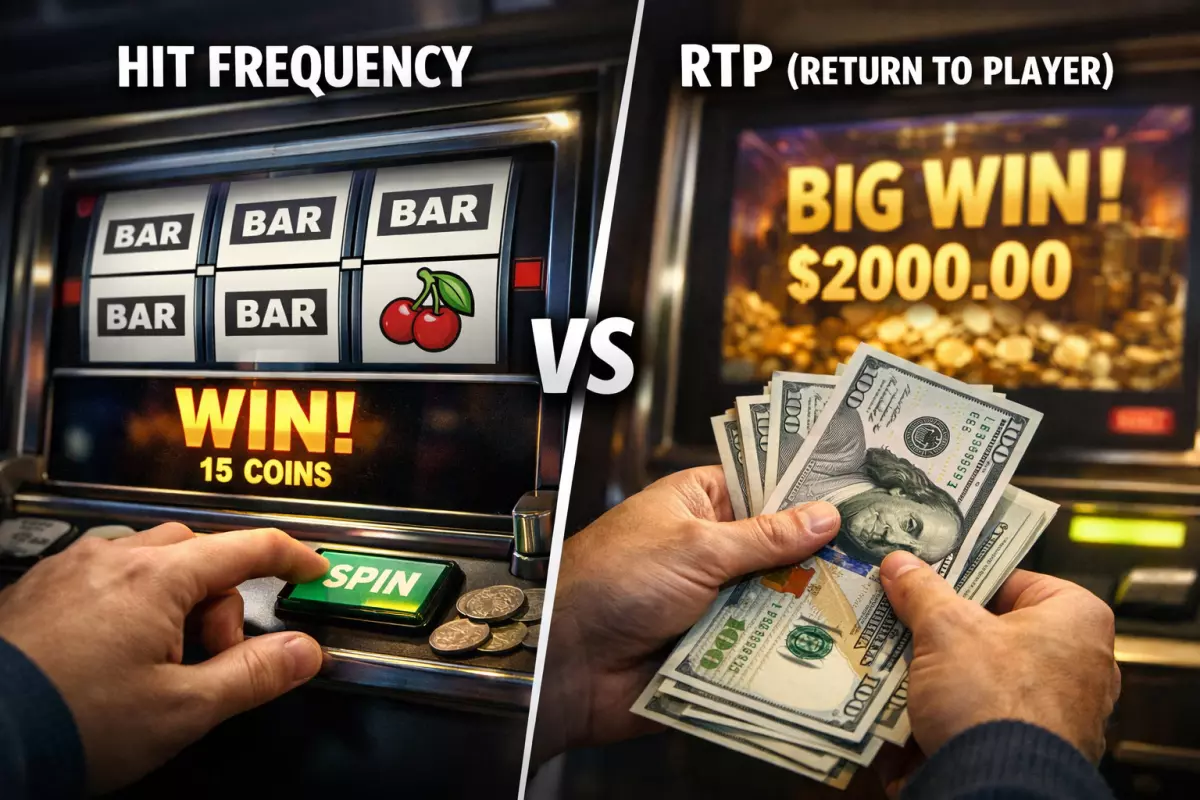
These two slot metrics answer different questions. One describes how often the game pays something back, while the other describes how much the game returns over the long run. Mixing them up can lead to wrong expectations about both session “action” and overall cost.
What each metric actually measures
Hit frequency (sometimes called hit rate) is the share of spins that produce any qualifying win. A “hit” might be a small payout that’s less than your bet, a break-even result, or a larger win—depending on how the game defines a win.
RTP (return to player) is the theoretical percentage of total wagered money that the slot pays back over a very large number of spins. It’s an average, not a promise for a single session.
Why they can move in opposite directions
A slot can pay out frequently but still have a modest RTP if most wins are tiny. Conversely, a game can have a strong RTP while paying rarely if a bigger share of returns comes from occasional large hits (for example, bonus rounds or high multipliers).
Think of it as “many small refunds” versus “rare but meaningful refunds.” Both can add up to a similar long-term return, but the experience feels completely different.
| Aspect | Hit frequency (hit rate) | RTP (return to player) |
|---|---|---|
| Main question it answers | How often do I see a win on a spin? | How much of my total stake comes back over time? |
| What it counts | Winning spins (as defined by the game) | Total payouts divided by total wagers (theoretical) |
| What it feels like in play | More frequent “activity” and smaller swings | Not directly felt spin-to-spin; shows up only across huge samples |
| How it can mislead | Frequent small wins can still drain your balance | A high RTP doesn’t mean you’ll win today or avoid long losing streaks |
| Best used for | Choosing how “busy” or calm a session feels | Comparing long-run cost between games (all else equal) |
Common misunderstanding: “More hits means better value”
A higher hit rate doesn’t automatically mean better value. If many wins are small (for example, returning 0.2x to 0.8x of your bet), you’re still losing money on those spins even though they count as hits. This is why two games can have similar RTP but very different bankroll behavior.
How to use both numbers together
Use the hit rate to gauge pacing and how often you’ll see payouts, then use RTP to estimate long-term expected return. If you prefer steadier feedback, you might lean toward games with more frequent hits. If you’re comfortable with longer dry spells in exchange for the chance of bigger spikes, a lower hit frequency can still be reasonable when paired with a comparable RTP.
One final nuance: published RTP is typically theoretical and may vary by configuration, while hit rate can also depend on what counts as a win (including very small returns). Reading both as complementary—rather than interchangeable—gives a more realistic picture of what a slot session may feel like.
How casinos calculate hit frequency
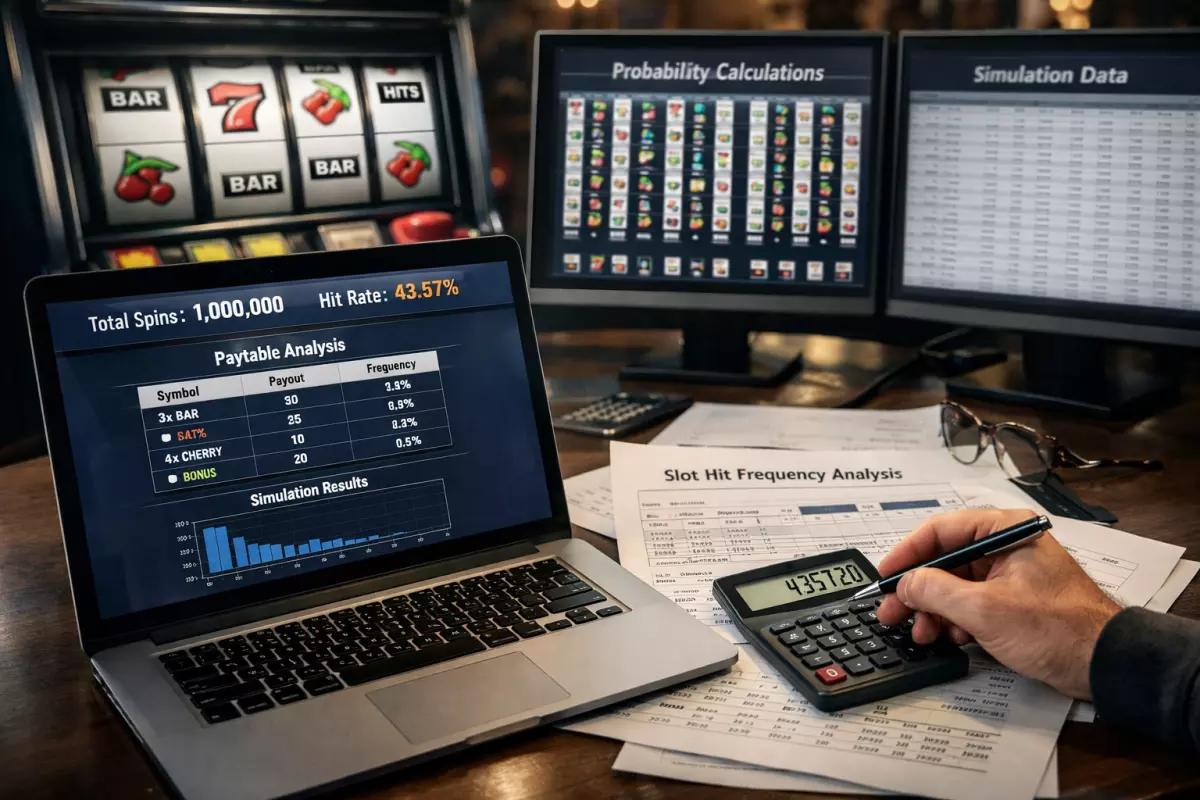
Casinos and game studios treat hit rate as a measurable output of the math model: how often a spin produces any payout, not how often it produces a profit. In practice, they estimate it from the slot’s paytable rules and reel/virtual-reel probabilities, then confirm it through large batches of simulated spins and (later) field data from real play.
What “a hit” means in the math
A “hit” is usually defined as a spin that returns credits greater than zero. That includes tiny wins that are smaller than the bet, and it may include outcomes like “win 0.20 on a 1.00 bet,” which feels like a loss even though it counts as a payout event.
Depending on jurisdiction and internal reporting, some operators also track variants such as “net-positive hits” (payout greater than the wager) or “feature hits” (a bonus trigger). Those are separate metrics; the standard hit frequency is the broad “any pay” version unless stated otherwise.
Two common ways it’s calculated
There are two main approaches, and they typically agree when done correctly. The first is a direct probability calculation from the reel mapping; the second is a simulation-based estimate using millions (or billions) of test spins.
- Combinatorial/probability method: compute the probability of every winning outcome based on the symbol distribution (often on virtual reels) and sum those probabilities.
- Monte Carlo simulation: run the game logic repeatedly, count how many spins pay anything, and divide by total spins to estimate the rate.
The core formula casinos use
At its simplest, the metric is just a ratio:
Hit frequency = (number of paying spins) ÷ (total spins)
If a game pays on 280,000 spins out of 1,000,000 spins tested, the hit frequency is 28% (often stated as “about 1 hit every 3.57 spins”). The “1 in X” version is just the reciprocal: X = 1 ÷ hit frequency.
Why reel mapping matters (especially with virtual reels)
Modern slots rarely use physical reels in the literal sense; they use weighted symbol positions on virtual reels. Each reel has a list of stops, and each stop maps to a symbol. The probability of a symbol landing is tied to how many stops it occupies, not to how it looks on screen.
To compute a hit rate from this setup, analysts determine the probability of each paying line/ways combination by multiplying the per-reel probabilities for the required symbols (and accounting for wild substitutions, scatters, and any “must appear on reel X” constraints). They then add up the probabilities for all outcomes that produce a payout.
What can change the reported number
Hit frequency isn’t a single universal truth unless you also specify the exact conditions. The same game can have different “hit” results depending on what you count and how the game is configured.
- Bet configuration: some titles alter eligible paylines/ways or feature eligibility at different bet levels.
- Game state: persistent features, collected symbols, or level-ups can change the chance of any payout over time.
- Definition differences: “any payout,” “net win,” and “bonus trigger” frequencies can be far apart.
- Rounding and accounting: how credits are rounded or how multiple simultaneous wins are logged can slightly affect reporting.
How it’s validated in practice
Before a game is deployed, studios typically run extensive test cycles to ensure the measured hit rate matches the theoretical model within expected statistical error. After deployment, casinos can also monitor telemetry: the observed share of paying spins over large play volumes should stabilize near the expected value, while short sessions will naturally swing high or low due to variance.
The key takeaway is that the number is driven by the game’s probability structure, then confirmed empirically. A higher hit frequency usually means more frequent small payouts, not necessarily better long-term value, which is governed by RTP and volatility.
High hit frequency vs low hit frequency slots
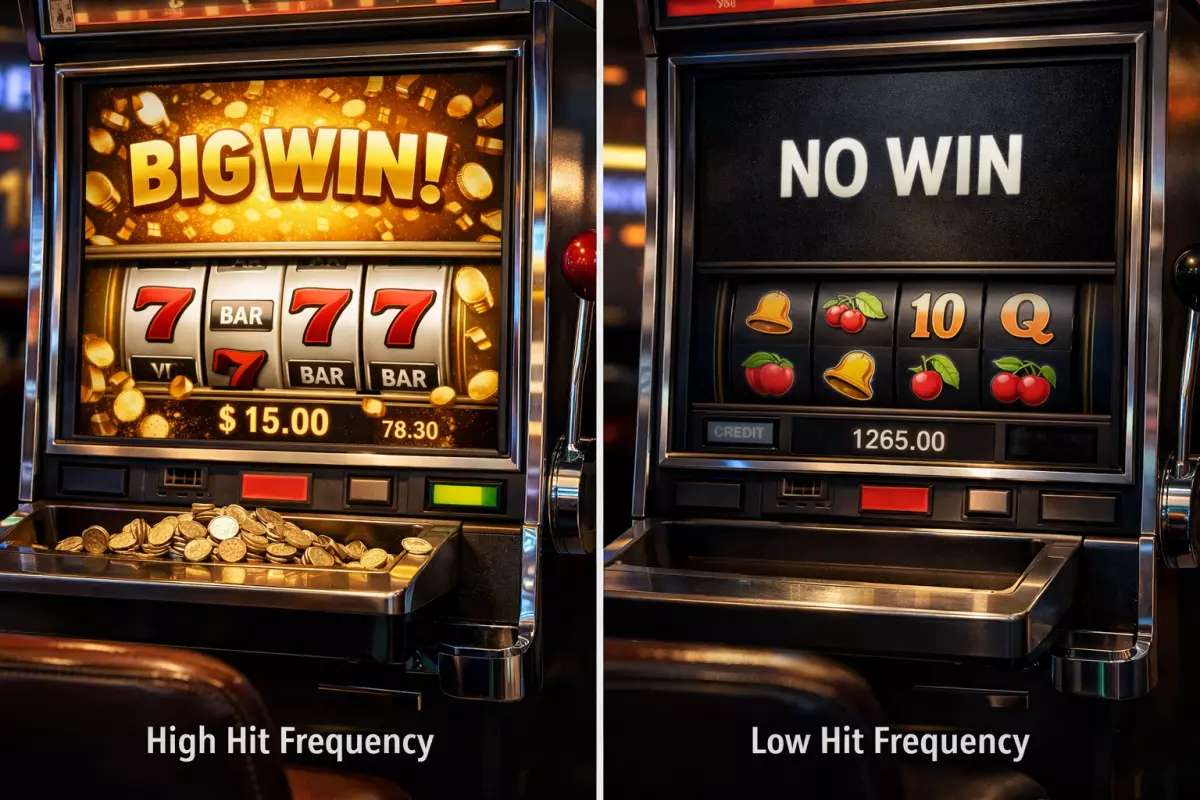
Hit frequency tells you how often a game produces any paying outcome, not how big those wins are. A slot that “hits” a lot can still be unprofitable if the payouts are tiny, while a game that hits less often can feel quiet for long stretches and then land a larger win. Understanding that difference helps you choose a game that matches your patience level and budget.
The key trade-off is usually pace versus volatility. Frequent-hit games tend to deliver more regular feedback (small wins, small bonuses, more “something happened” spins). Infrequent-hit games often have fewer winning spins, but the wins that do appear may be more meaningful relative to the bet size, especially if the design concentrates value into bonuses or higher-paying symbol combinations.
What “high” and “low” hit frequency typically feels like
With a higher hit rate, your balance may decline more slowly because you get more small returns along the way. That can make sessions feel steadier, but it can also create the illusion of doing well even when most hits are below your stake (for example, a $1 win on a $2 bet is still a net loss for that spin).
With a lower hit rate, you’ll see more dead spins and longer losing streaks. The upside is that when a win arrives, it may be larger or tied to a feature that can swing results more dramatically. This style suits players who can tolerate quiet stretches without increasing stakes impulsively.
Side-by-side comparison
| Aspect | Higher hit frequency slots | Lower hit frequency slots |
|---|---|---|
| Winning-spin cadence | More frequent small payouts; fewer long dry spells | Fewer wins overall; longer gaps between payouts |
| Typical session “feel” | Busier, more feedback; can seem smoother | Quieter, more waiting; can feel swingy and tense |
| Common payout shape | Many low-value hits; value often spread across base game | Value often concentrated in bigger line hits or bonus rounds |
| Bankroll impact | Balance may last longer, but frequent sub-bet wins can still drain funds | Balance can drop faster during droughts; requires more cushion |
| Best for | Players who prefer steadier pacing and frequent outcomes | Players comfortable with variance who chase fewer, larger moments |
How to choose based on your goals
If your priority is entertainment time and a steady rhythm, a frequent-hit slot can be a better fit, especially at lower stakes. You’ll typically get more “mini-events” (small wins, small features) that keep the session moving, even if the net result trends downward.
If your priority is the chance of a standout win and you can handle extended losing runs, a less frequent-hitting game may suit you better. In these titles, it’s common for the base game to feel sparse because much of the potential is reserved for bonus triggers or higher-impact combinations.
Practical tips for reading hit frequency correctly
Don’t judge a game by a handful of spins. Short samples can mislead you into thinking a slot is “hot” or “cold,” when you’re just seeing normal randomness. Instead, focus on what the game’s pattern suggests: lots of tiny returns versus fewer but more meaningful payouts.
- Track net results, not just win count: 10 small hits can still be worse than one medium win if most returns are below your bet.
- Match bankroll to drought risk: lower hit frequency usually means you need more spins’ worth of budget to avoid chasing losses.
- Separate hit rate from RTP: a game can hit often and still have the same long-term expected return as one that hits rarely; the difference is how results are distributed.
How hit frequency affects gameplay
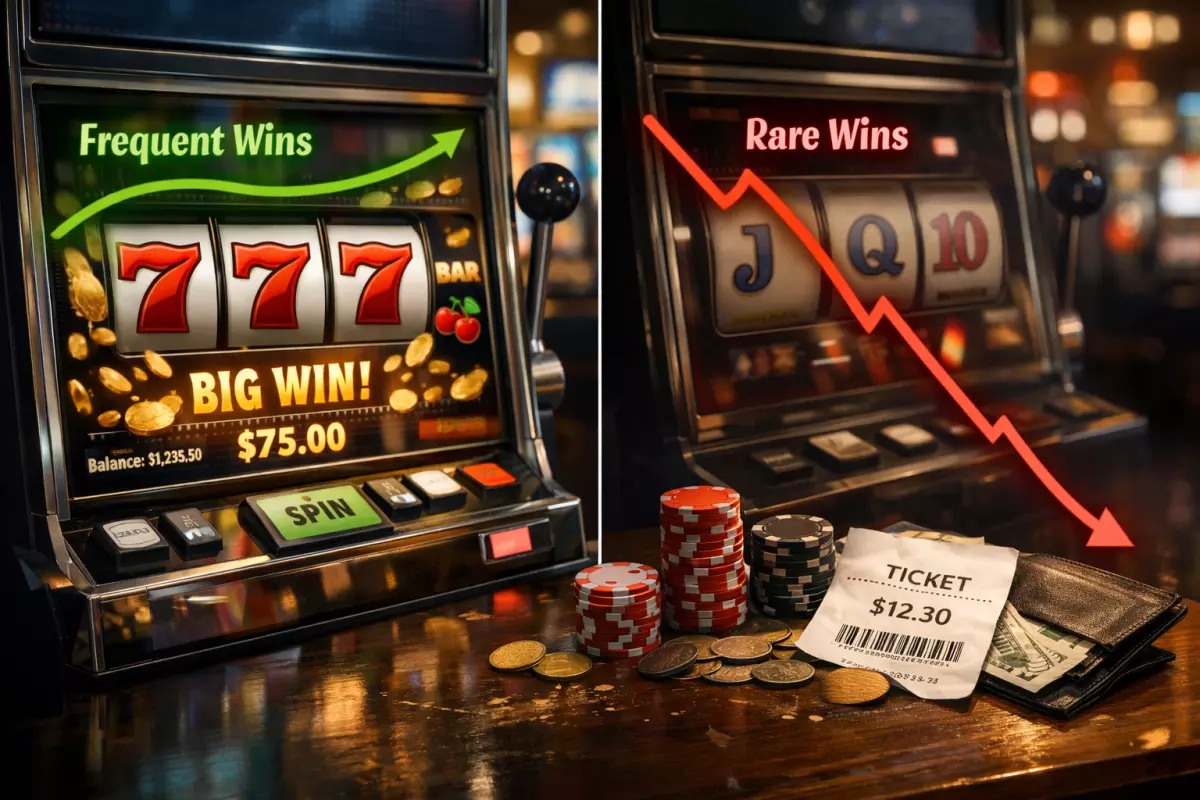
How often a slot produces any winning result shapes the entire feel of a session: how quickly your balance moves, how long your bankroll tends to last, and whether the experience feels steady or streaky. This “win rate” is separate from RTP and volatility, but it interacts with both in ways players notice immediately.
Session pace and bankroll “survival”
A game that lands wins more frequently usually creates more pauses in the downward drift of your balance, which can make play feel slower and more controlled. When hits are rare, your bankroll can drop in a more linear way between occasional payouts, so sessions may end sooner unless you lower your stake.
That said, frequent wins don’t automatically mean you lose less. Many of those hits can be small returns that don’t cover the full bet, so you’re still spending money even while “winning” often.
Emotional rhythm: steady feedback vs. long dry spells
Hit frequency strongly influences the emotional rhythm of play. Regular small wins provide constant feedback and can make a slot feel “active,” while low-hit games can feel quiet for long stretches and then suddenly spike with a bigger result. Neither style is inherently better; they simply suit different temperaments.
- Higher hit rate: more frequent reinforcement, fewer extended losing streaks, but often more small payouts.
- Lower hit rate: longer gaps between wins, more pronounced streakiness, and sessions that can feel more intense.
How it changes what “volatility” feels like
Volatility describes how widely outcomes swing, but the win frequency affects how those swings are experienced. A high-volatility slot can still have a decent number of small hits, yet the meaningful payouts may be rare. Conversely, a low-volatility game often pairs frequent hits with modest win sizes, producing a smoother balance curve.
In practice, players often confuse these concepts: a slot with many tiny wins may feel “safe,” even if the overall expected return is the same as a game that pays less often but in larger chunks.
Bonus features and perceived value
Many modern slots concentrate their best value in features such as free spins, respins, or bonus rounds. If the base game hits often but the feature triggers rarely, the session can feel busy without delivering many memorable moments. If triggers are more common, you may see more feature action, but that doesn’t guarantee higher profits; it just changes where the game’s payouts tend to appear.
Practical ways to use hit frequency when choosing a slot
Use the win rate as a comfort and pacing filter, then check whether it matches your goal for the session. If you want longer play time on a fixed budget, a game with more frequent hits and lower volatility often feels more forgiving. If you’re comfortable with droughts and prefer the chance of bigger spikes, a lower hit rate paired with higher volatility can fit better.
Whatever you pick, set a stake that keeps you comfortable through the expected dry spells. A slot with infrequent wins can be perfectly playable at smaller bet sizes, while the same game may feel punishing if the bet is too high for your bankroll.
Examples of slot hit frequency percentages
Hit rate (sometimes called hit frequency) is simply the share of spins that return any win, even a tiny one. It does not tell you how big those wins are, and it can look “good” while your balance still drops if most payouts are smaller than the bet.
To make the percentages feel concrete, imagine a session of 1,000 spins. If a game has a 25% hit rate, you’d expect roughly 250 spins to pay something back and about 750 to return nothing. Real sessions can swing above or below that because results are random in the short run.
How different percentages tend to feel in play
Lower hit frequencies usually mean longer dry spells but potentially more dramatic moments when a win lands. Higher hit frequencies tend to produce more frequent “small hits,” which can feel steadier, though it doesn’t guarantee slower losses.
| Hit frequency (approx.) | Expected winning spins per 1,000 | What the session often feels like | Typical trade-off to keep in mind |
|---|---|---|---|
| 10% | About 100 | Many dead spins; wins feel “rare” | Longer losing streaks are common; wins may be more volatile |
| 20% | About 200 | Noticeable gaps between hits | Can still be swingy; bankroll needs room for variance |
| 30% | About 300 | Regular but not constant payouts | Many wins may be small and not cover the stake |
| 40% | About 400 | Frequent “something back” moments | Often balanced by lower average win size per hit |
| 50% | About 500 | Feels busy; wins appear very often | Common to see lots of low-value returns that don’t offset losses |
Mini scenarios (same stake, different hit rates)
If you bet $1 per spin for 1,000 spins, you wager $1,000 total. With a 20% hit frequency, you might see around 200 winning spins, but if many of those pay $0.20–$0.80, your balance can still trend downward despite “wins” showing up. With a 40% hit frequency, you may see around 400 wins, yet the average payout per win is often smaller to compensate.
This is why it helps to separate three ideas: how often you win (hit rate), how big wins are when they happen (payout distribution/volatility), and what you get back overall (RTP). A game can have a high hit frequency and still be costly if the typical hit is below your bet size.
A quick way to estimate hit frequency from your own play
If you want a rough personal estimate, track spins and count any spin that returns a payout greater than $0 as a “hit.” Then divide hits by total spins. For example, 87 paying spins out of 300 total is 87 ÷ 300 = 0.29, or about 29%.
Keep the sample size in mind: short sessions can mislead. A few hundred spins can still deviate a lot from the long-run percentage, especially on more volatile titles where wins cluster and droughts happen.
Hit frequency and slot volatility
How often a slot pays something back and how “swingy” its results feel are closely connected, but they are not the same thing. A game can land small wins frequently while still being capable of long losing stretches, and another can pay rarely yet deliver steadier mid-sized returns when it does.
In simple terms, hit frequency describes the share of spins that produce any payout (sometimes even a tiny one). Volatility describes how results are distributed over time: whether outcomes cluster around small wins or are dominated by occasional big hits separated by dry spells.
Why a “high hit rate” can still feel volatile
A common misunderstanding is assuming frequent wins automatically mean low risk. Many modern slots use lots of small “return” events (like 0.2x–0.8x of your bet) that count as hits, but don’t meaningfully rebuild your balance. If most wins are smaller than the stake, you can see many payouts while your bankroll still trends downward.
This is why two games with a similar win rate can feel completely different: one might sprinkle small wins constantly, while the other saves most of its value for bonus features or rare premium symbol combinations.
How volatility shapes bankroll swings
Volatility is about variance: how far outcomes can deviate from the average in the short run. Higher-volatility slots tend to concentrate a larger portion of their total return into fewer, larger wins (often tied to free spins, multipliers, or stacked symbols). Lower-volatility games tend to distribute return more evenly across base-game hits.
Practically, that means a high-variance slot can produce longer losing streaks even if its hit rate looks decent on paper. Conversely, a low-volatility slot can feel smoother even with a modest hit frequency, because its wins are less “all-or-nothing.”
Common patterns you’ll see in real games
- High hit frequency + low volatility: frequent small-to-medium base-game wins; bonuses are nice but not essential to keep the balance moving.
- High hit frequency + high volatility: many small hits (often below the bet) plus occasional large feature wins that drive most of the returns.
- Low hit frequency + high volatility: long quiet periods with rare but potentially large payouts; the bonus round may carry the game.
- Low hit frequency + low volatility: less common, but can happen when wins are infrequent yet relatively consistent in size when they arrive.
Quick comparison: hit rate vs. volatility
| Aspect | Hit frequency (win rate) | Volatility (variance) |
|---|---|---|
| What it measures | How often any payout occurs | How uneven payouts are over time |
| What it feels like | “Something happens often” | “My balance swings a lot (or not)” |
| What can mislead you | Many hits can still be net losses if wins are below the bet | A few big wins can mask long dry spells |
| What to watch in play | How many spins return any amount | Length of losing streaks and how much value sits in bonuses |
| Best used for | Setting expectations for “action” and pacing | Choosing bankroll size and how long you can tolerate downswings |
How to use both metrics when choosing a slot
Start by deciding what you want the session to feel like. If you prefer steady feedback, look for a higher hit frequency and a lower-to-medium volatility profile. If you’re comfortable with quieter stretches in exchange for the chance of a standout win, higher variance may fit better, even if the win rate is lower.
A practical approach is to watch for two things during a short test: whether “wins” are actually covering your stake, and whether most of the game’s value seems locked behind features. Those observations often tell you more about risk and pacing than the raw hit rate alone.
Tips for choosing slots by hit frequency
When you use hit frequency (how often a slot produces any winning result) as a selection tool, the goal is to match the game’s “rhythm” to your budget and patience. A machine that lands small wins often can feel steadier, while a lower-hit game may go quiet for longer but can be built around bigger individual payouts.
Start by separating frequency from profitability. A slot can hit frequently but mostly return tiny amounts that don’t cover the cost of spins. Another can hit less often yet deliver occasional wins that meaningfully change your balance. Treat hit rate as a comfort and volatility indicator, not a promise of value.
Use hit frequency to match your bankroll and session length
If you’re playing a short session or working with a tight bankroll, a higher hit rate can reduce long “dead” stretches and make it easier to track your spending. If you’re comfortable with swings and can handle extended losing runs, a lower-hit title may suit you better, especially if you’re chasing fewer but larger outcomes.
- Short sessions: lean toward games that produce wins more regularly so the balance doesn’t drop too fast between hits.
- Long sessions: you can tolerate lower frequency because you have more spins to wait for the game’s bigger moments.
- Fixed budget: choose a hit rate that keeps you engaged without forcing you to raise bet size to “feel” action.
Check what counts as a “hit” (and why it matters)
Not all hits are equal. Many slots count any win, including returns smaller than your bet. A game can advertise frequent wins while still draining your bankroll because a large share of those hits are “micro-wins.” When comparing titles, focus on how often you get meaningful wins, not just any payout line.
A practical approach is to watch for the balance effect: if you’re seeing frequent wins but the balance trends down quickly, the hit frequency may be high while the average win size is low. That’s a common pattern in games designed around lots of small returns.
Pair hit frequency with volatility and bonus behavior
Hit rate becomes more useful when you combine it with volatility (how swingy payouts are) and how the bonus features pay. Two slots can have similar win frequency but feel completely different if one concentrates value in rare bonuses while the other spreads it across base-game hits.
| What you observe | What it usually suggests | Who it tends to suit |
|---|---|---|
| Many small base-game wins, balance still declines steadily | High hit frequency, low average win size; “busy” gameplay | Players who prefer constant feedback and can accept slow losses |
| Long dry spells, then occasional larger base-game hits | Lower hit frequency with higher variance in normal spins | Players comfortable with waiting and bankroll swings |
| Base game hits often, but most value arrives in bonus rounds | Frequency is decent, but profitability depends on feature triggers | Players who enjoy frequent action plus periodic “event” moments |
| Rare wins overall, but bonuses can be very large | Low hit frequency and high volatility; outcomes are concentrated | Players chasing big spikes and accepting long no-win stretches |
Run a quick “feel test” before committing
Because published hit frequency isn’t always easy to find (and can be defined differently), your own short test can help. Set a small, fixed number of spins and a fixed bet size, then observe how often you see any win and how often you see wins that cover the stake.
- Pick a bet size you can repeat comfortably for at least 50–100 spins.
- Track two counts: any win, and wins that are at least 1x your bet.
- Note how often features trigger and whether they meaningfully change results.
- If the pace feels frustrating or too “noisy” with tiny returns, switch games rather than increasing the bet.
Avoid common mistakes when using hit frequency
The biggest trap is assuming a higher hit rate means better odds. It doesn’t. Slots are built around long-term return (RTP) and volatility, and a frequent-hitting game can still be expensive if most wins are small. Another mistake is chasing losses on a low-hit slot; those games can naturally produce long gaps between wins, so increasing stakes to “force” a hit usually backfires.
Use hit frequency as a way to choose a game that fits your tolerance for downtime and your preferred pacing. If you want steadier engagement, prioritize more regular wins and lower volatility. If you’re fine with quiet stretches in exchange for occasional spikes, a lower frequency profile can be a better match.