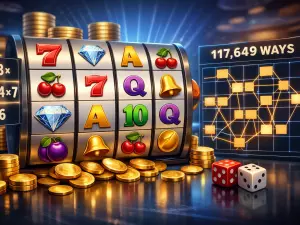
How Megaways Slots Work – Reels and Payways

 This article explains what makes Megaways slots different, how the reels change each spin, how winning combinations are formed, and how avalanche or cascade features work. It also covers multipliers and bonuses, typical volatility, how RTP applies, and common myths.
Knowing how Megaways-style slots calculate reels and payways helps you judge volatility, plan your bankroll, and decide when a bonus round is worth chasing. Each spin can change reel heights, creating thousands of left-to-right symbol combinations. When you understand how the grid shifts from spin to spin, the game’s payout swings and hit frequency become easier to predict.
What makes Megaways slots different
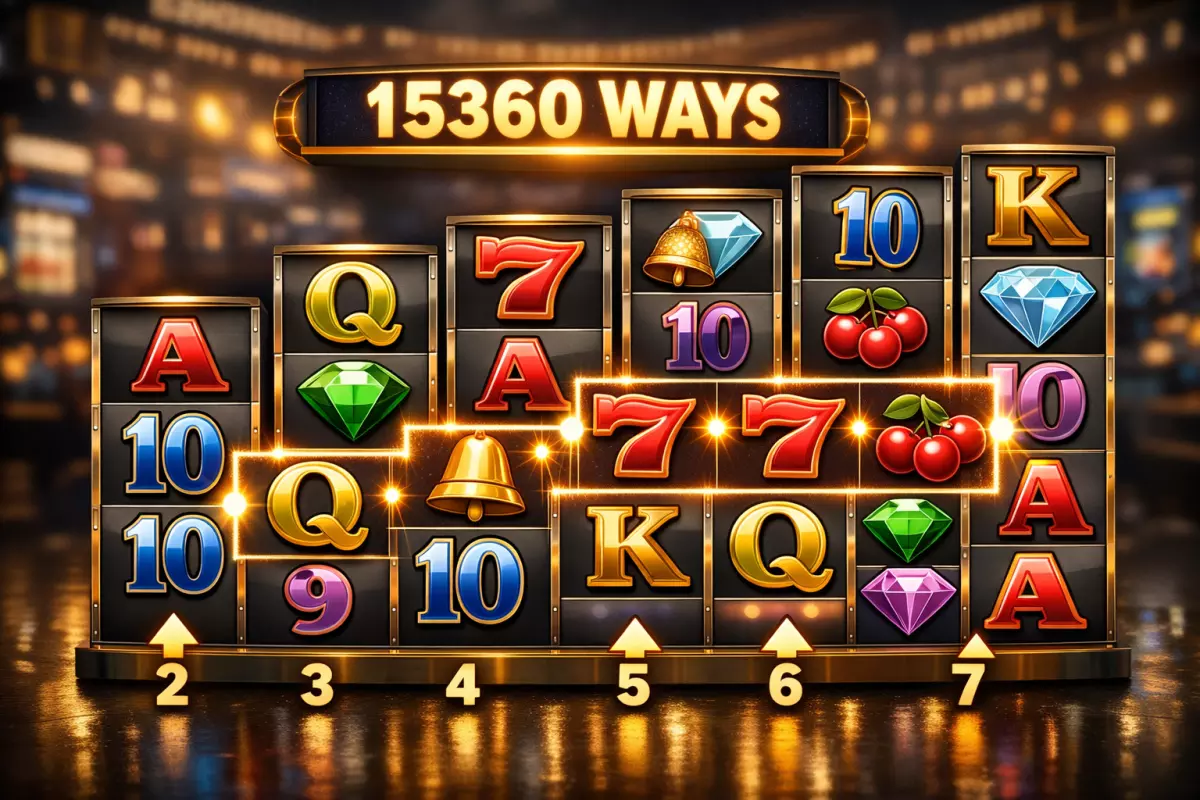
These games stand out because the number of symbols on each reel can change on every spin. Instead of a fixed 3–4 rows per reel, you might see 2 symbols on one reel and 7 on the next, which constantly reshapes the grid and the total number of possible winning routes.
The core idea is “payways” rather than fixed paylines. A win is formed by matching symbols from the leftmost reel to the right, and it can land on any position on each reel. When the reel heights expand, the game can create far more routes to connect matching symbols than a traditional slot layout.
Variable reel heights and shifting payways
In a classic slot, the reel set is stable: the same number of rows, the same line map, and the same visual footprint each spin. In Megaways titles, the reel “window” is elastic. That means the math doesn’t rely on you “hitting a line”; it relies on how many matching combinations are available across the current reel configuration.
This variability is why two spins with the same symbols can pay differently: if one spin shows more symbol positions on key reels, it can create more ways to complete a left-to-right match.
Cascades (tumbles) and chain reactions
Many Megaways slots use cascading reels: when you land a win, the winning symbols disappear and new ones drop in to fill the gaps. Each drop is effectively a new evaluation of the grid, so a single paid spin can produce multiple consecutive wins without re-spinning the reels from scratch.
Because reel heights can change and new symbols can enter during cascades, outcomes often feel “bursty”: long stretches of no wins can be followed by a sequence of connected hits.
Multipliers that build during a spin
Another common twist is a multiplier that increases with each cascade (for example, +1 per tumble). This doesn’t change the base payways mechanic, but it changes the value of extended winning chains. The longer the sequence continues, the more the later wins are boosted.
Not every game uses the same multiplier rules, but the pattern is similar: the feature is designed to reward consecutive wins rather than isolated line hits.
How this compares to fixed-payline slots
The differences are easier to grasp when you line up the mechanics side by side. The table below focuses on how wins are formed and why the experience can feel more volatile than a standard payline game.
| Feature | Traditional paylines | Megaways-style payways |
|---|---|---|
| Reel layout | Fixed rows per reel (stable grid) | Variable symbols per reel (grid can change every spin) |
| How wins are counted | Matches must land on specific paylines | Matches can land anywhere as long as they connect left-to-right |
| Number of win routes | Set number of lines (e.g., 10, 20, 50) | Changes with reel heights; can reach very high counts on some spins |
| Common “extra” mechanic | Often single evaluation per spin (no tumble) | Cascades/tumbles frequently create multiple evaluations per paid spin |
| Typical feel | More predictable hit pattern | More swingy due to changing ways and chain-win potential |
In practical terms, the format trades the simplicity of fixed lines for a system where the reel configuration matters as much as the symbols themselves. If you’re used to counting paylines, it helps to think in terms of “how many positions are available to complete a match” on the current spin.
How Megaways reel mechanics work
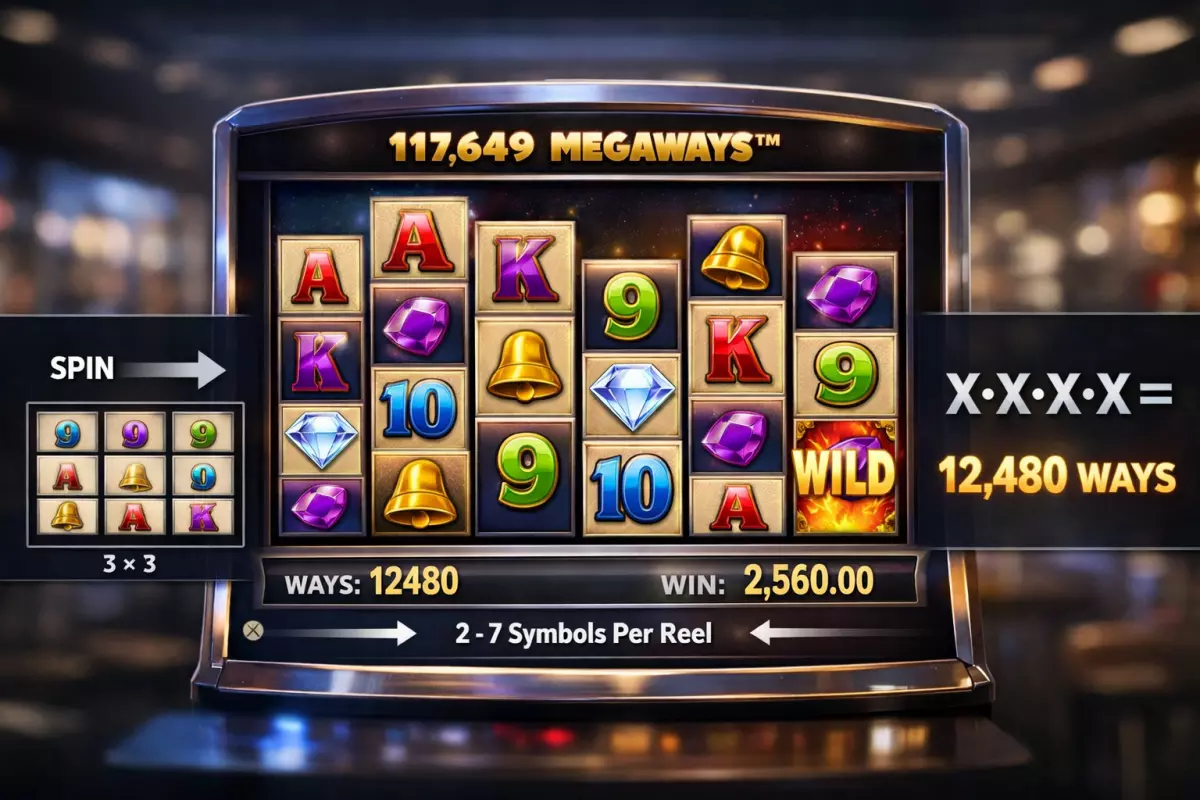
Megaways slots change the reel layout on every spin by varying how many symbol positions appear on each reel. Instead of a fixed 3-row or 4-row grid, each reel can “expand” or “shrink,” so the number of possible winning routes (payways) fluctuates from one result to the next.
The key idea is simple: each reel has a range of possible heights, and the game randomly selects a height for each reel when the spin resolves. When you multiply the number of visible symbol positions across all reels, you get the total payways for that spin. More positions usually means more potential routes, but it doesn’t automatically mean a higher payout.
Variable reel heights and symbol stacks
In a typical Megaways setup, each reel can show a different number of symbols at the same time. One reel might land with 2 visible symbols while another shows 7. The outcome is still RNG-driven, but the presentation looks more dynamic because the grid is not constant.
Many titles also use stacked symbols (the same symbol appearing multiple times on a reel segment). Stacking doesn’t change the rules, but it can increase the chance of forming multiple routes when a symbol is repeated across several positions.
How payways are counted on a spin
Payways are counted as all left-to-right combinations where matching symbols appear on consecutive reels. You don’t typically need the symbol to land on a specific “payline”; it just needs to appear anywhere on each reel in sequence, starting from the leftmost reel.
- If a symbol appears in multiple positions on a reel, each position can contribute to additional routes.
- The game multiplies the counts of matching positions on each reel involved in the win to determine the number of ways for that symbol.
- Wins are usually evaluated separately per symbol and per win length (for example, 3-of-a-kind, 4-of-a-kind, etc.).
Why the maximum Megaways number matters (and what it doesn’t tell you)
Games often advertise a maximum (like 117,649 ways), which is simply the highest possible product of reel heights. It’s a description of the largest grid configuration the reels can generate, not a promise of frequent big wins. A spin can land far below the maximum and still pay well, especially if high-value symbols connect or multipliers are active.
Also, the maximum count doesn’t describe volatility, hit rate, or payout distribution by itself. Two slots can share the same top payways number and still feel very different depending on symbol values, bonus features, and how often the larger reel heights occur.
Common reel-related features that interact with Megaways
Megaways mechanics are often paired with features that take advantage of the changing grid. These don’t redefine the reel system, but they can make the shifting reel heights more impactful in practice.
- Cascading reels: winning symbols disappear and new ones drop in, potentially creating multiple wins from one spin.
- Multipliers: can increase during cascades or in free spins, making long chains more valuable.
- Expanding reels in bonuses: some games lock in higher reel heights or increase the reel range during free spins.
- Wilds and special symbols: wilds can substitute to complete routes; scatters typically trigger bonuses regardless of position.
Overall, the reel system is about variability: each spin builds a new reel layout, the game counts all valid left-to-right routes through that layout, and additional features (like cascades) can repeatedly re-roll the grid within the same round.
How winning combinations are formed

In a Megaways slot, a win is created when matching symbols land on adjacent reels from left to right. Instead of fixed paylines, the game checks every possible route across the current reel layout, which changes each spin because each reel can show a different number of symbol positions.
The key idea is that the game doesn’t “draw” lines on the screen. It evaluates symbol connections across reels based on the rules set in the paytable: which symbols can pay, how many consecutive reels are required, and whether special symbols can substitute or trigger features.
Adjacent reels, not fixed lines
Most Megaways titles use a left-to-right rule: a combination starts on reel 1 and continues across reels 2, 3, and so on, as long as the same symbol (or a valid substitute) appears on each next reel. If a reel has multiple matching symbols, each one can connect to each matching symbol on the next reel, multiplying the number of potential winning paths.
Some games also allow right-to-left or “both ways” wins, but that’s not guaranteed. The safest way to read a specific title is to check its paytable wording, because the direction of evaluation and the minimum number of reels needed can differ.
Why the number of ways changes every spin
Megaways mechanics vary the reel height. For example, a reel might show 2 symbols on one spin and 7 on the next. The total number of payways is the product of the visible positions on each reel. That’s why the “ways” counter can jump dramatically even if the reel strip content hasn’t changed.
- More visible positions usually means more possible connections between reels.
- More connections increases the chance of forming a qualifying match, but it doesn’t guarantee a larger payout.
- Payout size still depends on symbol value, bet size, and how many reels the match reaches.
How payouts are calculated when multiple matches exist
When the same symbol appears multiple times on a reel, the game counts all valid combinations that extend across consecutive reels. Each distinct route is treated as a separate winning way. If you have, say, 3 matching symbols on reel 1 and 2 on reel 2, that alone creates 6 potential connections before even considering reels 3–6.
Most Megaways slots pay the highest-length match for each way (for example, a 5-of-a-kind pays according to the 5-of-a-kind value). If a longer match is present, it typically overrides shorter versions along that same route rather than paying both, but exact counting rules can vary by game.
Wilds, scatters, and other special cases
Wild symbols commonly substitute for regular symbols to help complete a chain across reels. They usually do not replace scatters, and they may have their own payout if they form a combination by themselves. Whether wilds can appear on every reel, and whether they can stack, is game-specific.
Scatter symbols typically don’t need to be adjacent. Instead, they pay anywhere or trigger free spins/bonus features when enough land on the screen. Because Megaways layouts change, the number of visible positions can affect how often scatters appear, but the triggering requirement (for example, 3+ scatters) remains fixed in the rules.
Other mechanics (like multipliers, expanding symbols, or cascading reels) can modify the final result after a winning way is found. In those cases, the game first identifies the valid symbol connections, then applies the feature effects to determine the final payout for that spin sequence.
Avalanche and cascade features
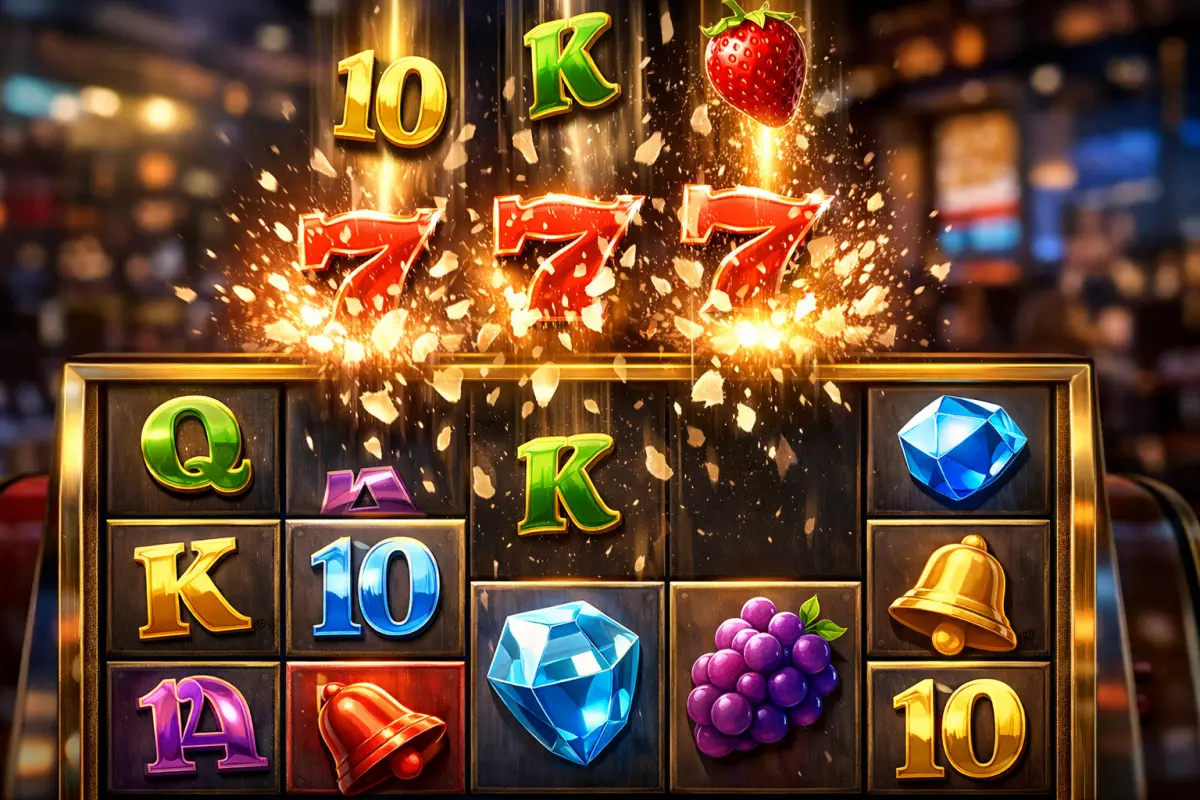
In many Megaways slots, wins don’t simply “end” when the reels stop. Instead, the game removes the winning symbols and lets the remaining icons drop down, with new ones entering from above. This creates a chain-reaction style of play where a single spin can produce several outcomes in sequence.
This mechanic is especially common in Megaways because the number of symbols per reel can change after each drop. As a result, the available payways can expand or shrink during the same paid spin, which is one reason these games can feel more dynamic than fixed-reel slots.
How a cascade sequence typically works
The exact rules vary by title, but the flow is usually consistent: a spin lands, a win is evaluated, then the board “refreshes” by clearing winners and dropping new symbols into place. The process repeats until no new wins appear.
- The reels stop and the game checks for winning combinations across adjacent reels.
- Any symbols that formed a win are removed from the grid.
- Remaining symbols fall to fill empty spaces, and new symbols drop in from the top.
- The game checks again for new wins created by the drop.
- The chain ends when the drop produces no additional wins.
Why this matters in a Megaways reel setup
Because each reel can display a different number of symbols, the grid is not static. After a tumble, a reel might “refill” with more (or fewer) positions than it had a moment ago. That change directly affects the number of paylines-by-ways available on the next evaluation.
Practically, this means two things: first, you can see multiple win checks from one wager; second, the potential number of ways to connect matching symbols can shift between each cascade step, even though you only paid for the original spin.
Cascades, multipliers, and feature triggers
Many Megaways titles attach a multiplier that increases with each consecutive win in the same chain. The first win may pay at base value, then subsequent drops apply a higher multiplier until the sequence ends. Other games keep the multiplier fixed but add extra mechanics like expanding wilds or symbol upgrades during the falling process.
It’s also common for bonus symbols (like scatters) to be counted after each drop. That means a free spins trigger can happen mid-sequence, not only on the initial landing. Whether scatters persist, drop again, or are removed depends on the game’s rules, so it’s worth checking how that specific title handles special symbols during tumbles.
What to watch for when you play
To understand what’s happening on-screen, focus on two readouts: the current win for the chain and the current number of ways. If the game shows a running multiplier, note when it resets (usually when the cascade ends, sometimes when a new spin starts in free spins as well).
Also pay attention to how wilds behave during drops. Some games allow wilds to fall like regular symbols, while others “stick” in place or expand, which can dramatically change how often follow-up wins appear.
Multipliers and bonus features

Extra payout boosts in Megaways slots usually come from two places: multipliers that increase a win after it’s formed, and bonus mechanics that create more (or better) winning opportunities. Because the reel heights change every spin, these add-ons can feel more volatile than in fixed-reel games: a strong spin can become much stronger, while quiet stretches can still happen.
How multipliers typically work
A multiplier is a number that scales your win, most often applied to the total win from a single spin or a single cascade. For example, a 5x multiplier turns a $2 win into $10. In Megaways titles, multipliers are commonly tied to the bonus round, but some games also offer them in the base game through special symbols or random modifiers.
It helps to check where the multiplier applies. Some apply per winning way, some apply to the combined result of all ways on that drop, and others apply only to specific symbols (for instance, premium icons). The same “10x” can behave differently depending on that rule.
Cascades, increasing multipliers, and why they matter
Many Megaways slots use cascades (also called tumbling reels): winning symbols disappear, new symbols fall in, and you can win again on the same paid spin. A common design is an “incrementing” multiplier that grows with each consecutive cascade during a feature. This is one of the main reasons bonus rounds can swing results dramatically: the longer the chain, the higher the boost on later hits.
Not every game increases the multiplier the same way. Some add +1 each cascade, others jump in steps, and some reset the multiplier when a cascade ends. Knowing whether it resets each spin or persists through the whole bonus changes how you should interpret big win potential.
Common bonus features in Megaways games
Bonus rounds are usually built around free spins, but the details vary. The most frequent features are designed to either increase the number of winning ways (by expanding reel heights more often) or to increase the value of wins (through multipliers, enhanced wilds, or both).
- Free spins with modified reel behavior (for example, more high-symbol-count reels appearing).
- Sticky or expanding wilds that stay in place for multiple cascades/spins, improving the chance of repeated connections.
- Random modifiers that add multipliers, extra wilds, or symbol upgrades mid-feature.
- Symbol upgrades where lower symbols transform into higher-paying ones, often after each cascade.
- Bonus buy options in some jurisdictions/games, letting you pay a set cost to enter a feature directly (availability depends on the title and local rules).
What to look for in the paytable and rules
Megaways payways already depend on how many symbols land on each reel, so feature rules can be easy to misread. The fastest way to understand the real impact of a bonus is to confirm three things in the info panel: whether wins are paid per way or per line-like evaluation, whether the game uses cascades, and how multipliers are applied and reset.
Before you commit to longer sessions, it’s also worth noting any caps or limits (maximum win, maximum multiplier, or feature-specific restrictions). Those constraints don’t make a game better or worse on their own, but they do define how far a hot streak can realistically go.
Volatility of Megaways slots
In Megaways games, the risk level is mainly shaped by how often meaningful wins land versus how large they can get when the reels expand and features connect. Because the number of symbols per reel changes every spin, results can swing from long quiet stretches to sudden spikes, especially when multipliers and free spins line up.
Most titles built on this mechanic lean toward medium-high to high variance. The reason is simple: the pay structure often rewards bigger combinations and feature-driven payouts rather than frequent small hits. You may still see many “wins” on paper, but a lot of them can be small returns that don’t move the balance much.
Why Megaways often feels swingy
The changing reel heights create a wide range of possible outcomes. When you get fewer symbols on key reels, the grid has fewer ways to connect and the spin can be uneventful. When reels expand, the number of potential paylines (payways) rises sharply, and that’s when larger clusters of matching symbols become more realistic.
Feature design amplifies this. Free spins, cascading reels, and increasing multipliers tend to concentrate value into short windows. That concentration is what many players experience as “dry spells” followed by a burst of returns.
- Variable reel sizes: more symbols can mean more connections, but it doesn’t guarantee them.
- Cascades/tumbles: one paid spin can trigger several consecutive wins, creating streaky sessions.
- Multipliers: often modest in the base game and stronger in bonuses, shifting value toward features.
- Bonus dependency: some games keep the best payout potential behind free spins or special modifiers.
What “high” vs “low” volatility looks like in practice
With lower variance, you typically get more frequent small-to-medium hits, and the balance curve looks smoother. With higher variance, you’ll often see longer gaps between meaningful wins, but the upside per hit can be much larger when the reel set-up and modifiers align.
| Volatility level | Typical hit pattern | Where most value comes from | Session feel |
|---|---|---|---|
| Low | Frequent small wins; fewer big jumps | Base game payouts and steady mid-size connections | Smoother balance changes, less dramatic swings |
| Medium | Mix of small wins and occasional strong runs | Combination of base hits and periodic feature boosts | Noticeable streaks, but not extreme |
| High | Longer quiet periods; rare but impactful wins | Free spins, stacked multipliers, extended cascades | Big up-and-down sessions; patience required |
| Very high | Infrequent meaningful wins; big outcomes are concentrated | Bonus rounds and “perfect storm” reel expansions | Highly swingy; bankroll can move fast in either direction |
How to judge a specific Megaways game’s risk level
Start with the game’s stated volatility (if provided) and then look at how its features distribute payouts. A slot that offers strong multipliers only in free spins will usually play riskier than one that can build multipliers in the base game. Also check the maximum win and how difficult it seems to reach: extremely high caps often come with lower hit frequency.
Finally, consider your session goals. If you prefer frequent feedback, choose Megaways titles that award regular base-game tumbles and modest multipliers. If you’re comfortable with longer downswings in exchange for bigger potential spikes, higher-variance versions may fit better. Whatever you choose, set a budget and treat the changing payways as a source of variability, not a guarantee of steady returns.
RTP in Megaways slot games
Return to player (RTP) is the long-run percentage of all stakes a slot is designed to pay back over a very large number of spins. In Megaways titles, the headline number is still a single percentage, but the path to that average can look different because the reel layout changes and the number of ways to win varies from spin to spin.
It helps to separate two ideas: theoretical RTP (what the math model targets over millions of spins) and short-term results (what you actually see in a session). Megaways mechanics often create bigger swings between ordinary spins and feature hits, so the same RTP can feel “tighter” or “looser” depending on how frequently bonuses land and how much of the payout is concentrated in them.
How to interpret the percentage in a Megaways format
The published figure is an average across every possible reel configuration and outcome the game can produce. Because each spin can have a different number of symbol positions per reel, the game’s probability tree is broader than in fixed-payline slots, but the RTP calculation still boils down to expected value: the sum of each outcome’s probability multiplied by its payout, divided by the stake.
In practice, two Megaways games can share the same return rate while feeling very different. One might drip-feed small wins more often, while another might push a larger share of the expected return into free spins, multipliers, or other high-impact features.
RTP vs volatility: why Megaways can feel swingy
RTP tells you the long-run average; volatility describes how widely results can vary around that average. The expanding/contracting reel setup tends to amplify volatility because the number of win ways can spike, and features often include multipliers or extra mechanics that create occasional large payouts.
If a game allocates a big portion of its expected return to bonus rounds, you may experience longer stretches of modest or losing spins even when the theoretical payback is competitive. That is not a contradiction; it is a distribution choice in the math model.
What can change the RTP you get in practice
Some Megaways slots ship with more than one RTP setting (for example, a higher and a lower version). The core gameplay looks the same, but the long-run payback differs because the underlying math parameters are adjusted. This is why the same title can show different percentages across casinos or jurisdictions.
- RTP variants: the operator may run a lower or higher configuration of the same game.
- Bonus buy options: when available, they typically change volatility and bankroll dynamics; the theoretical return may be stated separately for base play versus feature purchase.
- Bet size and bankroll: these do not change the theoretical percentage, but they strongly affect how closely your results can track it within a realistic number of spins.
Where to check the RTP and what to look for
The most reliable place is the game’s information panel (often an “i”, “help”, or “paytable” screen). Look for a line that states the return percentage and, if applicable, whether it refers to the base game, the bonus buy, or the overall model.
Also check whether the game mentions multiple RTP versions. If it does, the displayed number should match the specific configuration you are playing. If you cannot find a clear value in the info screens, treat the exact payback as unknown rather than assuming it matches what you have seen elsewhere.
Common myths about Megaways slots
Because Megaways games use changing reel heights and a large number of possible reel combinations, they often get misunderstood. Below are a few persistent misconceptions, along with what’s actually happening under the hood when the reels stop.
Myth 1: “More ways means you win more often”
A higher number of payways can make the screen look busier, but it doesn’t automatically translate to more frequent payouts. Hit frequency is a design choice set by the game’s math model, not a direct result of how many ways are available on a given spin. A spin showing 50,000+ ways can still be a complete miss if no qualifying symbol connections form from left to right.
Myth 2: “Megaways guarantees bigger wins than regular slots”
Maximum win potential depends on the specific title (its paytable, multipliers, bonus rules, and volatility), not the reel mechanic alone. Some Megaways slots are built for very high volatility with rare but large outcomes, while others are more moderate. A classic fixed-payline slot can also have a huge top prize if its pay structure supports it.
Myth 3: “The number of ways is chosen to control your result”
It’s easy to assume the game “decides” the number of ways first and then picks a win or loss, but that’s not how properly implemented RNG-based slots work. The random outcome determines which symbols land on each reel position; the displayed number of ways is simply a consequence of how many symbol rows appear on each reel for that spin. In other words, the way count is an output, not a steering wheel.
Myth 4: “If you keep spinning, you’re due a bonus”
Bonus rounds and free spins are triggered randomly according to the game’s rules, and each spin is independent. A long dry streak doesn’t make a feature “more likely” on the next spin, and a recent bonus doesn’t make the next one “less likely.” This is the same independence principle found in other RNG casino games.
Myth 5: “Changing your bet changes the RTP”
In most cases, the return-to-player percentage is fixed for a given game version, regardless of stake size. What your bet changes is the cost per spin and the size of any payouts relative to that stake. Some casinos may offer different RTP configurations of the same title, but that’s a version-level setting, not something your bet toggles mid-session.
Myth 6: “Cascading reels mean extra ‘free’ spins”
Cascades (or tumbling reels) can create multiple wins from a single paid spin by removing winning symbols and letting new ones fall in. That can feel like free extra spins, but the expected value is already baked into the game’s overall math. Cascades are a feature format, not a loophole.
Myth 7: “More volatility means the game is unfair”
High volatility simply means outcomes are more spread out: fewer small wins and a greater share of value concentrated in bigger hits and bonus rounds. That can feel harsh in short sessions, but it isn’t inherently “rigged.” Fairness is about whether the game follows its stated rules (RNG integrity, correct pay evaluation, and the published RTP for that version), not whether results feel smooth.
If you want a practical way to sanity-check a Megaways slot, focus on the published volatility description, the paytable (especially symbol values and multipliers), and how wins are evaluated left-to-right across adjacent reels. The shifting number of ways is the presentation of the reel layout, not a promise of constant action.