Texas Hold'em Poker Rules and Gameplay Explained

 This article explains how Texas Hold’em works, with a step-by-step gameplay walkthrough covering hole cards, community cards, hand rankings, and each betting round. It also shares basic beginner strategy, common new-player mistakes, and what to expect when playing online.
To play Hold’em confidently, you need a solid grasp of the rules and how a hand unfolds from the first deal to the final bet. This guide explains blinds, betting rounds, community cards, and showdowns in clear, simple language, helping you avoid common mistakes, follow the action smoothly, and focus on making stronger decisions on every hand.
How Texas Hold'em poker works

In this poker variant, each player is dealt two private cards and then shares five community cards with the table. Your goal is to make the best five-card hand using any combination of your two hole cards and the community cards, or to win by getting everyone else to fold.
Core idea: hole cards plus community cards
You always start with two face-down cards (your hole cards). Over the course of the hand, five face-up cards are dealt to the center of the table. At showdown, you build the strongest five-card poker hand you can from the seven cards available to you (2 + 5). Sometimes the best hand uses both hole cards, sometimes only one, and sometimes none (you can “play the board”).
Blinds and the starting pot
Instead of everyone anteing, most games use blinds to create action. The player to the left of the dealer posts the small blind, and the next player posts the big blind. These forced bets form the initial pot and set the minimum amount needed to call before any cards are revealed.
The betting rounds (street by street)
A hand unfolds through four betting rounds. Each round gives players a chance to check, bet, call, raise, or fold depending on the action and the game format (limit, pot-limit, or no-limit).
- Pre-flop: Players receive two hole cards. Action starts left of the big blind.
- Flop: Three community cards are dealt face up, followed by a betting round.
- Turn: A fourth community card is dealt, followed by another betting round.
- River: A fifth community card is dealt, followed by the final betting round.
If at any point all but one player folds, the remaining player wins the pot immediately without showing cards.
Showdown and how the winner is decided
If two or more players remain after the final betting round, the hand goes to showdown. Players reveal their hole cards, and the best five-card hand wins. If multiple players have equally strong hands, the pot is split according to the rules of the game and the exact hand rankings involved.
Hand strength follows standard poker rankings (for example: high card, pair, two pair, three of a kind, straight, flush, full house, four of a kind, straight flush). When hands share the same category, kickers and the highest relevant cards break ties.
What “position” means in practice
Where you sit relative to the dealer button matters because it determines who acts first or last in each betting round. Acting later is generally an advantage: you see what others do before you decide. Early-position players often need stronger starting hands, while late-position players can play a wider range because they have more information.
Common outcomes you’ll see at the table
- Winning without showdown: You bet or raise and everyone folds.
- Winning at showdown: Your best five-card hand beats the others that remain.
- Chopping the pot: Two or more players make the same best hand and split the winnings.
Once the pot is awarded, the dealer button moves one seat clockwise, blinds shift with it, and the next hand begins.
Texas Hold'em gameplay step by step

A hand of Hold’em follows a fixed rhythm: forced bets go in, players receive two private cards, five community cards are revealed across three streets, and betting happens after each reveal. The goal is to make the best five-card poker hand using any combination of your two hole cards and the board.
1) Post the blinds and set the button
Before any cards are dealt, two players must post forced bets to create action. The player to the left of the dealer button posts the small blind, and the next player posts the big blind. The dealer button marks who acts last on later betting rounds and moves one seat clockwise after each hand.
2) Deal two hole cards to each player
Each player receives two private cards face down. These are your only hidden cards for the entire hand, so decisions often start with whether your starting hand is strong enough to continue against the blinds and any raises.
3) Pre-flop betting (first betting round)
Action begins with the player left of the big blind (often called “under the gun”). Players can fold, call the big blind, or raise. Betting continues clockwise until everyone has either folded or matched the current bet size.
- Fold: give up your hand and any chips already put in.
- Call: match the current bet.
- Raise: increase the bet; later players must respond to the new amount.
4) The flop (three community cards) and betting
After pre-flop betting ends, the dealer reveals three community cards face up (the flop). These cards belong to everyone, and players now evaluate made hands (like pairs or two pair) and draws (like flush or straight draws). A new betting round starts with the first active player to the left of the button.
If no one has bet yet in this round, a player may check (bet zero) to pass action. If a bet is made, the options become call, raise, or fold.
5) The turn (fourth community card) and betting
The dealer reveals one more community card (the turn). Because there are now four board cards, hand strength can swing quickly: top pair can improve to two pair, draws can complete, and previously strong hands may become vulnerable. Another betting round follows with the same order as on the flop.
6) The river (fifth community card) and final betting
The last community card (the river) is dealt. This is the final chance to bet. After river action, if two or more players remain, the hand proceeds to showdown.
7) Showdown: reveal hands and award the pot
At showdown, remaining players table their hole cards (or sometimes muck if they concede). The best five-card hand wins. Players can use:
- Both hole cards and three community cards,
- One hole card and four community cards, or
- No hole cards at all (playing the board) if the community cards already make the best hand.
If two or more players have identical best hands, the pot is split. When chips are split and an odd chip remains, house rules determine who receives it (commonly the player closest to the left of the button among those tied).
How betting order changes after the flop
A common point of confusion is who acts first. Pre-flop starts left of the big blind, but after the flop the first active player left of the button acts first, and the button (if still in the hand) acts last. This positional advantage is why the dealer button is so valuable in poker strategy.
Quick reference: what happens on each street
| Stage | Cards dealt | Who acts first | Typical decision focus |
|---|---|---|---|
| Blinds | No cards | N/A | Forced bets posted; button position set |
| Pre-flop | 2 hole cards to each player | Left of big blind | Starting hand strength, raises, defending blinds |
| Flop | 3 community cards | Left of button (first active player) | Pairs, strong draws, board texture |
| Turn | 1 community card (4th) | Left of button (first active player) | Pot building, protection, draw completion |
| River | 1 community card (5th) | Left of button (first active player) | Value bets, bluffs, thin calls |
| Showdown | No new cards | N/A | Best five-card hand wins; ties split the pot |
Hole cards and community cards explained

In Texas Hold’em, every player builds a five-card poker hand using a mix of private cards and shared cards. Your two private cards are dealt face down and belong only to you, while the shared board is dealt face up in the middle for everyone to use.
The key idea is simple: you can use any combination of your two private cards and the five board cards to make the best five-card hand. That means you might use both of your private cards, just one of them, or even none of them if the board already makes your strongest hand.
What are hole cards?
Hole cards are the two face-down cards you receive at the start of the hand. Because opponents can’t see them, they’re the main source of hidden information in the game. Your decisions preflop (before any shared cards appear) are based largely on how strong these two cards are together and how they play in your position.
Even “small” hole cards can become powerful when they connect with the board, such as making a straight, a flush, or a strong pair-plus-kicker situation.
What are community cards?
Community cards are the face-up cards dealt to the center of the table that all players can use. There are five community cards total, revealed in stages. As more board cards appear, hand strength can change dramatically, which is why betting happens after each reveal.
Because everyone shares the same board, players often compete over who has the best “fit” with it. For example, a board with three hearts makes flushes possible for anyone holding hearts in their private cards.
How the board is dealt: flop, turn, and river
The shared board is revealed in three steps, with a betting round after each step. This structure is what creates most of the strategy: you’re constantly reassessing how the visible cards interact with your hidden ones and what they could mean for opponents.
- Flop: three community cards are dealt face up.
- Turn: a fourth community card is added.
- River: a fifth and final community card is added.
Making the best five-card hand
At showdown, the goal is to form the strongest five-card poker hand. You are not required to use both hole cards. This is a common point of confusion for new players, especially when the board itself is strong.
Here are common ways hands are formed:
- Using both private cards: for example, one card completes a flush while the other improves the kicker or makes a pair.
- Using one private card: for example, the board has four cards to a straight and one of your hole cards completes it.
- Using zero private cards (playing the board): if the five community cards already make your best possible hand, your hole cards don’t help and are ignored.
Why these cards matter for reading hands
Because the community cards are visible to everyone, they shape what hands are possible. A paired board can create full houses and four of a kind; three cards of the same suit can create flush threats; connected ranks can create straight possibilities. Your hole cards determine whether you actually have those hands or are drawing to them.
When you evaluate a situation, think in two directions: what your two private cards can realistically make with the board, and what ranges of hole cards other players could have that also connect with the same shared cards.
Poker hand rankings in Hold'em
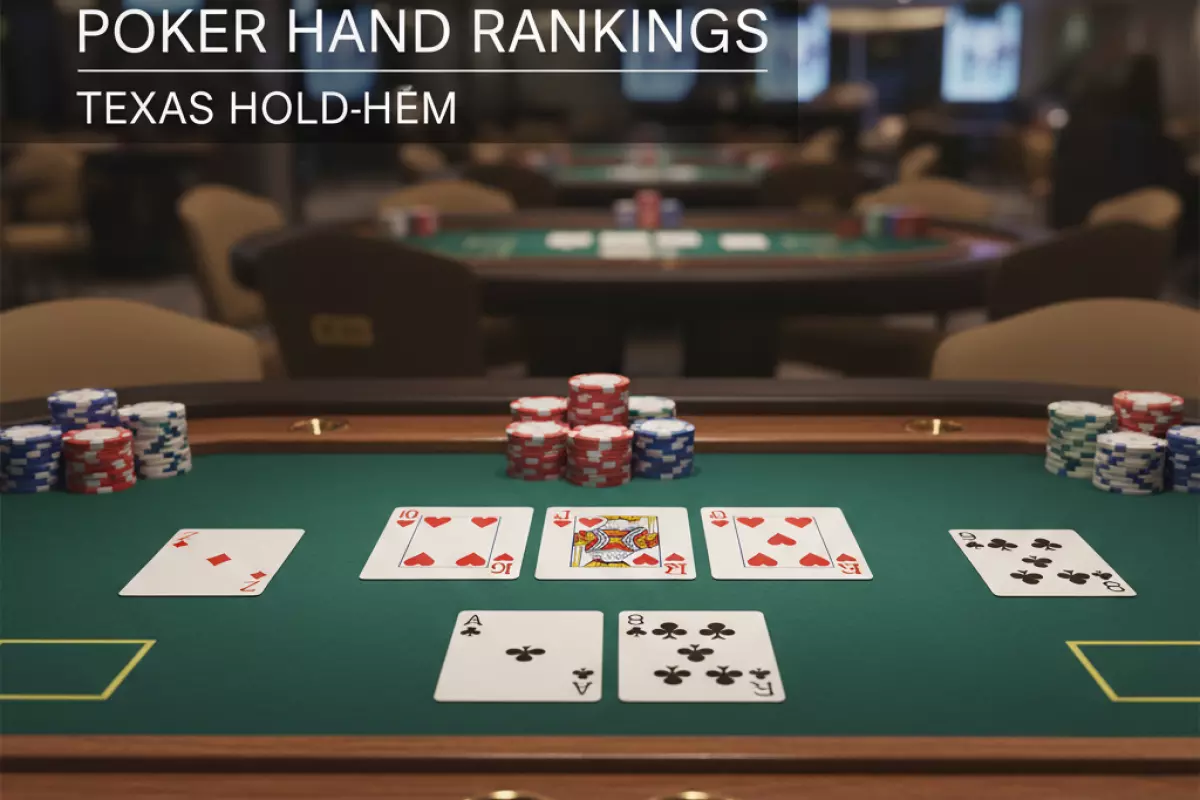
In Texas Hold’em, every player builds the best possible five-card hand using any combination of their two hole cards and the five community cards. The order of hand strength is fixed, so once you know the ranking, you can quickly judge whether you’re likely ahead or drawing thin.
Hands are compared first by category (for example, a flush beats a straight), and then by the highest relevant cards within that category. Suits never break ties in Hold’em; if two players truly have the same five-card hand, the pot is split.
| Rank (high to low) | Hand type | What it means | How ties are decided |
|---|---|---|---|
| 1 | Royal Flush | A-K-Q-J-10 all in the same suit | Always the same top straight flush; ties split |
| 2 | Straight Flush | Five consecutive cards in the same suit | Highest card of the straight wins |
| 3 | Four of a Kind | Four cards of the same rank (e.g., four 9s) | Higher quads win; if equal, compare the kicker |
| 4 | Full House | Three of a kind plus a pair (e.g., 7-7-7-2-2) | Higher three-of-a-kind wins; then higher pair |
| 5 | Flush | Any five cards of the same suit, not in sequence | Compare highest card, then next highest, and so on |
| 6 | Straight | Five consecutive cards, mixed suits allowed | Highest card of the straight wins |
| 7 | Three of a Kind | Three cards of the same rank plus two kickers | Higher trips win; then compare kickers |
| 8 | Two Pair | Two different pairs plus one kicker | Higher top pair wins; then lower pair; then kicker |
| 9 | One Pair | One pair plus three kickers | Higher pair wins; then compare kickers in order |
| 10 | High Card | No made hand; highest five cards play | Compare highest card down through the fifth card |
How to read “kickers” and break close ties
A kicker is any card that isn’t part of the main made hand but still counts toward your best five cards. If two players share the same pair, for instance, the next highest side card often decides the winner. Example: both players have a pair of kings, but one has A-K and the other has Q-K; the ace kicker wins.
When the board already contains a strong five-card combination (like a straight or flush), players can end up “playing the board.” In that case, hole cards don’t improve the best five-card hand, and the result is a chopped pot.
Important Hold’em specifics (that trip up new players)
You must always form a five-card hand. Unlike some poker variants, you are not required to use both hole cards, and you are not required to use exactly one. Any mix is allowed as long as it produces the strongest five-card result.
The ace can act as high or low in a straight. That means A-K-Q-J-10 is the highest straight, while A-2-3-4-5 (often called the “wheel”) is the lowest straight. An ace cannot “wrap around” (so Q-K-A-2-3 is not a straight).
Betting rounds in Hold'em

In Texas Hold’em, each hand is split into four moments where players act in turn and the pot grows through bets, calls, raises, or folds. The goal is the same each time: make the best decision with your cards and the information available, while respecting the order of action and the current bet size.
Across all streets, players can generally choose to fold (give up the hand), check (pass with no bet when allowed), bet (put chips in when no bet exists), call (match a bet), or raise (increase the bet). A round ends when everyone still in the hand has either matched the highest bet or folded.
How turn order works
Position matters because it determines who must act with less information. Before the flop, action starts with the player immediately left of the big blind (often called “under the gun”). From the flop onward, action starts with the first active player to the left of the dealer button.
The dealer button rotates one seat each hand, so the advantage of acting later (seeing what others do first) moves around the table. If a player has folded, they are skipped; only players still in the hand take turns making decisions.
The four betting rounds (streets)
Each street reveals more community cards and creates a new opportunity to wager. Here’s what happens on each one:
| Street | Cards dealt | Who acts first | What typically changes |
|---|---|---|---|
| Pre-flop | Each player gets 2 hole cards; blinds are posted | Left of the big blind | Players decide whether to enter the pot and how large to build it |
| Flop | 3 community cards | Left of the dealer button (first active player) | Hand strength becomes clearer; draws and made hands appear |
| Turn | 1 community card (4th board card) | Left of the dealer button (first active player) | Equity shifts; many hands gain or lose key outs |
| River | 1 community card (5th board card) | Left of the dealer button (first active player) | No more cards to come; decisions are about value, bluffing, or giving up |
When a round ends and the next card is dealt
A betting cycle is complete once all remaining players have had the chance to respond to the last bet or raise, and the amounts are “even” (everyone has put in the same amount for that street). If no one bets, the round can close with a sequence of checks.
If at any point all but one player folds, the hand ends immediately and the last player wins the pot without needing to show cards. If two or more players reach the river and finish the final wagering, the game goes to a showdown to determine the winner.
Showdown and winning the pot
At showdown, players make the best five-card poker hand using any combination of their two hole cards and the five community cards. The strongest hand wins; if multiple players tie with the same best hand, the pot is split evenly (with any odd chip handled by house rules, commonly awarded by position).
In many games, if there was betting on the river, the last aggressor is typically expected to show first, and then others may choose to show or muck if they are beaten. The exact reveal order can vary by venue, but the hand-ranking outcome does not.
Basic Texas Hold'em strategy for beginners
Start by making fewer, better decisions: play stronger starting hands, use position to your advantage, and avoid putting lots of chips in the pot with marginal holdings. In Texas Hold'em, many beginner mistakes come from calling too often and betting without a clear goal.
Choose solid starting hands (and fold the rest)
Preflop discipline is the quickest way to improve. If you regularly enter pots with weak hands, you’ll face tough decisions after the flop and lose money in small, repeated ways. A simple rule is to play tighter from early position and loosen up as you get closer to the button.
- Prioritize high pairs and strong big-card combos (like A-K, A-Q, K-Q suited).
- Be cautious with small pairs and suited connectors; they can be profitable, but mostly when stacks are deep and you’re in late position.
- Avoid dominated hands (like A-7, K-9) that often make a weaker top pair and lose to better kickers.
Position matters more than most beginners think
Acting later gives you extra information: you see who bets, who checks, and how many players stay in. That information makes your decisions more accurate and lets you control pot size more effectively.
When you’re in late position (especially the button), you can profitably play a wider range because you can take free cards, value bet thinner, and bluff more selectively. From early position, keep your range tighter because you’ll be forced to act without knowing what others will do.
Have a reason for every bet: value, bluff, or protection
Before you bet, decide what you’re trying to accomplish. If you can’t name a purpose, checking is often better. In Texas Hold'em, random “see where I’m at” bets tend to build pots you’re not prepared to win.
Value betting means you expect worse hands to call. Bluffing means you expect better hands to fold. Protection means you want to charge draws so opponents don’t get to realize equity cheaply (this often overlaps with value betting).
Play draws correctly: count outs and respect the price
Beginners often chase draws without considering whether the call is profitable. A quick approach is to estimate your outs (cards that improve you) and compare that to the bet size and pot size. If you’re paying too much to try to hit, folding is usually the right long-term play.
Also remember that not all outs are clean. For example, if you have a flush draw but the board is paired, completing your flush could still lose to a full house. When your draw can be second-best, treat it more cautiously.
Common situations and a simple plan
| Situation | Beginner-friendly default | Why it works |
|---|---|---|
| Early position, no raise yet | Open only strong hands; fold the rest | You avoid playing big pots out of position with uncertain ranges behind you |
| Late position, everyone folds to you | Raise more often (steal) with playable hands | Blinds are forced bets; you can win without seeing a flop and use position postflop |
| You hit top pair with a good kicker | Bet for value on safe boards; slow down on heavy action | Top pair wins many small-to-medium pots, but it’s not a hand to stack off automatically |
| You miss the flop completely | Check/fold most of the time; bluff selectively | Saving chips is a skill; bluffing works best when the board favors your preflop range |
| Facing a big bet on the river | Call only with hands that beat clear value ranges | Large river bets are often polarized; avoid “curiosity calls” with bluff-catchers |
Keep the pot small with medium-strength hands
Hands like second pair, weak top pair, or underpairs can win, but they don’t want to play for stacks. Use checking and smaller bets to control the size of the pot, especially when you’re out of position. If an opponent shows strong aggression across multiple streets, be willing to fold even if you have “something.”
Pay attention to opponents, but use simple categories
You don’t need advanced reads to start. Just classify players by what you observe: who plays too many hands, who folds to bets, and who raises frequently. Against loose callers, bluff less and value bet more. Against tight players who fold often, well-timed bluffs and steals become more effective.
Avoid the most expensive beginner leaks
Many losses come from predictable patterns rather than bad luck. If you fix these, your results in Texas Hold'em typically improve quickly.
- Calling too much preflop instead of raising or folding.
- Overvaluing one pair on coordinated boards (lots of straight and flush possibilities).
- Chasing draws without odds and ignoring when outs may be tainted.
- Tilting after a bad beat; take a break if your decisions become emotional.
Common mistakes new players make
Most early losses in Texas Hold’em come from avoidable habits rather than bad luck. Newer players often overvalue “pretty” starting hands, ignore position, and bet in ways that give opponents easy decisions. Fixing a few fundamentals quickly improves both your win rate and your confidence at the table.
Playing too many starting hands
Calling “just to see a flop” is one of the fastest ways to bleed chips. Weak offsuit hands and low, disconnected cards make pairs that are frequently second-best, and they rarely make strong draws. A simple rule is to be tighter from early position and widen your range only when you have position and a clear plan for later streets.
Ignoring position (and acting like every seat is the same)
Position is power in Hold’em because acting later gives you more information. Beginners often play the same hands from under the gun as they do on the button, which leads to tough post-flop spots. When you’re last to act, you can control pot size more easily, take more profitable bluffs, and value bet thinner because you see what others do first.
Misunderstanding pot odds and chasing draws incorrectly
Drawing can be profitable, but only when the price is right. Many new players call large bets with a flush draw or straight draw without considering whether the pot is offering enough value to justify the call. If you’re routinely paying too much to try to “get there,” the math will grind your stack down over time.
| Situation | Common mistake | Better default approach |
|---|---|---|
| Flush draw on the flop | Calling big bets with poor pot odds | Call when the price is reasonable; otherwise fold or consider a semi-bluff if fold equity is realistic |
| Top pair with weak kicker | Overplaying it for stacks | Value bet smaller and be willing to fold to heavy pressure on later streets |
| Out of position post-flop | Calling too much and guessing on turns/rivers | Play tighter preflop; use more check-calls with clear reasons and avoid bloating pots without strong hands |
| Facing a raise preflop | Flat-calling with dominated hands | Fold more, 3-bet with strong hands, and call mainly with hands that play well post-flop |
Overvaluing one-pair hands
Top pair feels strong, but it is often not a “go broke” hand, especially in multiway pots. New players commonly keep calling because they have something, even when the betting pattern suggests they’re beaten. Pay attention to board texture: on coordinated boards with possible straights and flushes, one pair shrinks in value quickly.
Bet sizing that gives away information
Beginners frequently bet small with strong hands to “keep them in” and bet big with bluffs to “make them fold.” This creates an easy read for attentive opponents. Aim for consistent sizing with the same line: for example, use similar bet sizes for value bets and bluffs on the same board so your story makes sense either way.
Calling too much and not having a plan
Passive calling is tempting because it feels safer than raising or folding. The problem is that calling without a clear reason leaves you guessing on later streets and paying multiple bets with marginal hands. Before you put chips in, decide what you’re trying to accomplish: are you value betting, bluffing, protecting, or realizing equity with a draw?
Tilting and chasing losses
Emotional decisions are costly in poker because they override discipline. After a bad beat, new players often widen their range, take low-quality bluffs, or call down “to catch someone.” If you notice frustration affecting your choices, slow down, tighten up for a few orbits, or take a break rather than trying to win it back immediately.
Forgetting the basics of table awareness
Even when you know the rules, it’s easy to miss key details: stack sizes, who is tight or aggressive, and how many players saw the flop. These factors should influence your decisions every hand. Make it a habit to track who is likely to fold, who calls too much, and who applies pressure, then adjust your strategy accordingly.
Playing Texas Hold'em online
Online poker keeps the same hand rankings and betting rounds as a live game, but the pace, interface, and decision-making feel different. You act with a mouse or taps, you see clear prompts for blinds and bet sizes, and the software enforces the rules automatically, which reduces mistakes but can also speed you into rushed choices.
How online tables work
You’ll typically choose a stake level, a table size (often 6-max or 9-max), and a format such as cash games or tournaments. The platform posts the small blind and big blind, deals two hole cards, and runs the action through pre-flop, flop, turn, and river. When it’s your turn, you’ll usually see standard options like fold, check, call, bet, or raise, with sliders or preset buttons to select amounts.
Because action is faster, it helps to watch the pot size, the current bet, and the effective stacks (the smallest stack involved in the hand). Those three numbers shape whether a call is affordable, whether a raise commits you, and how much pressure a bet can apply.
Choosing a format: cash games vs. tournaments
Cash games let you buy in for a chosen amount and leave whenever you want, so decisions revolve around deep-stack strategy and steady bankroll control. Tournaments have escalating blinds and a fixed entry, so survival and stack preservation matter more as the average stack shrinks and pay jumps approach.
| Aspect | Cash games | Tournaments |
|---|---|---|
| Risk per session | Flexible; you can top up or quit at any time | Fixed buy-in (plus fee); you’re out when your chips are gone |
| Blinds | Stay the same | Increase on a timer, forcing action |
| Typical stack depth | Often deeper and more stable | Trends shallower as levels rise |
| Primary goal | Make profitable decisions hand to hand | Accumulate chips and reach payout positions |
| Common strategic focus | Value betting, pot control, exploiting tendencies | Push/fold spots, ICM pressure, adjusting to short stacks |
Timing, tells, and reading opponents
You won’t get physical tells, but you do get patterns: bet sizing, frequency of raises, how often someone continuation-bets, and how they react to pressure on later streets. Timing can be informative too, but treat it carefully—some players use “auto” buttons, others multi-table, and internet lag happens.
A practical approach is to build a simple profile: who plays too many hands, who folds to raises, who calls down light, and who only bets big with strong holdings. Over time, those observations become more reliable than any single fast or slow action.
Bet sizing and interface habits that prevent mistakes
Misclicks are an online-specific leak. Before you confirm a bet or raise, double-check the amount and whether you’re clicking “call” versus “raise.” Also watch for situations where the software offers an “all-in” option by default when stacks are short.
- Use consistent sizing rules (for example, similar open-raise sizes by position) so you don’t accidentally give away information.
- Pay attention to the minimum raise and the current bet; online rooms enforce these strictly.
- Take your full decision time on big pots; speed is rarely an advantage when the pot is large.
Bankroll and game selection basics
Online games can be available 24/7, which makes it easy to play too high or too long. Set a budget for the stake you’re playing and pick tables where you’re comfortable with the pace and player pool. If you notice you’re frequently facing large 3-bets or aggressive multi-street lines you don’t understand yet, it’s usually better to drop down in stakes and practice than to “fight it out” at higher limits.
Finally, keep your environment distraction-light. Because you’ll see far more hands per hour than in a live setting, small lapses in focus add up quickly, especially in no-limit Texas Hold’em where one decision can cost your entire stack.