Deuces Wild Video Poker Rules and Gameplay

 This article explains what Deuces Wild video poker is, how it differs from classic video poker, and how wild deuces work. It covers hand rankings, paytables and payouts, RTP and odds, basic strategy, and how to play Deuces Wild online.
Learning the rules and flow of Deuces Wild video poker helps you avoid costly misplays and get more value from every hand. Since all 2s act as wild cards, the pay table changes and the best holds differ from Jacks or Better. This guide explains how the game is dealt, how the draw works, and which winning hands you can expect.
What Deuces Wild video poker is

Deuces Wild is a five-card draw video poker variant where all four 2s act as wild cards. That single rule changes the entire feel of the game: you’ll see more made hands, more “almost there” draws, and a strategy that focuses heavily on building premium results rather than simply protecting medium-strength pairs.
Like other video poker games, you start with five cards, choose which to hold, and then draw replacements for the rest. The difference is that any deuce can substitute for another rank and suit to complete the best possible hand, which makes strong outcomes more frequent and also changes what counts as “high value” in the paytable.
How the wild deuces change hand strength
Because 2s can stand in for any card, hands that are rare in non-wild games become realistic targets. For example, a single deuce plus three cards to a straight flush can be a serious draw, and two deuces can turn many ordinary starts into strong made hands. At the same time, some hands you may be used to valuing highly (like a full house) can be less important depending on the paytable, since the game often pays extra for higher wild-based combinations.
Many Deuces Wild paytables also remove or reduce payouts for hands that would be common with wild cards. A common example is that a standard three of a kind may not pay at all, while special hands such as four deuces or wild royal flush can be the main profit drivers.
Typical winning hands you’ll see in this variant
Rules vary slightly by machine, but most versions rank and pay a mix of “natural” hands (made without wild substitutions) and “wild” hands (where at least one deuce is used). The presence of wild cards usually introduces special categories that don’t exist in Jacks or Better.
- Natural royal flush: a royal flush with no deuces used.
- Wild royal flush: a royal completed using one or more deuces.
- Four deuces: all four 2s, typically a top payout.
- Five of a kind: made possible by using deuces to match a rank.
- Straight flush / four of a kind: appear more often due to flexible completion.
Why the paytable matters more than usual
In this game, the paytable isn’t just a payout list; it effectively defines the strategy. Small differences (for example, whether a straight pays, whether three of a kind pays, or how much is awarded for a wild royal) can change which holds are correct in common situations. Two machines that both say “Deuces Wild” can play very differently in terms of expected returns and optimal decisions.
When you’re learning the rules and gameplay, it helps to think of Deuces Wild as a draw poker framework with a wild-card twist and a paytable-driven priority system: you’re often choosing between a made hand that pays now and a draw that has a higher chance of reaching a premium payout.
How Deuces Wild differs from classic video poker

The biggest shift from standard games like Jacks or Better is that all four deuces (2s) act as wild cards. That single rule changes what “good” hands look like, how often you’ll hit big combinations, and which cards you should keep on the draw.
Wild cards change both hand values and priorities
In classic video poker, pairs and high cards often drive your decisions because they’re reliable ways to build paying hands. In Deuces Wild, a deuce can stand in for any rank and suit, so hands that would normally be “nothing” can become strong draws, and hands that look decent in a non-wild game can be less valuable than they appear.
For example, a lone deuce is frequently worth holding because it can complete straights, flushes, and premium hands with just one or two helpful cards. By contrast, a simple high pair (like Jacks) is not automatically a centerpiece hand in many Deuces Wild paytables, because the game’s payouts are tuned around the extra power of wilds.
The paytable is rebalanced (and often removes full houses and flushes)
Because wild cards make strong hands much easier to form, Deuces Wild typically pays less for mid-tier results and shifts value toward rarer “wild-enhanced” hands. Many versions also don’t pay for a full house or a flush at all, which is a major departure from classic video poker where those are standard paying outcomes.
Instead, you’ll commonly see payouts for hands that either require wild cards or are difficult even with wilds, such as Four of a Kind, Straight Flush, Five of a Kind, and premium categories like Wild Royal Flush and Four Deuces. The exact list depends on the machine’s paytable, so reading it before you play matters more here than in many non-wild variants.
| Aspect | Classic video poker (e.g., Jacks or Better) | Deuces Wild |
|---|---|---|
| Role of 2s | Normal rank; no special power | All 2s are wild and can substitute for any card |
| Common paying hands | Pair of Jacks or better, Two Pair, Full House, Flush, etc. | Often emphasizes Four of a Kind+; some versions don’t pay Full House/Flush |
| Top-end categories | Royal Flush is the headline hand | Often adds Wild Royal, Five of a Kind, and “Four Deuces” as premium results |
| Typical holding logic | High pairs and high cards frequently guide holds | Deuces and suited/connected cards gain value because wilds boost completion odds |
| Volatility feel | More steady, frequent small-to-mid wins | More swingy: more big hands possible, but paytable may reduce mid-tier payouts |
Strategy shifts: you play more for “made” power and premium draws
With wild cards available, the best play often becomes more aggressive about chasing high-value outcomes. Holding a deuce (or multiple deuces) can turn marginal-looking starts into strong opportunities, and it can be correct to break what would be a safe made hand in a classic game if it blocks a higher-paying route in Deuces Wild.
- Deuces are usually keepers: even one wild card can dramatically improve your draw.
- Suited and connected cards matter more: they combine well with wilds to form straight flushes and royals.
- Paytable-dependent decisions increase: whether a flush/full house pays (and how much) can change optimal holds.
More big hands, but not always “easier money”
Deuces Wild can feel more exciting because premium hands appear more often than in non-wild video poker. At the same time, the game compensates by adjusting payouts and, in some versions, trimming or removing common paying categories. The result is a different rhythm: you may see more dramatic hits, but you can also experience longer stretches where the paytable doesn’t reward the same “solid” hands you’d expect in classic play.
Wild deuces explained

In Deuces Wild, every 2 in the deck acts as a wildcard. That means it can stand in for any rank and suit to help you form the strongest possible five-card poker hand. This single rule changes how you evaluate draws, because hands that would be “good enough” in other video poker games often become discard candidates here.
When you’re dealt one or more deuces, you don’t “choose” what they are in advance. The game automatically scores your final five-card hand as the best legal hand you can make, using the deuces as whatever cards maximize the payout.
How wild cards change hand building
Wild 2s make premium hands much more common, but they also reshape what counts as a strong starting hand. For example, three-of-a-kind without a deuce is usually not a made hand you can relax with, because a single wild card can turn many partial draws into four-of-a-kind, straights, or flushes.
They also affect what you chase. In many Deuces Wild paytables, a flush can pay less than a straight, and a full house can pay less than four-of-a-kind. Because deuces make “big” hands more reachable, the paytable is typically rebalanced and certain traditional rankings don’t map cleanly to “keep this” decisions.
What happens with 0, 1, 2, 3, or 4 deuces
The number of wild cards in your hand largely determines your ceiling:
- 0 deuces: You’re playing a tougher version of draw poker because many paytables don’t reward pairs. You often need at least three-of-a-kind, a straight, or a flush to get paid.
- 1 deuce: Many hands become one-card-away from a straight/flush, and four-of-a-kind becomes a realistic target with the right supporting cards.
- 2 deuces: You can frequently build five-of-a-kind (if the paytable offers it) or very strong four-of-a-kind variations.
- 3 deuces: You’re usually deciding between the highest “natural” upgrade available (like a straight flush possibility) and the guaranteed high-paying wild-card hand.
- 4 deuces: This is typically an automatic top-tier result (often the game’s special jackpot hand), so there’s no real “choice” to make.
Natural hands vs. wild hands
Most Deuces Wild games distinguish between hands made without any deuces (often called natural) and hands that use wild cards. A natural royal flush, for instance, is commonly paid much higher than a royal flush created with one or more deuces, because the wild version is far easier to hit.
This distinction matters during play: sometimes you’ll hold cards that preserve a chance at a natural premium hand, but only if the paytable reward justifies giving up a more reliable wild-card payout.
Quick examples of how the deuce is “assigned”
Think of the 2 as a flexible placeholder that completes the best scoring pattern:
- If you hold A♠ K♠ Q♠ J♠ 2♦, the deuce can act as the 10♠ to complete a royal flush (a wild royal in most games).
- If you hold 9♥ 9♣ 2♠ 2♥ K♦, the deuces can both become 9s to make five-of-a-kind (if offered), otherwise they’ll form the highest paying alternative available.
- If you hold 6♣ 7♣ 8♣ 2♦ Q♠, the deuce can become 9♣ to complete a straight flush, which often outranks other options.
The key takeaway is that wild deuces make “potential” more valuable than it looks at first glance. Your best hold is usually the one that keeps the highest-paying routes open, not the one that simply locks in a modest made hand.
Hand rankings in Deuces Wild
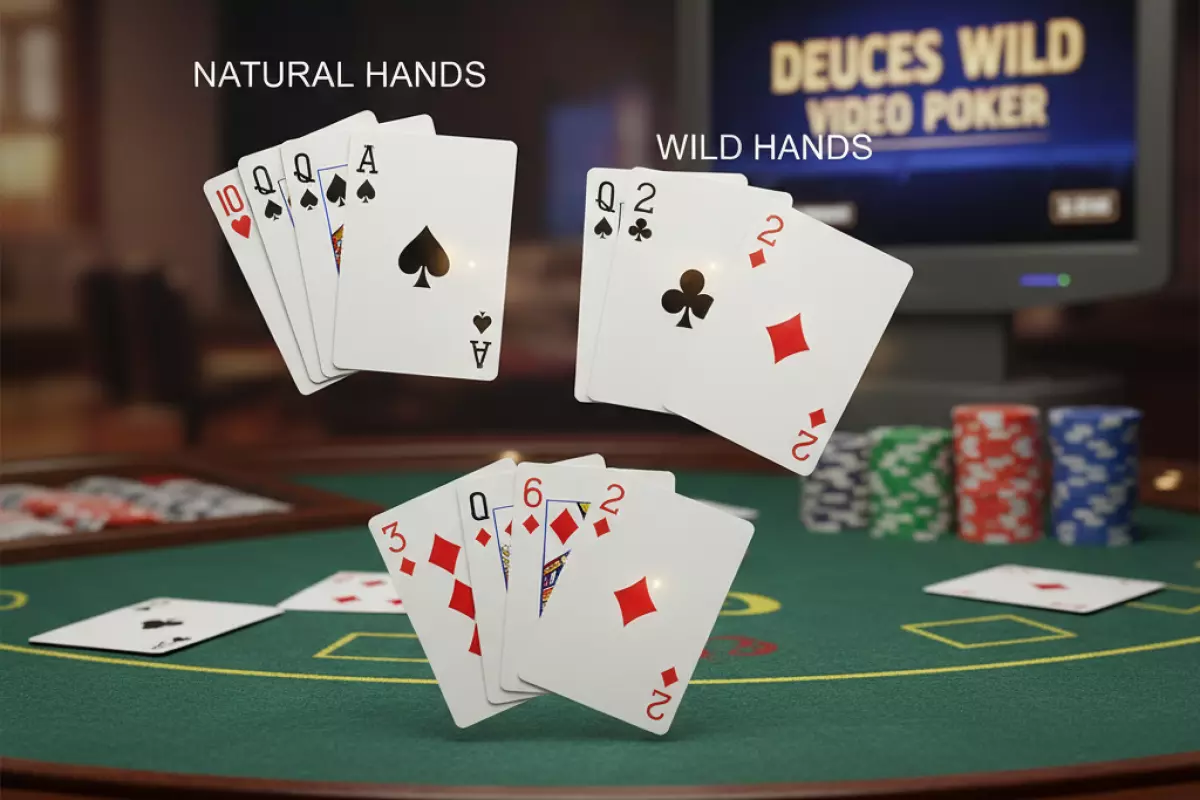
The key difference in this variant is that all 2s act as wild cards, so many “ordinary” poker hands become easier to make. To keep the game balanced, the paytable and the order of winning combinations are adjusted, and some hands you may know from Jacks or Better are ranked differently.
In most Deuces Wild paytables, the general rule is simple: hands made without any wild cards (often called “natural” hands) tend to outrank similar hands that rely on deuces. That’s why you’ll see categories like a natural royal flush listed separately from a wild royal flush.
Standard Deuces Wild ranking order (highest to lowest)
| Rank | Winning hand | What it means in Deuces Wild |
|---|---|---|
| 1 | Natural royal flush | A-K-Q-J-10 of the same suit with no deuces used. |
| 2 | Four deuces | All four 2s. Because they are wild, this is a premium hand in most versions. |
| 3 | Wild royal flush | A-K-Q-J-10 suited where one or more cards are substituted by deuces. |
| 4 | Five of a kind | Any five cards of the same rank (e.g., five Kings), made possible by wild 2s. |
| 5 | Straight flush | Five consecutive cards of the same suit; deuces may fill gaps or replace ranks. |
| 6 | Four of a kind | Four cards of the same rank; can be natural or completed with deuces. |
| 7 | Full house | Three of a kind plus a pair; wild cards can help complete either part. |
| 8 | Flush | Any five cards of the same suit; deuces count as that suit for the purpose of the flush. |
| 9 | Straight | Five consecutive ranks; deuces can act as missing ranks to complete the sequence. |
| 10 | Three of a kind | Three cards of the same rank, often formed with help from a deuce. |
Notice what’s missing: in many Deuces Wild games, two pair and a single pair are not paying hands. That changes the feel of play because you’ll often discard more aggressively instead of “hanging on” to a low pair.
Natural vs. wild: why it matters
When a hand category is split into “natural” and “wild” (most notably the royal flush), the game is telling you that using a deuce makes the result easier to achieve and therefore less valuable. A natural royal flush is rarer, so it usually sits at the top of the rankings and receives the biggest payout.
For everything else, the ranking is typically based on how strong the final five-card hand is, not on how many deuces you used. For example, a straight flush generally beats four of a kind even if the straight flush required wild cards to complete.
Common paytable variations to watch for
Casinos and online platforms may tweak the order slightly, especially around the top-tier hands. Before you play, scan the paytable to confirm which premium hands are offered and how they’re prioritized.
- Some versions add “natural straight flush” as a separate, higher-paying category than a straight flush made with deuces.
- Some versions pay for a pair (or bring back two pair), but this is less common in classic Deuces Wild.
- Bonus structures can shift emphasis (for example, extra value for four deuces or certain five-of-a-kind outcomes).
Paytable and payout structure

The payout chart is the “map” of Deuces Wild: it tells you what each final hand is worth and, just as important, it signals what kind of strategy the game expects. Because all four 2s act as wild cards, the game shifts value away from ordinary hands and toward wild-card combinations, with natural hands (no deuces used) usually paying a premium.
How wild cards reshape hand values
In Deuces Wild, you’ll make strong hands more often than in Jacks or Better, so the machine typically pays less for common outcomes. Many versions drop or reduce the payout for two pair, and some even remove it entirely. In exchange, the paytable adds (or boosts) hands that only exist because of wild cards, such as Five of a Kind and Wild Royal Flush.
A common hierarchy you’ll see is: Natural Royal Flush at the top, then Four Deuces, then either a Wild Royal Flush or Five of a Kind depending on the specific schedule. The exact ordering and payouts vary by casino and by game variant, so reading the chart before you play matters.
Typical Deuces Wild hand categories (from top to lower)
Most machines use a familiar set of winning hands, but the presence of deuces changes the “middle” of the list. The following categories are widely used, though the payouts attached to them can differ:
- Natural Royal Flush (A-K-Q-J-10 suited, no deuces)
- Four Deuces (all four 2s)
- Wild Royal Flush (royal flush completed with one or more deuces)
- Five of a Kind (made possible with wild cards)
- Straight Flush
- Four of a Kind
- Full House
- Flush
- Straight
- Three of a Kind
If you don’t see a listed hand on the machine’s chart, it doesn’t pay, even if it would be a winner in another poker variant. That’s why two pair and even some low pairs are often treated as “try again” hands in this game.
Common paytable variants and what they imply
Deuces Wild comes in several recognizable payout schedules. You don’t need to memorize every number, but it helps to know what changes usually signal:
- “Full-pay” style schedules tend to pay relatively well on Full House and Flush and keep the overall return higher, assuming correct strategy.
- Lower-paying schedules often shave value from mid-tier hands (like Straight/Flush/Full House) while leaving the headline jackpots (like royals) looking similar.
- No two pair is common; if two pair is absent, your optimal holds will lean more toward building straights/flushes or improving with deuces rather than “settling” for small made hands.
The practical takeaway is that the best play on one machine can be slightly wrong on another if the rewards for Flush, Straight, or Full House move up or down.
Bet sizing and the “max-coin” effect
Most Deuces Wild games are designed so the top jackpot (usually the Natural Royal Flush) pays a much larger amount only when you wager the maximum number of coins/credits. If you bet fewer credits, you still get paid, but the royal payout is typically reduced disproportionately compared to other hands.
That structure creates a trade-off: smaller bets lower variance and cost, but they also reduce the value of rare premium outcomes. If you’re playing for the best long-run return on a given machine, max-coin betting is usually the standard approach; if you’re managing bankroll swings, smaller bets may be more comfortable even if they give up some upside.
Reading a machine’s chart before you play
To quickly evaluate a Deuces Wild payout chart, focus on the “anchor” hands that reveal the schedule: Full House, Flush, Straight, and the wild-card premiums (especially Four Deuces and Wild Royal). Those numbers tell you whether the game is closer to a generous version or a tightened one, and they also hint at which draws you should prioritize during play.
RTP and odds in Deuces Wild
Return-to-player (RTP) in Deuces Wild comes down to two things: the pay table you’re playing and how closely your decisions match optimal strategy. Because all four deuces act as wild cards, the game produces more premium hands than Jacks or Better, but casinos usually balance that by lowering payouts on some “ordinary” hands.
The practical takeaway is simple: two Deuces Wild machines can look similar yet have meaningfully different expected returns. Before you worry about “luck,” check the payouts for key hands (especially the top end like royal flushes and the mid-tier like full houses and flushes), because small changes there can swing the long-run results.
How RTP is determined (and why the pay table matters)
In video poker, RTP is the long-run average percentage of your wager that the game returns when played with correct strategy. It’s not a promise for a short session; it’s a mathematical expectation across a huge number of hands.
Deuces Wild is especially sensitive to pay-table tweaks because wild cards increase the frequency of strong outcomes. If a machine pays less for certain common results (for example, flushes or full houses), the overall return can drop even if the jackpot hands still look attractive.
- Pay table: sets the value of each winning hand and is the biggest driver of expected return.
- Strategy: determines how often you actually realize those payouts; suboptimal holds can leak a surprising amount of value.
- Bet size: doesn’t change the percentage return, but it changes variance and (often) eligibility for the best royal-flush payout when betting max credits.
Typical RTP ranges you’ll see
Most Deuces Wild variants fall into a broad band: “tight” schedules in the mid-to-high 90% range, and stronger schedules that can approach (or in some cases exceed) 100% with perfect play. The exact number depends on the specific pay table, not the name on the screen.
If you’re comparing machines, focus on whether the game includes bonuses like a natural royal flush payout (royal without any deuces) and how it treats hands that become more common with wilds, such as four of a kind and straight flushes.
Odds and volatility: what to expect in real play
Deuces Wild tends to be more volatile than many non-wild poker variants. You’ll often see more frequent “nice” wins (because wilds help complete hands), but a large share of the total return can still be concentrated in rare premium outcomes like royals and straight flushes.
This means your results can swing widely over short sessions. Even on a high-RTP pay table, it’s normal to experience long stretches without a top-tier hit. Thinking in terms of bankroll and session length helps more than trying to “time” the game.
Key pay-table checkpoints to evaluate a machine
You don’t need to memorize every payout line to make a smart choice. A quick scan of a few critical hands can tell you whether the schedule is player-friendly or heavily discounted.
| What to check | Why it affects expected return | What a lower payout usually implies |
|---|---|---|
| Natural royal flush vs. wild royal flush | Natural royals are rare but often carry a premium that meaningfully boosts RTP | Less value concentrated in the top end; overall return often drops |
| Four deuces payout | This is a signature hand in the game and a major contributor to long-run value | A “cheaper” schedule that relies on frequent small wins instead |
| Full house and flush payouts | These occur relatively often; small changes add up quickly over many hands | Lower baseline return even if jackpots look unchanged |
| Straight flush and four of a kind payouts | Wild cards increase the rate of these hands compared to non-wild games | Reduced mid-to-high tier value, increasing reliance on rare royals |
How strategy changes the “real” odds you experience
The posted payouts assume you make the best hold/discard decisions. In Deuces Wild, that often means prioritizing hands that can grow into premium results because a single deuce can dramatically improve your draw. For example, keeping a deuce with three to a straight flush can be stronger than chasing a lower guaranteed return, depending on the exact cards and pay table.
If you play casually, your effective return will typically be lower than the theoretical RTP. The gap can be modest with decent fundamentals, but repeated small mistakes—like breaking strong draws or holding the wrong kickers with wilds—compound over time.
A quick way to think about value at the machine
When you sit down, treat the pay table like the “rules” that matter most for your long-run results. If two games have different payouts for the same hand, they are not equivalent, even if the gameplay feels identical. Pair a solid schedule with sound decisions, and your expected return improves; choose a weak schedule, and no amount of short-term luck changes the math.
Basic Deuces Wild strategy
Play in Deuces Wild revolves around one idea: deuces are flexible, so your main job is to decide when to keep them for a big hand and when to use them to stabilize a weaker draw. Because 2s can stand in for any rank or suit, hands that look ordinary in other video poker variants can become strong keepers here.
A practical rule of thumb is to prioritize outcomes that either (a) already qualify as a premium made hand, or (b) have a clear, high-probability route to a payout with the fewest cards needed. When in doubt, remember that holding more “live” cards (cards that can improve you in multiple ways) usually beats holding a narrow draw.
1) Start by counting deuces and identifying made hands
Before you think about straights and flushes, look at how many 2s you were dealt. Your decision tree changes dramatically with 0, 1, 2, 3, or 4 deuces. Next, check whether you already have a paying hand (for example, a straight/flush or better, depending on the paytable). If you do, you’ll often keep it unless a clear upgrade path is available with strong odds.
- 4 deuces: this is typically the top hand; hold all four.
- 3 deuces: you’re usually one card away from a very high payout; hold the three 2s and draw two.
- 2 deuces: you can often force strong results; hold both 2s and choose the best supporting cards (see below).
- 1 deuce: treat it like a wildcard that can “complete” a premium draw; pair it with the best suited/connected cards.
- 0 deuces: play looks more like standard draw poker, but you should still favor hands that can become premium outcomes efficiently.
2) With two or more deuces, build toward the highest ceiling
When you have multiple wilds, the value of “just making something” drops, because your hand is already close to a monster. In many paytables, the biggest jumps come from hands like five of a kind, wild royal flushes, and strong straight flush outcomes. That’s why, with 2–3 deuces, you’ll usually keep them and then select side cards that maximize high-end possibilities rather than low-level safety.
As a general approach, prefer side cards that are suited and high (to support flush/royal-type finishes) or that create strong straight-flush structure (connected cards in the same suit). Avoid holding random kickers that don’t meaningfully increase your chance of a top-tier hand.
3) With one deuce, choose the best “partner” draw
A single wildcard is powerful, but it’s also easy to waste by chasing too many directions at once. The best keeps typically combine the 2 with either a strong suited group (to target flushes and premium flush variants) or with a tight set of connected ranks (to target straights and straight flushes). If you can hold a hand that has multiple ways to improve (for example, it can become a flush, straight, or a high made hand), that’s usually a solid line.
Be cautious about holding low, uncoordinated cards alongside one deuce. Even though the 2 can “fix” one missing rank or suit, you still need the rest of the draw to do real work.
4) With no deuces, lean into premium draws and avoid weak pairs
Without wilds, you’re playing a more traditional draw, but the paytable in Deuces Wild often makes some hands less attractive than they look. In many common versions, three of a kind can be the minimum paying hand, which means one-pair holds lose a lot of their usual value. Instead, prioritize hands that can reach three of a kind or better efficiently, or that can land a straight/flush with reasonable odds.
Typical “good shape” no-deuce holds include four-card flushes, open-ended straight draws, and hands that are already trips or better. Meanwhile, a lone pair with no strong backup (no flush draw, no straight structure) is frequently a discard in this variant.
5) Let the paytable break ties
Small rule and payout differences change optimal decisions, especially around hands like full house vs. four of a kind, or how heavily the game rewards wild royals and five of a kind. If you’re choosing between two reasonable holds, use the paytable to decide which hand class is being rewarded more and aim your draw toward that.
| Situation | What to prioritize holding | Why it’s usually correct |
|---|---|---|
| 4 deuces | All four 2s | Already a top made hand in most versions; drawing can only reduce value. |
| 3 deuces | Three 2s (draw two) | Very high chance to upgrade into premium outcomes with two fresh cards. |
| 2 deuces | Both 2s plus best suited/connected side cards | Wildcards supply the “missing pieces,” so you chase the highest-ceiling finishes. |
| 1 deuce | The 2 plus a strong flush or straight-flush framework | One wild helps complete a premium draw; uncoordinated kickers dilute your odds. |
| 0 deuces | Premium draws (4-card flush/straight) or made trips+ | Pairs are often weak in this pay structure; strong draws and made hands carry the value. |
6) A simple checklist for faster decisions
If you want a quick process while you learn, run through these questions in order. It keeps you from overthinking marginal hands and helps you make consistent holds.
- How many deuces do I have?
- Do I already have a paying hand, and is it likely best to keep?
- Can I aim for a premium outcome (five of a kind, strong straight flush, wild royal) with a clear draw?
- If I’m choosing between holds, which option aligns best with the paytable?
Over time, you’ll recognize common patterns quickly: multiple deuces push you toward high-ceiling hands, one deuce works best when paired with coordinated cards, and no deuces usually means skipping weak pairs in favor of stronger draws.
Playing Deuces Wild online
Digital Deuces Wild is the same five-card draw game you know, but the interface changes how you manage pace, bankroll, and mistakes. Because 2s act as wild cards, paytables and strategy are more sensitive to small rule differences than in many other video poker variants, so it pays to check the settings before you start.
Begin by confirming you’re on the correct game type (not “Jokers Wild” or a bonus version) and that the paytable matches the one you intend to play. The paytable determines the return and the correct holds, especially for hands that can become a straight flush, five of a kind, or a wild royal.
Choose the right paytable and understand why it matters
Deuces Wild machines come in multiple paytable versions, and they do not play the same from a strategy standpoint. A small change to full house, flush, or straight payouts can shift which draws are best, and it can meaningfully change the long-term return. If you’re practicing, use the same paytable you plan to play for real so your decisions transfer cleanly.
| What to check | Where to find it in the interface | Why it affects your results |
|---|---|---|
| Full house / flush payouts | Paytable panel (usually above the cards) | Changes the value of made hands versus drawing to higher hands |
| Straight / three of a kind payouts | Paytable panel or “Info/Rules” screen | Alters whether you keep a made straight/three of a kind or break it to chase premium outcomes |
| Wild royal / four deuces payout | Top lines of the paytable | Sets the ceiling for hands involving 2s and influences aggressive draws |
| Bet multiplier and max-coin bonus (if any) | Bet controls near “Deal/Draw” | Some games reward max bet on top hands; underbetting can reduce expected value |
Controls, speed, and avoiding misclicks
Online interfaces make it easy to play quickly, which is convenient but can lead to sloppy holds. Use the “Hold” buttons deliberately, and pause before hitting “Draw,” especially when you have one or more deuces. A single missed hold can turn a strong expectation hand into a low-value draw.
- Turn off turbo/quick deal while learning or when switching paytables.
- Confirm how the game marks held cards (highlight, lock icon, or “HOLD” text).
- If auto-hold is available, use it cautiously; it can be wrong for borderline hands.
- Keep an eye on the current bet level before each deal, particularly after changing stakes.
Bankroll and session management
Variance is a real factor in Deuces Wild because premium hands can be rare but valuable, and wild cards create swingy outcomes. Set a session budget and a stop point (time-based or loss-based) so the pace of online play doesn’t quietly push you into higher risk than you intended.
A practical approach is to pick a stake where normal downswings don’t force you to change bet size mid-session. If you want steadier results, consider playing fewer hands per minute rather than “chasing” with larger bets.
Practice tools and strategy support
If the platform offers a free-play mode, use it to get comfortable with the game flow and to test your instincts on tricky spots like one-deuce hands or four-card straight flush draws. Strategy trainers can help, but make sure they’re configured for the exact paytable you’re using; otherwise you’ll learn the wrong holds.
When reviewing decisions, focus on patterns: how often you correctly prioritize premium draws (like wild royals) over lower made hands, and whether you’re overvaluing “pretty” hands that are actually weak in Deuces Wild due to the wild-card dynamics.